

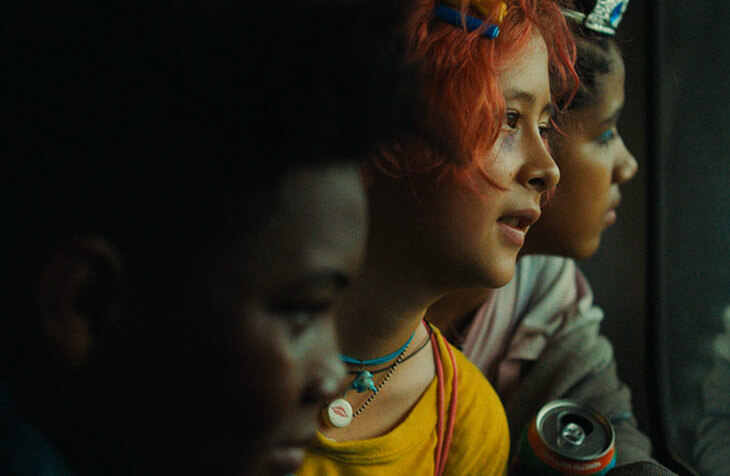
In writer-director Joseph Amenta’s feature-length debut, Soft, three young friends find their friendship tested when someone close to them disappears and leaves them reeling.
Soft
Joseph Amenta (director and writer), Liam Higgins (cinematography), Alexander Farah (editor)
Matteus Lunot, Zion Matheson, Harlow Joy, Miyoko Anderson, Trevor Hayes (cast)
September 9, 2022 (TIFF)
Content warning: Transphobic language
Set in Toronto, Soft is the story of three young friends, Julien (Matteus Lunot), Tony (Zion Matheson), and Otis (Harlow Joy), who spend every moment they can together during their summer break. They are perfectly comfortable in their own skins and happy to be annoying and rambunctious. But all is not as blissful for these three characters as it seems.
Julien lives with a guardian and not his mother; Otis hides his sexuality from his religious father; Tony’s home life is the only stable and welcoming one. The three children are queer but Amenta does not label their identities, instead focusing on how the three of them interact with one another and the world they inhabit, which is run by adults, queer and otherwise.
At the screening I attended, the 2022 Toronto International Film Festival programmer introduced the film as being “about kids who know exactly who they are but they don’t know how the world works.” And that’s partially right. There’s no way these tweens can grasp the complexity of what they’re dealing with—all they know is they’re on summer break and they want to make the most of it.
Soft is beautifully shot with tight, intimate close-ups that allow the audience to feel part of the inner circle of this friendship. You feel connected to these characters because they are often, literally, in your face. The chemistry among the trio is tangible—their ease with one another, their youthful understandings and misunderstandings are authentic.
But the story itself is confused. It feels like a lot of what director Amenta was trying to say or convey either through the script or the visuals simply didn’t translate to the final film.
There was some confusion about the title of the film. Originally announced as Pussy, the film later showed up in the TIFF schedule as Soft. When I attended the screening, the title card still said Pussy and the word appears repeatedly in the film. Either the kids are using it against one another or the songs in the background repeat it. Amenta was asked in the Q&A about the change and he explained that it was due to the word being censored in many countries, which would restrict distribution. The change to Soft was as a direct swap—“soft” used in this case as a pejorative.
Truth be told, the title doesn’t fit the narrative at all. Yes, the kids repeat the insult without understanding the socio-political context of it, but it’s hardly vital to their interactions or how the people closest to them see the characters themselves. No one can accuse these children of being anything but brave to live in this world as themselves. I also understand that a lot of people are reclaiming the word, but that doesn’t feel relevant to the story either.
There are a lot of story and plot threads in Soft, but they’re not tied up or followed through. Julien is obsessed with entering a club but what he sees there leaves nary an impression on him; it’s incidental to the plot, but surely it would have made some kind of impact on him, good or bad. A bonfire is mentioned and appears at the end of the film but again, I felt like it was a misplaced setting and mood.
A lot of this comes down to a major plot point in the story–the disappearance of a supporting character who is close to the group. The incident threatens the central friendship but also changes Julien’s life. However, it feels like nothing more than a moment in time. The children grow closer but the person at the centre of the incident appears to have been forgotten. She is little more than a catalyst and that really bothered me. Amenta mentioned in the Q&A that trans women go missing all the time, but I just don’t think that’s something to be frivolous about. The plot being left open-ended felt like a disservice to a trans character. I agree not every story moment has to be, or can be, neatly tied up, but this one needed some kind of acknowledgement in the end.
The performances are electric and so natural. I don’t think any of the actors missed a beat in bringing their characters to life. Because of the acting and the cinematography, Soft feels more like an immersive experience than a film. Amenta explained in the Q&A that Miyoko Anderson, who plays Julien’s guardian Dawn and was the story editor on the film, brought a lot of her own life experiences to her character’s backstory, and honestly, those are the most fascinating and heartbreaking parts of the film. But these nuggets of information never blossom into much more. The film is packed with seeds that don’t come to fruition.
Soft is a rumination on youthful friendships and queerness but it lacks coherence. The film eventually comes across only as an essence of a story rather than a complete narrative in itself.
