

Made as a response to the 250th anniversary of James Cook’s second voyage to Australia and New Zealand, We Are Still Here showcases eight stories by 10 indigenous filmmakers, from the arrival of colonizers to the determination of the indigenous people to persist into the future.
We Are Still Here
Beck Cole, Dena Curtis, Tracey Rigney, Danielle MacLean, Tim Worrall, Renae Maihi, Miki Magasiva, Mario Gaoa, Richard Curtis, Chantelle Burgoyne (directors), Samuel Nuggin Paynter, Tiraroa Reweti, Dena Curtis, Tracey Rigney, Danielle MacLean, Tim Worrall, Renae Maihi, Miki Magasiva, Mario Gaoa, Richard Curtis (writer), Eric Murray Lui, Raymond Edwards (cinematography), Roland Gallois (editor)
Clarence Ryan, Tioreore Ngatai-Melbourne, Villa Lemanu, Lisa Flanagan, Meyne Wyatt, Leonie Whyman, Calvin Tuteao, Evander Brown, Sean Mununggurr, Willow Rupapera, Baz Te Hira, Deborah Brown, Serene Dubs Yunupingu, Elijah Jade Bowen, Oriini Kaipara, Robert Taylor (cast)
September 11, 2022 (TIFF)
Content warning: racism
I was really looking forward to catching We Are Still Here at TIFF 2022. There’s been a very slow reckoning around the world about the colonial impact on indigenous communities and we desperately need more indigenous stories told by indigenous storytellers.
With We Are Still Here, we get eight amazing stories spanning 1000 years, from the beginning of time to well into the distant future. Each era shows how indigenous communities lived, struggled, rose up, and remained strong, with directors from Australia, Aotearoa, and Pasifika.
The entire anthology is tied together by the animated story, ‘Lured,’ directed and written by Danielle MacLean (True Colours, Blown Away). The animation shows a Utopian time where a mother and daughter fish together before colonizers tear them apart. The animation is as breathtaking as it is heartbreaking and every time we return to it, we can’t help but hope that the pair will somehow be reunited.
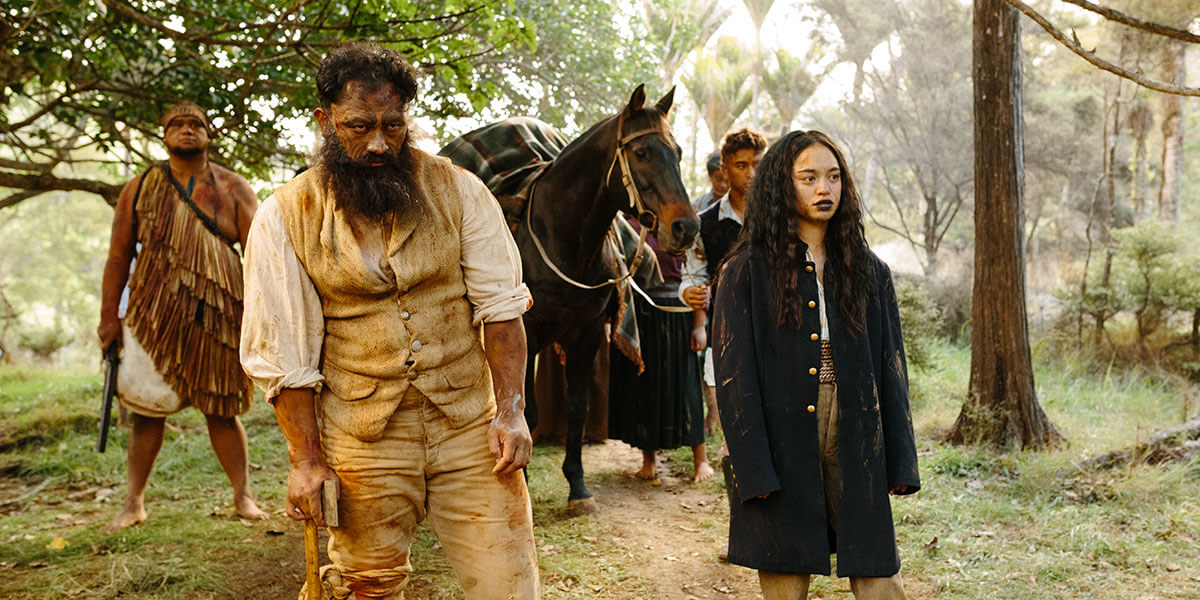
In ‘Woke,’ a British settler is lost and asks an aboriginal man to guide him to safety. Despite the help he gets, the settler is quick to anger and draw his gun. It’s that attitude that caused so much pain and suffering to the aboriginal communities, as the settler eventually learns. This story was a tense watch since the settler is constantly threatening to attack. And yet the way the story ends hurts more than anything one would have imagined.
‘Te Puuru’ depicts the Battle of Orākau, following a tribal leader’s daughter who inspires her people to fight against the British colonizers against her parents’ wishes. Told largely through the Tūhoe haka, this story by directors Tim Worrall (Only in Aotearoa) and Richard Curtis (Nanakia, Pete & Pio’s Kai Safari) was as rousing and inspirational as it was devastating.
In Miki Magasiva (The Panthers) and Mario Gaoa’s (Bro’Town) black comedy, ‘The Uniform,’ a lone Samoan soldier at Gallipoli struggles with the rigours of life in the trenches until he makes an unlikely ally in a Turkish soldier from the other side. Though gruesome at times, ‘The Uniform’ demonstrates the power of friendship in the darkest of circumstances and one can’t help but feel hopeful in its closing moments.
The only story set in the future, ‘Blankets,’ from writer Tiraroa Reweti and director Chantelle Burgoyne, follows a young girl in a dystopian Auckland who is desperate to get medication for her ailing grandfather. But the marketplace is tough and she needs all the knowledge of her ancestors to get what she requires. This is probably the quietest story in We Are Still Here. Very little is spoken in the bustling marketplace but much is said in the expressions of the characters. It’s a bit subtle but still manages to be impactful. I would have loved to see a future Utopia, though. I’m so tired of dystopian societies, especially with the pandemic going on.
‘Rebel Art,’ by writer/director Tracey Rigney (A Chance Affair), was a difficult story to watch and also required a content warning for self-harm. An Aboriginal street artist and activist tries to fight the system after an encounter with white thugs leads to tragedy. She finds an ally and together they try to realise the wishes of their ancestors. I feel like almost all of We Are Still Here makes a case against Australia Day, but if anyone is still wondering why Aboriginal peoples have been fighting against it, this is the story to watch.
‘The Bull & The Rūrū,’ from writer/director Renae Maihi (Waru), was the most devastating and viscerally powerful story in the film. Set during the Springbok Tour Protests of 1981, the story centres on a young man looking for answers who becomes the accidental face of the protests. While under arrest, he meets an older mentor who helps him find answers and start his first steps towards internal peace. I’m sorry to say I had no idea about the Springbok Tour Protests so this was a good lesson. But despite the larger political backdrop, the intimate story of a lost boy and the man who saves him was so incredibly powerful — I totally cried at the end of this story.
My favourite of the stories in We Are Still Here was undoubtedly ‘Grog Shop,’ from Samuel Nuggin-Paynter and Beck Cole. (Grog means alcohol in Australian English, for people who may not know.) We follow a man as he makes his daily attempt to buy grog from the shop, chat with the lovely store manager, and make his way back to his friend, only to be stopped every single day by a police officer. Turns out that areas in Australia have alcohol restriction laws meant to target Aboriginal populations, including ID checks that allow police to confiscate alcohol if you live in a “dry” area. Which makes no sense! They bought it with their own money. What the hell? It’s similar to the ‘random’ checks that BIPOC folk in Canada and USA are subjected to just for being visible to an officer. It’s absolutely infuriating to watch this man get stopped every single time for no reason. But the ending! The denouement was completely unexpected and so incredibly sweet. That police officer’s face when he learned the truth. This is why I love cinema!
We Are Still Here was an educational experience and completely immersive. I honestly felt like I’d been through time and space watching this film. It’s an unusual anthology as it goes back and forth between stories. Instead of showing one short film from start to end, we slip in and out of other stories and back again. This technique is so clever because it underscores the film’s central theme—that Aboriginal peoples have faced similar types of setbacks for generations and have always overcome them.
Despite the adversities, pain, and loss showcased in this film, there’s always an underlying message of hope in We Are Still Here because the indigenous communities of Australia and New Zealand are still here, and they’re thriving. I want so many more anthologies now!
