

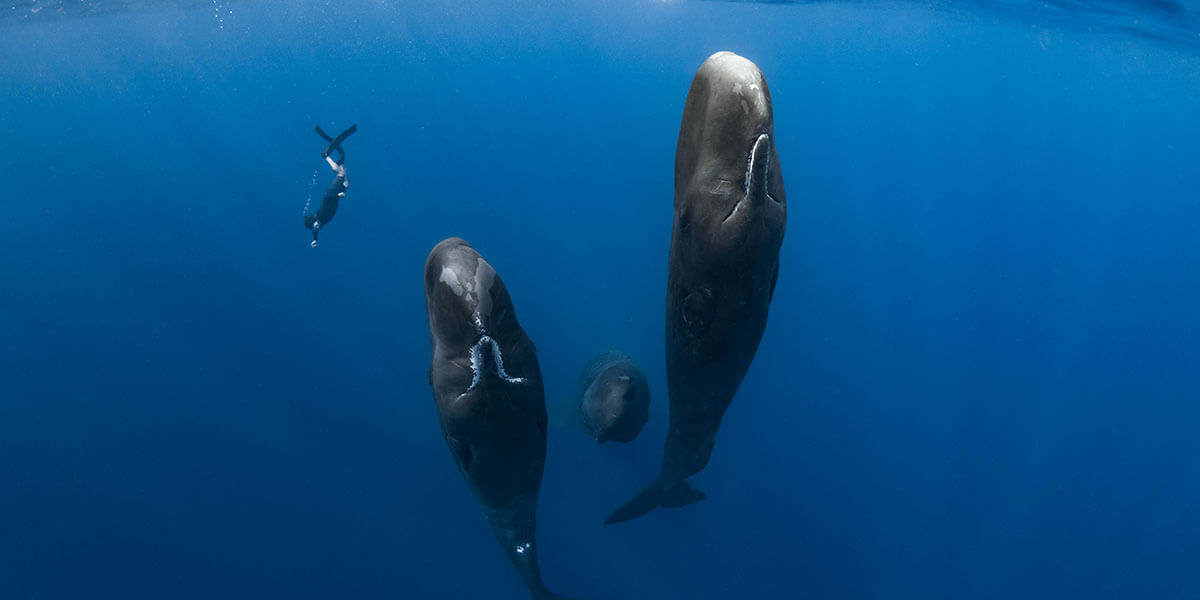
In the documentary Patrick & the Whale, marine videographer Patrick Dykstra explores the relationships whales have to each other and to humankind. While this is director and editor Mark Fletcher’s film debut, his background in nature documentary shows and film helped create a delightful and awe-inspiring visit underwater.
Patrick & the Whale
Mark Fletcher (director and editor), Rupert Murray, Gail Jenkinson, Patrick Dykstra, Romain Barats, Abdullatif Nurdin-Hussein (cinematographers)
Patrick Dykstra (cast)
September 9, 2022 (TIFF)
I almost avoided Patrick & the Whale because of my intense dislike for My Octopus Teacher, another film about a man and a marine animal. My Octopus Teacher felt more like watching a therapy session for the filmmaker than anything else. And it won an Oscar somehow! But there was so much hype around Patrick & the Whale that I felt I couldn’t skip it.
Fortunately, Patrick & the Whale is less about therapy and the human beings who need it than it is about the fascinating lives and relationships of the elegant, enormous beings that roam the oceans. We know so little about whales, and the aim of this film is to educate the audience as much as it is to awe us. Because knowledge is the key to sperm whales’ survival.
Spurred by the strandings of 10 male teenage sperm whales in England, Patrick & the Whale follows Dykstra as he attempts to put a tag with a camera onto a sperm whale. Since sperm whales spend 3/4th of their lives in extremely deep water that human bodies cannot withstand, the only way to study the creatures when they dive into the depths is via camera.
Who is Dykstra’s whale of choice? Dolores, the titular whale. Dykstra met Dolores a couple of seasons ago. Young and curious, Dolores makes a beeline for Dykstra. She’s unlike any other whale Dykstra’s met—she immediately makes an effort to communicate with him and even makes physical contact, which is quite rare. If there’s any whale that Dykstra can get close enough to put the tag on, it’s Dolores. Or so he thinks.
Animals have their own schedules and their own lives. The best laid plans by humans don’t matter. And that’s primarily what Patrick & the Whale is about. Because the plan for Dolores doesn’t quite work out. The rest of the film follows Dykstra trying to get the tag on a whale while keeping his existing relationships with the whale pods alive, so he can find a way to keep sperm whales safe from humans.
Patrick & the Whale turned out to be a fascinating and beautiful film. I’m glad I watched it on the big screen because that’s the best way to appreciate the grandeur of these marine animals. Whales are beautiful and delicate. They’re sophisticated but playful. They have their own rules but aren’t afraid to make friends with a human. But they’re also severely endangered, as Dykstra explains. There are fewer sperm whales in the world than the population of Omaha. The deaths of those 10 teenagers is devastating in scope. There’s a real sense of loss and it gives the film purpose.
And of course along the way the audience gets to learn so much about whales. Dykstra explains in the opening minutes of Patrick & the Whale that he fell in love with whales when he was a child. He saw a replica of a blue whale in a museum and he made it his life’s mission to meet one in real life. It took him years and he studied other whales in the meantime. He shares that knowledge early in Patrick & the Whale. Some fascinating facts we learn are that killer whales make aggressive clicks to communicate while humpbacks sing to each other. When he eventually found a blue whale, Dykstra realized the creatures were so large that they have little choice but to concentrate on getting food. As a result, they aren’t social at all. Sperm whales, however, are at the other end of the spectrum. They’re extremely social and that’s what makes them easy targets for human beings.
What I found enthralling about Patrick & the Whale was Dykstra’a relationship with the whales. I haven’t had any animal friends in years but I remember what it was like when I was a child and just randomly made friends with people’s cats. But cats are tiny in comparison to us humans. Befriending a whale? That’s incredible!
And Dykstra’s connection to his whale friends is as real as any human ones. He shares genuine delight when a whale remembers him and is practically giddy with excitement talking about the traits of his whale friends. There are a couple of times in Patrick & the Whale when he inadvertently upsets a whale and he’s so completely torn up by his mistake that I was surprisingly moved. It really is a wonder that a simple human can create such a bond with a formidable whale.
Though a chunk of the film focuses on getting the camera on the whale, the best parts are when Dykstra is just hanging out with his whale buddies. It allows for him to get extraordinary shots of the creatures. The word ‘breathtaking’ doesn’t do Patrick & the Whale justice. It’s as unreal that we have footage of these magnificent beings as it is that we exist alongside these creatures at all. As Dykstra says in the film, the whales are the closest thing to aliens we have on this planet. Some of the scenes of the sperm whales just hanging out vertically in the water will make you wonder if they actually are from earth.
This is an odd thing to say about a documentary, but I was disappointed by the way Patrick & the Whale ended. With this genre one doesn’t have much control over where the narrative can go but the film ends so abruptly, I was caught off-guard. It feels like the filmmaker gave up because there wasn’t enough time to complete the mission. I wonder if adding a note at the end, before the credits began, letting us know what happened next would have made the film feel more complete. The third act appears to go one way, change tack, and then it ends. Bizarre.
The ending aside, I am delighted I watched Patrick & the Whale. It was such a glorious feast for my eyes. I’ve always been fascinated by the fact that such large creatures can roam the planet alongside us tiny mortals. This film reiterates how astounding a fact that is. As beautiful as the film is, it’s also a harsh reminder that human beings are the number one danger to wildlife and marine life. On an individual level we can’t do much but with films like this, perhaps we will finally see some positive change for sperm whale populations.
