

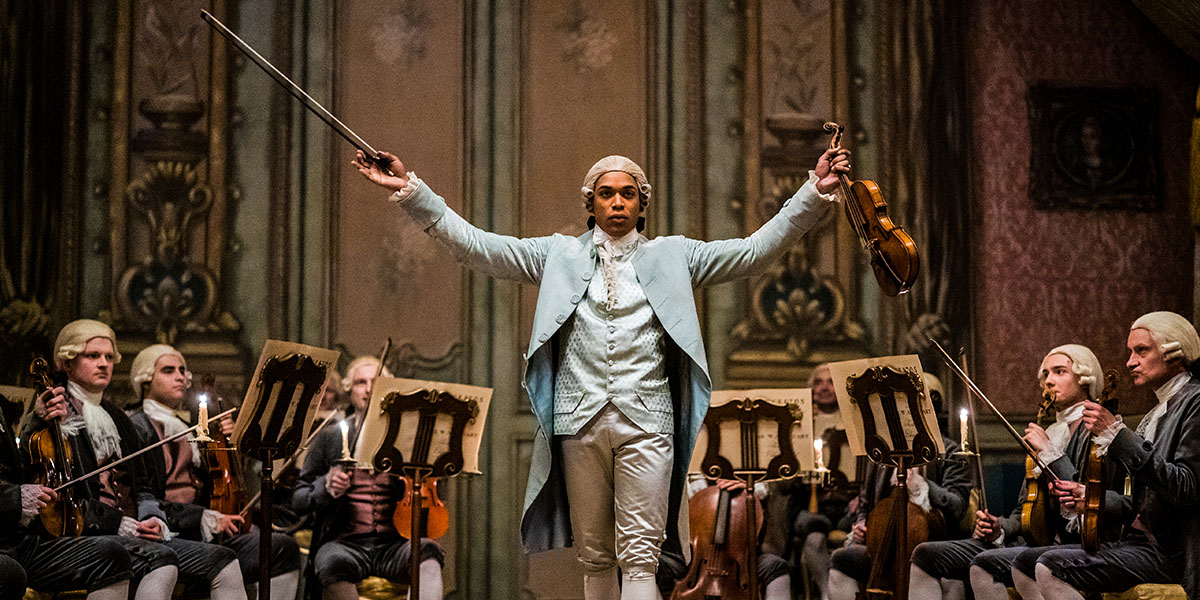
Joseph Bologne (Kelvin Harrison Jr), the titular Chevalier de Saint-Georges, has one goal—become the leader of the Paris Opera. But in pre-revolution France, how is a Black man going to achieve his dreams? Director Stephen Williams, perhaps best known for Lost, returns to feature film-making in this look at the virtuoso violinist who has been called the “Black Mozart.”
Chevalier
Stephen Williams (director), Stefani Robinson (writer), Jess Hall (cinematography), John Axelrad (editor)
Kelvin Harrison Jr, Samara Weaving, Lucy Boynton, Ronke Adekolujoe, Marton Csokas, Alex Fitzalan, Minnie Driver (cast)
September 11, 2022 (TIFF)
Content warning: racism
I was looking forward to watching Chevalier. I knew nothing about Bologne so the chance to learn about a man erased from history was intriguing. I enjoyed a lot of it, but the film ends up being more of a generic period drama about racism than a faithful retelling of the virtuoso’s life and times.
Chevalier does know how to get our attention. It opens with a bang—Bologne interrupts a concert by Mozart and then completely outperforms him in a violin duel. It’s an incredible sequence and a great sendup of the smarmy Mozart, who some music historians believe was directly influenced by Bologne’s compositions. (This is not, however, mentioned in the film.)
We quickly learn that this type of competition is nothing new for Bologne. He’s worked his entire life to be excellent. It was the diktat of his absent father, a French nobleman who had Bologne with one of his slaves working on his plantation. The elder Bologne then plucked the boy from the only home he’d known in Guadalupe and plonked him in a French school. Why? Because the young Bologne was truly gifted with the violin.
Despite his strange circumstances, Bologne does excel, in music, fencing, and with the ladies. Eventually the white aristocrats around him have no choice but to notice Bologne’s abilities. He is given the title of Chevalier by none other than the Queen of France herself, Marie Antoinette (Lucy Boynton).
From there, Bologne becomes the queen’s trusted friend. But he makes a major error—he forgets that he’ll always be an outsider to the French aristocracy. Bologne’s bid for the head of the Paris Opera should have been a slam-dunk. But Bologne, despite putting on a tremendous opera as his audition, was never in the running for the French. Because he’s the only one who considers himself French.
Coupled with a doomed romance with his lead singer, Marie-Josephine (Samara Weaving), and the sudden death of his father, who leaves his son no heritance, Bologne’s life goes from the top of the world into a tailspin.
Since Bologne’s music was prohibited by Napoleon (after he reinstated slavery in French colonies), scholars have had to rediscover his music and piece his life together. Now we get to hear what’s left of it in Chevalier. Scholars are also hailing Bologne as one of the first Black composers and a virtuoso with the violin. It gives me hope that other maestros forgotten by history will be found and shared with the world.
The more I think about it, the more I realise that I loved quite a bit of Chevalier, but not all. Though I’m not a huge fan of period films but even I can’t ignore how stunning the set design, costumes, makeup and hair were. Dare I predict Oscar nominations for those categories? It’s just that this story could have been anyone’s rag to riches story. Had it not been for Kelvin Harrison Jr’s (The Trial of the Chicago 7, Elvis) astute and nuanced portrayal of Bologne, I can’t see Chevalier leaving a huge mark in historical fiction.
This is primarily because of the heavy focus on the romance between Bologne and Marie-Josephine. It was very distracting, and I wonder about the optics of focusing a Black man’s story on his romance with a white woman. A romance is the easiest way to get an emotional reaction from the audience, but it took away time that would have been better spent exploring Joseph’s changing political leanings, his art, the fallout of his being taken from his mother, and his relationship with France as the sole Black man in the royal court.
There is one powerful scene where Marie-Josephine and Bologne discuss love and marriage and I would have loved more of that. They each come to the conversation with their own perspective, as a woman and a Black man, and they challenge each other’s understanding of their roles in society.
Since Chevalier is about a violinist and composer, the music of the film does a lot of emotional heavy-lifting. Film scores these days are being forced so far into the background that we can barely hear them but the musical compositions are fantastic in Chevalier. Very little of Bologne’s original work remains, but some of the music is based on Bologne’s compositions. The score highlights the powerful and poignant moments of the film without overwhelming the audience. There’s a scene right at the end that uses the score magnificently to underscore the momentous events onscreen.
I found Chevalier captivating but the man himself was often lost to the love story in the film. I was left wanting to learn more about Bologne, especially his work during the French Revolution. That period of his life really should have been included in this film.
But as a starting point to one of history’s forgotten legends, Chevalier more than does its job. A true feast for the eyes and ears, Chevalier was a good watch that leaves a bit too much room for viewers to do their own research into Bologne.
