
The Situation #1
Paul Jenkins (writer), Talent Caldwell (artist), Paul Mounts (colorist), Bill Tortolini (letterer)
Wizard World
July 2012
Some days you wander Comixology, only to come across an undiscovered gem of a comic, and the heavens shine down on you.
Other days, you find The Situation.

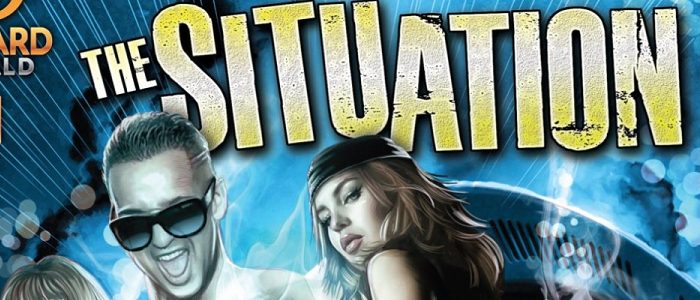
“Now, wait,” your brain says, “wasn’t that Jersey Shore guy called The Situation? What a coincidence.” Despite the cover’s . . . aggressive T&A, you click through to read more.

Now your brain short-circuits, because it’s not a coincidence. Someone made a comic about the guy from Jersey Shore. “James Bond meets The Sopranos,” the blurb tells you. You can’t possibly resist, so you don’t.
I’m supposed to summarize the plot here, but I’m still not sure there was one. Can a story have negative plot?
All right, I admit I’m being slightly tongue-in-cheek: The Situation has a bit of plot. In the beginning, oldest Sorrentino brother Frankie, a technological genius, creates a tanning bed that uses radio waves to super-power the human body. Unfortunately, feckless youngest brother Mike “The Situation” Sorrentino breaks in and steals one of the prototypes. Three years later, The Situation is reality television-famous, Frankie is still mad about the theft, and middle brother Mark haunts a local restaurant like a low-rent Don Corleone. Following a brief jaunt down memory lane, the brothers manage a tense Sunday dinner with the family before going their separate ways.
Clearly this was intended to be the first in a series of Sorrentino brother escapades. Unfortunately, in trying to bring Sorrentino’s vision to life, writer Paul Jenkins crafted a series of scenes only tied together by virtue of featuring the same characters. Attempted intrigue comes across as a frat boy’s wet dream of a day in the life of a world-renowned spy.
Sadly, there’s no apparent point to the fancy technology, either. Wait, that’s a lie. The Situation eventually uses said stolen tech as (appropriately blue) luminescent libido booster. Then he hops in bed for the obligatory “protagonist uses leave-you-drier-than-the-Sahara bad lines to get laid” scene. That’s literally the only use of the thing in the whole story. Very spy, much Bond, wowe.

Despite the efforts of Caldwell, Mounts, and Tortolini, not even the art could salvage this awkward situation. While there’s some weirdness going on in the angularity and planes of the male characters’ faces (to say nothing of their impeccably rendered musculature), the color palettes are eye-catching. Mirrored actions in paired panels link the past and the present. Honestly, that was probably the most successful part of the comic: seeing how the brothers’ childhoods influence their current tense relationships.

In true spy novel fashion, women are window dressing. For example, the only woman not depicted as having outrageous breasts bursting from her shirt or dress is Mama Sorrentino. Not even their sister is immune, as her Sunday dinner dress requires more double-sided tape than Fashion Week.
Basically, what I’m saying is if your brain ever tempts you to jump into the sordid pit of comics spearheaded by reality television stars, stop. Close Comixology, leave the comic shop, walk away from the con table. Your brain is a liar, and you deserve better. Just say no.
