
This year marks the 160th anniversary of Lewis Carroll’s novel Alice’s Adventures in Wonderland, which was originally published in 1865. Very few works of English-language children’s literature have had such a lifespan. 2025 also marks the 160th anniversaries of Mary Papes Dodge’s Hans Brinker, Mary White Sewell’s Mother’s Last Words, and Jean Ingelow’s Stories Told to a Child, but it is hard to imagine many people taking note. Indeed, even if we look at the books for children published over the course of the entire 1860s, we find only two that can honestly be said to be remembered alongside Alice: Charles Kingsley’s The Water-Babies (1863) and Louisa May Alcott’s Little Women (1868).
Alice, then, is a great survivor, a character who has existed coelacanth-like even as so many of her contemporaries have perished in the public imagination. She fascinates us. Even her prehistory is a story in itself, one worth retelling.
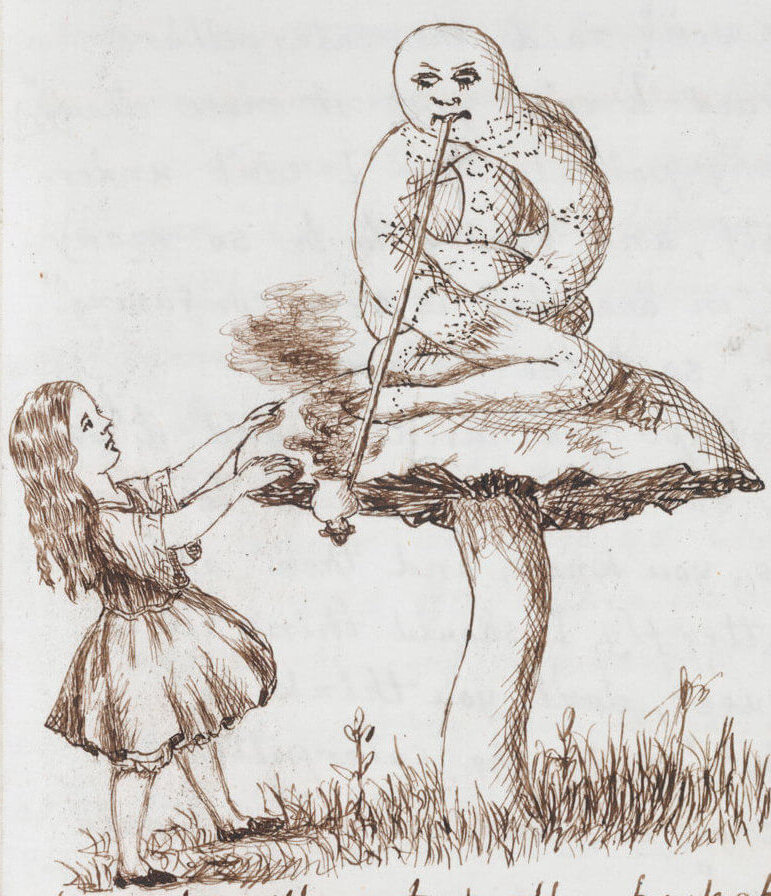
Carroll completed the original draft of his novel, then entitled Alice’s Adventures Under Ground, in early 1863 and subsequently presented an illustrated manuscript to his young friend Alice Liddell the following year. This ur-text is distinct in several ways from the completed book. It is shorter, lacking such memorable incidents as the Mad Hatter’s tea party. It has a different set of illustrations, with Carroll providing his own sketches rather than hiring the services of John Tenniel, as he would when the book was professionally published. And it has a different ending.
Both versions of the story conclude with Alice awakening from her dream and being reunited with her sister, who listens to Alice’s story and is left in a state of quiet contemplation. The version of this scene in Alice’s Adventures in Wonderland shows Carroll at his most straightforwardly sentimental. Alice’s Adventures Under Ground, however, has a paragraph nowhere to be found in the published book, in which Alice’s sister has a dream of her own:
She saw an ancient city, and a quiet river winding near it along the plain, and up the stream went slowly gliding a boat with a merry party of children on board – she could hear their voices and laughter like music over the water – and among them was another little Alice, who sat listening with bright eager eyes to a tale that was being told, and she listened for the words of the tale, and lo! it was the dream of her own little sister. So the boat wound slowly along, beneath the bright summer-day, with its merry crew and its music of voices and laughter, till it passed round one of the many turnings of the stream, and she saw it no more.
The scene described here is one that occurred in real life. The “ancient city” is Oxford; the “other little Alice” is Alice Liddell; the boat-trip is the one in which Lewis Carroll amused the Liddell sisters by making up, on the spot, the story that would eventually evolve into Alice’s Adventures in Wonderland. Behind the sentimentality is the stark metaphysical implication that the real world, as inhabited by the author and his audience, was in fact dreamt up by Alice’s sister – just as Alice dreamt up Wonderland
It is easy to see why Carroll omitted this paragraph from his final draft, as the anecdote of the boat-trip would have meant nothing to the wider reading public. Yet, looking back, the original conclusion seems an entirely appropriate one. The notion that we are but dreams of a character in a book, that we have no more reality than the White Rabbit or Queen of Hearts, is both charmingly topsy-turvy and amusingly alarming – and also a fitting conclusion to a novel whose characters are some of the most real in all of children’s fantasy.
Carroll’s own writing suggests that he was knowingly treading fresh ground in terms of genre. In 1887 he reminisced that his decision to start Alice’s adventure with a fall down a rabbit-hole was “a desperate attempt to strike out some new line of fairy-lore.” As early as June 1864, months before he gave the manuscript to Alice Liddell, he wrote a letter to his friend Tom Taylor announcing that he had come to see his original title of Alice’s Adventures Under Ground as being “too like a lesson-book, in which instruction about mines would be administered,” and was seeking a new name. He was already leaning towards Alice’s Adventures in Wonderland by that point, but his letter includes a few other potential titles, including Alice Among the Goblins and Alice’s Hour in Elf-Land.
![Excerpt from letter by Lewis Carroll. 'P.S. I should be very glad if you could help me in fixing on a name for my fairy-tale, which Mr. Tenniel (in consequence of your kind introduction) is now illustrating for me, and which I hope to get published before Xmas. The heroine spends an hour underground, and meets various birds, beasts, etc. (no fairies), endowed with speech. The whole thing is a dream, but that I don't want revealed till the end. I first thought of "Alice's Adventures Under Ground," but that was pronounced too like a lesson-book, in which instruction about mines would be administered in the form of a grill; then I took "Alice's Golden Hour," but that I gave up, having a dark suspicion that there is already a book called "Lily's Golden Hours." Here are the other names I have thought of: Alice among the [elves/goblins], Alice's [hour/doings/adventures] in [elf-land/wonderland]. Of all these I at present prefer "Alice's Adventures in Wonderland.” In spite of your "morality," I want something sensational. Perhaps you can suggest a better name than any of these.](https://womenwriteaboutcomics.com/wp-content/uploads/2024/12/LewisCarrollTitleLetter.jpg)
The various characters described by the Brothers Grimm and Charles Perrault are vivid, but hardly deep. Any texture that they possess is developed in the imagination of each child to read (or hear) their exploits. With the assorted characters encountered by Alice, however, the development is right there in Carroll’s writing. The denizens of Wonderland and the looking-glass world discuss such matters as philosophy, nature, sport, and literature with their young visitor — all topics that a child, grappling to understand the world, will recognise from real-life conversations with schoolteachers and other adults. Some characters are condescending to Alice, some empathic, and others downright hostile — again, all attitudes that will be familiar to children. The Alice books were the work of an author with a rare understanding of childhood, capable of capturing not just a desire for worlds of magic and escapism but also of how the mundane, adult-dominated world comes across to children.
Yet none of this would be obvious from a cursory look at the man behind the pen-name. “Lewis Carroll” was, in his day-to-day life, the Reverend Charles Lutwidge Dodgson, a deacon of the Church of England and a respected mathematician whose non-fiction works include such titles as An Elementary Treatise on Determinants, With Their Application to Simultaneous Linear Equations and Algebraic Equations. On the surface, a man this straight-laced and sober-minded might seem the last person to be conjuring up the likes of the Mad Hatter and Cheshire Cat. But in fact, Dodgson’s principled nature is precisely what gave his children’s fantasy much of its longevity.

To understand how Dodgson the clergyman gave shape to Carroll the jovial fantasist, we must appreciate his deep-seated opposition to the mixing of religion with frivolous humour. Morton N. Cohen’s Lewis Carroll: A Biography points to a number of instances in the author’s life and writing that make this point clear. In a 1896 letter to his friend Dora Abdy, Carroll wrote that: “While the laughter of joy is in full harmony with our deeper [i.e., religious] life, the laughter of amusement should be kept apart from it. The danger is too great of thus learning to look at solemn things in a spirit of mockery, and to seek in them opportunities for exercising wit.” Nine years earlier, he had chided the Bishop of Ripon for a sermon that made use of a humorous analogy involving arguing parents: according to Carroll, the good of the sermon may have been undone by its “distinctly amusing” aspects. At around the same time, the Boston Latin School for Girls put out a student newspaper entitled Jabberwock, and Carroll was appalled to read an issue that contained the following limerick:
There was an old deacon of Lynn,
Who confessed he was given to sin,
When they said, “Yes, you are,”
Oh, How he did swear!
That angry old deacon of Lynn!
Although Carroll had previously been on good terms with Jabberwock and its young editors, and had even contributed some verse of his own, this irreverent limerick prompted him to send a stern letter declaring that he never wanted to see an issue again. To Lewis Carroll, sin was simply not something to be joked about. (Indeed, Cohen’s biography shows that Carroll spent a portion of his twenties and thirties grappling with what he perceived as sinful habits of his own, his diaries containing repeated self-chastisement at failure to fulfill his Christian duties.)
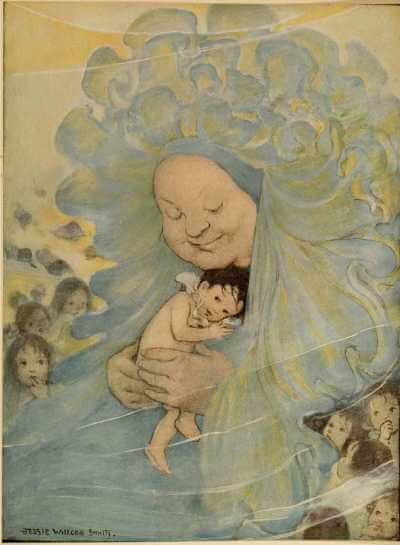
Carroll’s firm belief that fun and faith should be kept separate worked entirely to the benefit of the Alice books. At the time, it was expected that children’s literature, even fantasy literature, should have a strong moralistic streak: Charles Kingsley’s The Water-Babies, published two years before Alice in Wonderland, populated its fairy-realm with characters with names like Mrs. Doasyouwouldbedoneby and Mrs. Bedonebyasyoudid. But Carroll, confident in leaving moral education to the church, kept such matters out of Wonderland. The closest either of the Alice books come to moralising is the sequence in Through the Looking Glass where Alice, after hearing the story of the Walrus and the Carpenter, debates which of the two was more considerate towards the oysters he ate – only to conclude that: “They were both very unpleasant characters.” Mrs. Doasyouwouldbedoneby is conspicuous in her absence.
Having set aside his religion, Carroll drew upon another aspect of his personal background to provide an underpinning for his fantasy world; his passion for mathematics and logic. To him, the realm of mathematics was, unlike the realm of God, a perfect topic for fun, and even the weird and wonderful characters that inhabit Wonderland were conceived through the clear reasoning that befits a logician.
Carroll was a man who could hear the phrases “as mad as a hatter” or “grinning like a Cheshire cat” and reach the logical conclusion that there must be Platonic ideals behind these expressions. It was this same train of logic that led to him hearing such nursery rhyme narratives as the battle between Tweedledee and Tweedledum or the tart-theft suffered by the Queen of Hearts and and using them as the bases for whole melodramas. He could consume a bowl of mock-turtle soup and contemplate just what sort of animal gave its life for this delicacy. He could play a game of chess and write an entire novel depicting that bizarre, yet entirely rule-bound, conflict between white and red. “Nonsense” seems misleading a term for what is ultimately the work of a deeply sensible thinker, albeit one whose sensibilities could take him in unusual directions.
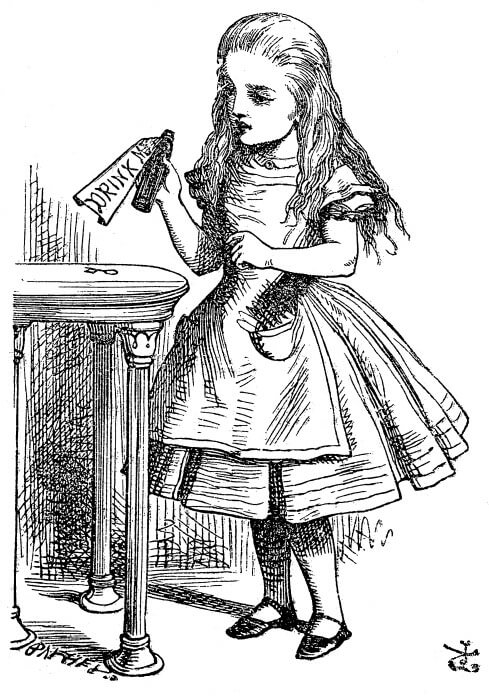
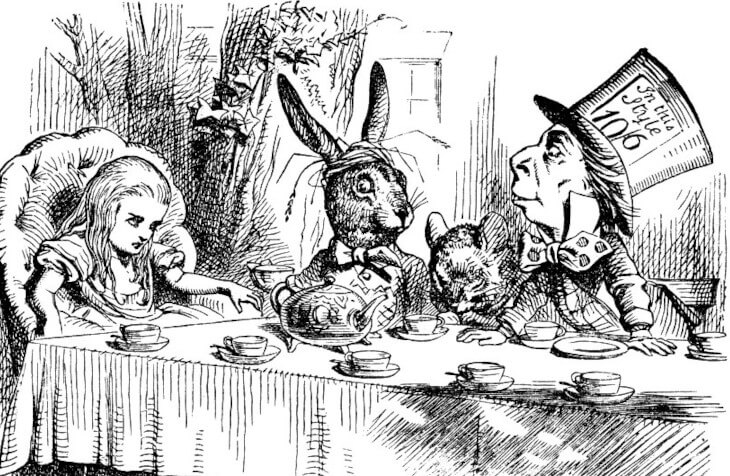
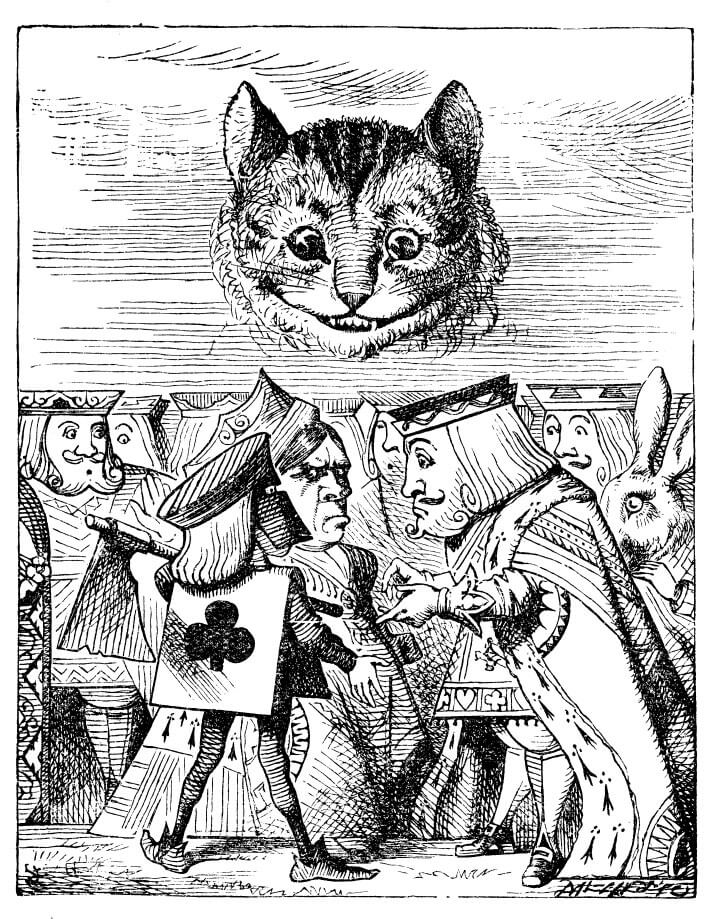
Lewis Carroll had only real creative partner in the drafting of the Alice books, save perhaps the Liddell sisters. This was John Tenniel, his illustrator. Tenniel’s drawings for the two books – Alice inspecting the “Drink Me” bottle, the Mad Hatter presiding over the tea party, the grin of the Cheshire Cat, Tweedledee and Tweedledum staring at each other’s sullen visages – retain a strong iconic status.
When asked to visualise the characters from The Wonderful Wizard of Oz, most will picture Judy Garland and the rest of the cast of the 1939 film rather than any of W. W. Denslow’s drawings for the original L. Frank Baum novel. Similarly, while readers of 1911 might have associated Peter Pan with the illustrations of Francis Donkin Bedford, these have long since been displaced by the animated designs of the Walt Disney studio. Yet Tenniel’s conceptions remain synonymous with Wonderland. Conversely, although Tenniel had an illustrious career as a political cartoonist – even becoming the first cartoonist in Britain to be knighted – nothing he produced can stand alongside his work on the Alice books in terms of public recognition. The seemingly infinite longevity of Tenniel’s illustrations for Carroll is a testament to the two men’s combined imaginative talents.
J. M. Barrie conceived Wendy’s exploits in Neverland as a stage play, a format that has room for reinvention as the directors, actors, and stage-designers will put their own spin on each staging; L. Frank Baum followed Dorothy’s trip to Oz with a long series of sequels, greatly expanding upon the setting and providing plenty of space for later authors to tell further stories. But Alice’s Adventures in Wonderland, and Through the Looking-Glass, remain the idiosyncratic creations of Lewis Carroll and John Tenniel.
Even in the face of this fact, however, we insist on remixing Alice. There are Alice in Wonderland films, Alice in Wonderland comics, Alice in Wonderland video games, Alice in Wonderland songs, Alice in Wonderland live performances, and much more besides. Often, these make no pretence of being straight adaptations, instead offering self-conscious twists on the original source texts – or, in many cases, twists on earlier re-interpretations.
This is a bold move for us to make, considering that we, ourselves, are but characters in the dreams of Alice’s sister.
So, to mark the 160th anniversary of Alice (or her 162th, if we count her earlier Adventures Under Ground) let us take a tour of the many Wonderlands dreamt up by readers of Lewis Carroll. This twelve-part series shall dig into rabbit holes and peer into strange mirror-worlds in the hopes of seeing the different faces that Alice has worn over her long life…
Note: Because WWAC is going on hiatus, subsequent posts in this series will be posted to my own site.
