

This month’s WWACommendations could be subtitled: “Damn, Comics Really are Everywhere.” We’re still reading titles published by the big two, but we’re also reading on Webtoons or picking up print collections that started on the app. We’re reading kickstarted collections from well known publishers, books available in bookstores and libraries, volumes self-published by the creators, and comics printed for museum exhibitions. This is an aspect of WWACommendations I really love — we pick up comics all over the place and throw their titles at you all at once. I’d love to hear from folks who have taken our recommendations and accessed them in your corners of the world. Comics are everywhere, where are you getting yours?

Kathryn Hemmann: Morgana and Oz is a cute paranormal romance about a clumsy teenage witch and the grumpy vampire she accidentally turns into a cat. While the first act of this hit Webtoon comic is light on romantic chemistry, it presents intriguing worldbuilding while setting up the conflict between the rival witch and vampire clans. If this premise sounds silly, it absolutely is! The main draw of this story is its comedy which is propelled by a large cast of sweet characters attractively rendered in Miyuli’s full-color, anime-style artwork. Morgana and Oz reminds me of the shojo manga I used to love as a kid, and I’d recommend its first print volume as a lighthearted Halloween-themed graphic novel for younger teens, as well as young-at-heart readers interested in a colorful jaunt of magical escapism.
Alenka Figa: Oooh, Kathryn I’m also enjoying Morgana and Oz! It’s a really intriguing story.
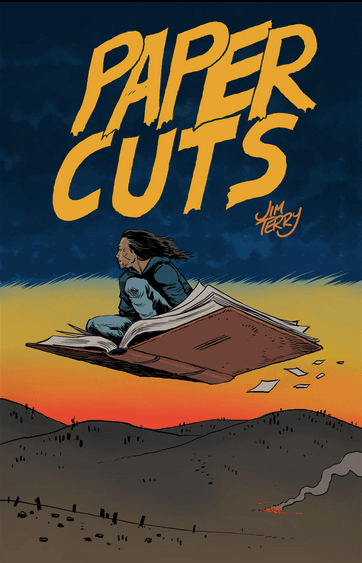
As a Chicago resident I am lucky to have gotten to visit the Indigenous Chicago exhibit at the Newberry Library, where I got to read the big, 11×17 version of Jim Terry’s new graphic novel Paper Cuts. You can purchase it online directly from his shop, although it will not be 11×17! It was a really wonderful experience to see his work in such a large format, right underneath two hand drawn prints.
Paper Cuts is a reflection on Terry’s time as an artist-in-residence at the Newberry. In addition to being part of a large contingent of indigenous Chicagoans who contributed to and helped shape the exhibit, Terry dove into the Ayer collection, and in the comic, reckons with the fact that he spent hours upon hours learning from books that were donated by a white man from a family of colonizers.
That’s just the tip of the iceberg — Paper Cuts is full of anxiety, imposter syndrome and, eventually, healing and an acceptance that his existence is resistance. Like his memoir Come Home Indio, Paper Cuts is full of gorgeous, heavy inks and fine cross-hatching and detailing that makes the piles of books, natural rock formations, deep water, and lush trees feel vibrant and alive, despite being rendered in black and white. It’s a privilege to go on this journey with Terry, and I hope he continues to create memoirs so we can continue to follow him.
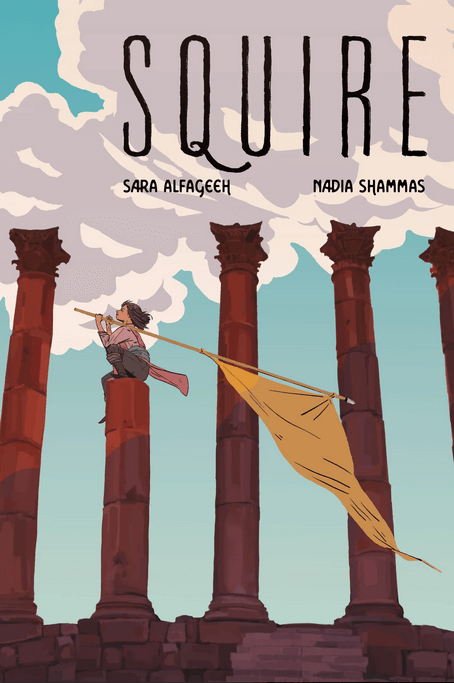
Louis Skye: Squire by Sara Alfageeh and Nadia Shammas had been on my reading list for ages. I finally found it on my library app and absolutely devoured it in one sitting. I had been following Sara Alfageeh as she talked about her process for creating this book on Twitter, so it’s great to have finally read it. Set in a fantastical world where young Aiza tries to become a knight, this book is a page turner and a feast for the eyes.
Everything about this story is delightful, hopeful, gut-wrenching, and all-too-real. From the first few pages, you know this is going to be a hard-hitting story because the protagonist, Aiza, is part of a marginalized community in the story world. There are times one forgets about the divisions in Squire because the protagonist and we as readers are swept away by the adventure. But life isn’t just about adventure. And when Aiza is faced with the hard truths of her world, she has to make tough decisions about who’s side she wants to be on. There are so many layers to what drives this story. The follies of political and patriotic allegiances. The treatment of refugees. History and who writes and wields it. All this and more wrapped up in a book about a teenage girl wanting to be a hero.
Of course, the world-building is extraordinary and completely captivated me. Set in an Arab world, the art draws inspiration from the beauty of places like Petra.
This book is a reminder of why we need diverse stories. It was such a relief to read a fantastical story set in a world I was familiar with. And it’s so beautiful to look at! I would love for there to be a sequel. This world is fascinating and there’s so much more story to tell. Some day, I hope.
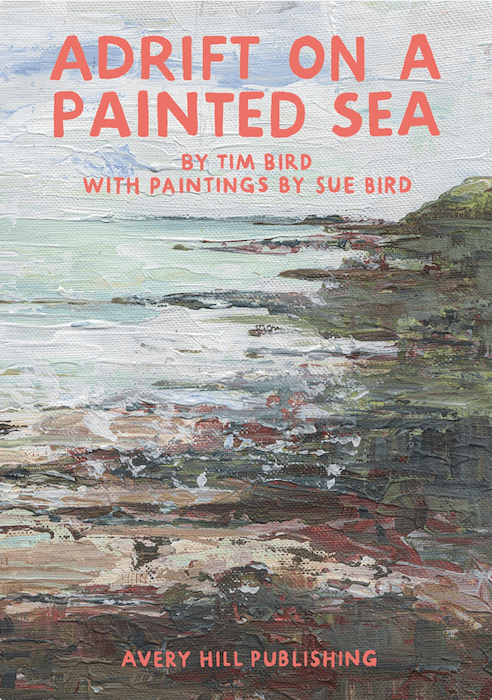
Emily Lauer: Adrift on a Painted Sea by Tim Bird is a memoir in which he reminisces about his mother’s paintings, and the paintings themselves are included in the graphic memoir. It’s a short book with a slow pace. A quiet contemplative read about how a parent’s creative pursuits influence her children and about the feelings of losing a parent generally. This book was kickstarted by Avery Hill and came out this month. I find myself thinking back on it frequently, long after finishing it. Tim Bird’s drawing style is very minimalist with spare linework and only a few flat, unsaturated colors used. That makes the images of the narrative contrast really striking against the detailed, textured, and colorful paintings by Sue Bird included throughout the book. Adrift on a Painted Sea is less than a hundred pages, including front and back matter. For all its apparent slightness, however, it has a lot of resonance, like a haiku of a graphic memoir. Small, but deep.

Leah Paloma: With writer G. Willow Wilson’s reliable consistency, Poison Ivy #26 transitions easily into a new arc. To visualize this new era, artists Marcio Takara and Arif Prianto reimagine Ivy’s iconic costume with their signature soft coloring and delicate linework, creating a chaotic renewal of Uma Thurman’s iconic Batman and Robin bodysuit. Their earthly tones lend themselves nicely to the western-style architecture of Marshview, the mysterious ghost town that has appeared in the swamp surrounding Ivy’s cabin with Killer Croc. In Gotham’s city limits, a series of ecoterrorist attacks ravage the community and unwillingly pull perpetual third wheel Janet-from-HR right into the middle of the schemes. This introduces the violent reign of the series’ newest antagonists: the mysterious Order of the Green Knight. The final page reveal of their new leader only drew me further into the intrigue of the operation, establishing a conflict that promises to feel just as deliciously satisfying as Ivy’s last confrontation against Jason Woodrue, the Floronic Man.
