

Continuing a series examining the early days of American vampire fiction: Part 1 looked at the work of Edgar Allan Poe, Washington Irving, and Ambrose Bierce; part 2 discussed a story by James Kirk Paulding. Now, let us meet another author…
Vampire literature saw two major periods of flourishment in the nineteenth century. The first came early on, during the height of the Romantic era, when Byron and Polidori laid the groundwork for the genre we know. The other arrived towards the end of the century, a time of aesthetic decadence when the queer fantasies of Oscar Wilde, the elegant grotesquerie of Aubrey Beardsley, and the nascent occultism of Aleister Crowley all blossomed, while the likes of Bram Stoker reacted with prosified anxiety dreams of predation and decay.
This zeitgeist was not confined to the Old World. It had American manifestations as well, among them an 1891 novel by Cora Linn Daniels entitled Sardia: A Story of Love. Despite having long since fallen into obscurity, Sardia is notable for its intriguing treatment of the vampire theme, which is very much a product of the decadent 1890s – and in certain respects closer to the modern vampire fiction of Anne Rice than to anything written by Stoker.
The novel begins with the marriage of cousins Ralfe Fielding and Helen Gray. For Ralfe, this is purely a marriage of convenience, as it will lead to the two halves of their millionaire uncle’s estate being reunited. “Love!” he scoffs in the first chapter: “don’t talk to me of love. That’s all past with me forever.” Helen knows of his feelings and accepts that she and her husband will be, in emotional terms, no more than “jolly good friends.”
As the couple discuss which friends they should invite to their newly inherited property, Ralfe decides to get back in touch with two people from his past. One is his family friend Sardia, a wealthy, world-travelling yacht-owner; the other is Sybil Visonti, a fiery woman who was Ralfe’s lover before his marriage to Helen.
The arrival of these two characters adds a disruptive new dimension to affairs. Helen becomes captivated with the dashing Sardia (“He is my idea of Bayard, without fear and without reproach”) and Sardia, likewise, becomes attracted to Helen. Ralfe and Sybil, meanwhile, begin rekindling their former passion. All of a sudden, the Fieldings’ marriage of convenience has begun to look less than convenient.
Characterisation is distributed unevenly throughout this tangle of relationships. Ralfe and Helen (despite the latter being based on the author’s mother, according to the book’s dedication) come across as cyphers through which the readers can experience the vicarious pleasures of opulent living and high society. As for Sardia, it is a mystery as to why he has the honour of getting his name in the title: outside of passages in which women gush over his charms, his character rarely extends beyond his yacht. The most vivid ensemble of the cast is Sybil Visonti – or, as many of her peers refer to her: “the Visonti.”
And the Visonti, as it happens, is a vampire, a detail established in an early conversation between the minor characters Guy and Lulu:
“The Visonti is the deadly night-shade, or the scarlet poppy! I never think of her without remembering what Charlie Vane said of her the first time he saw her. You know how clairvoyant, how keen-sighted Charlie is! How he seems to pierce one through and through, and read one’s very soul!”
“Yes,” said Lu; and then irrelevantly, “I think him the most of a saint I ever saw.”
“So do I,” echoed Guy, heartily. “Well, I asked him one evening after his first presentation to the Visonti, ‘What is she, anyway, Charlie? Can you make her out?’ – ‘She is a vampire!’ he answered. ‘She eats one up body and soul.’ And he meant it!”
Granted, this description is meant figuratively. Daniels’ story is one in which the “vampire” is not an undead being that sleeps in a coffin but rather a mortal woman with predatory sexual appetites, a concept also seen six years later in Rudyard Kipling’s poem “The Vampire.” The curious thing about Sardia, however, is that the distinction hardly matters: Sybil Visonti’s underworld of passion and vice is portrayed with a fantastical touch that leaves it not far removed from the more literalistic vampire realms depicted by the likes of Anne Rice.
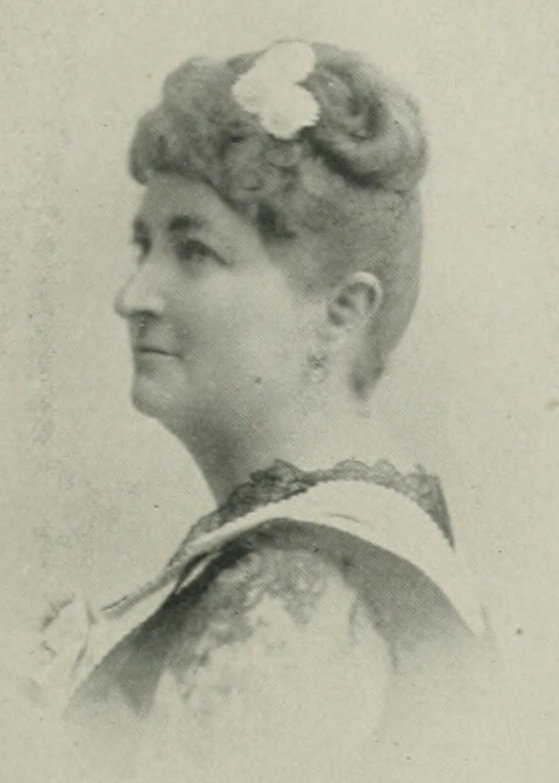
Cora Linn Daniels lived in a world alive with spirits. Her nonfiction book As It Is To Be (published in 1892, the year after Sardia) lays out her spiritual beliefs in great detail, as evidenced by such chapter headings as “Evil and Purity,” “Scientific Spiritualism and Heavenly Powers,” and “Spirits Do Not Tempt – The Celestial Body.” Daniels starts this book by claiming to regularly have conversations with the voices of disembodied entities, and much of the volume’s content takes the form of transcribed discussions with the spirit world:
“The magnificent library of Alexandria was destroyed by fire,” I said wistfully.
“Are you sure? But material fire cannot destroy spiritual facts. The Alexandrian library is still as accessible to us as ever.”
“And the Alexandrian authors also?” I cried. “Oh! what a thought.”
“Yes,” said the Voice, as if smiling.
While the fiction of Sardia is less bizarre than the author’s non-fiction, there is nonetheless a thick strain of the pseudo-supernatural running through the novel. One of the story’s supporting characters – who turns out to be more memorable than most of the main players – is Madame Menshikoff, a Russian princess who fled her home country to escape an arranged marriage. Having spent time in India, where she encountered Hinduism and Buddhism, she now styles herself a Universalist.
Throughout the book, she discusses legends from both Russia (members of her family, so she claims, have been known to reach the age of 130) and India (she possesses a sapphire, reportedly a tear of Brahma, which brings spiritual peace so long as its owner leads a pure and healthy life). She speaks at length about “invisible powers… Those powers which by most are seen through a glass darkly; but which adepts in the art of self-control claim to see face to face. Menshikoff also provides the other characters with drugs, the novel being written at a time when hashish was in wide use for both medicine and recreation. Menshikoff lives with a short, dark-skinned, mute servant nicknamed Satan; she refers to the man as her slave, but Sardia scoffs at this on the grounds that America has no slaves and so Satan must be her adopted son. If anything, though, he comes across as some impish familiar.
We see here a strain of fantasy that goes back to at least as far as the time in which Western authors discovered the Arabian Nights, the influence of which bled into Gothic fiction such as William Beckford’s Vathek (1786) and Robert Southey’s Thalaba the Destroyer (1801). This is a mode where the supernatural flits against a landscape characterised by a taste for the exotic (sometimes bleeding into outright racism, as with Daniels’ portrayal of the “slave”) and a lust for the opulent.
Sybil, our pseudo-vampire, is similarly exoticised. The novel places great emphasis upon her Italian heritage as her carnal passions are attributed to her carrying “the thick blood of a Southern climate” in contrast to the “Northern blood” and “American fibre” of the Fieldings and their associates. Her otherness manifests in multiple ways: she is foreign; she is transgressive; and she is queer. One chapter has Sybil visited by Lulu, a naive young woman who looks up to her (“it is so beautiful to learn life from a mother instead of from schoolgirls!”), leading to an encounter that brims with lesbian implications:
They stood for a moment gazing straight at each other’s faces in the reflection, when the Visonti suddenly clasped the young girl close, in a magnetic embrace. Her bare, rounded arms and full, throbbing throat softly caressed Lulu, who, with an enraptured expression and a filmy haze in her eyes, still kept her charmed gaze on the other’s face.
“What is the difference between us, darling?” murmured Sybil, with soft, clinging kisses on the high, white forehead, and hot, flushed cheeks; “only this, chérie! that thou art light and I am dark; thou art North and I am South; thou art unawakened and I am all awake! Beautiful innocent, how thy lovely youth appeals to me!”
Lulu felt herself losing all power of reasoning. Her heart seemed ceasing to beat, her eyes were suffused. She felt herself about to press a kiss on Sybil Visonti’s lips, when suddenly she seemed to hear Guy’s voice warning her. “Beware!” it rang out; “she wins women as easily as she does men. I have seen her table loaded with gifts from women. She possesses a strange, undefinable power to which all must, more or less, yield.” “I yield no more!” she thought, catching a long breath, and stepping quickly away.
“I can’t endure women’s kisses,” she burst out bravely, and with all the vehemence of an offended child. “Miss Visonti, I will not be so kissed!”
Lurid lightning leaped for a second into those dark eyes; but she answered tenderly, “You were so beautiful, dear, I could not help it! I am such a passionate admirer of beauty, and your sweet face is so fair. Will you not forgive me?”
This is strikingly similar to the famous scene of sapphic predation in Dracula’s Daughter, yet Sardia predates that film by 45 years. Small wonder that one of the few websites to document the plot of Daniels’ largely-forgotten novel is QueerHorror.com, while an excerpt from Sardia was also included in Pam Keesey’s 2006 anthology Dark Angels: Lesbian Vampire Erotica.
The other characters notice that, having fallen under the sway of Sybil, Lulu begins showing a different personality. Sardia articulates the change in terms of animal magnetism, a concept that was still current at the time Daniels was writing:
“Do you believe in animal magnetism, Guy? The power of one will over another? If you do not you cannot see those women from the same standpoint that I do. But is not Lulu thin, excitable, changed? Where is her blithe laugh? I miss it.”
The above dialogue comes from a chapter entitled “A Vampire,” in which Sybil furthers her taboo-breaking romance with Lulu:
“Let us prove to ourselves if to none others, that there can exist between two women a love, holy, pure, exalted, which no change of circumstance can alter, no jealousy can make less true. Let us enter into a sweet secret together of undying faith and mutual help, that for once in all this great sceptical world we may bring out the possibilities of womanly character, — a loyalty so belied, so scouted, that but to admit it exists is to be scorned.” […] Lulu with all her sweet soul tossed by varied emotions, sprang into Sybil’s arms and sealed the compact with a long, clinging kiss, the first that she had voluntarily tendered to her woman-lover.
Much of the novel has a soft focus in terms of plot, as we watch the characters drift around in their state of careless luxury in much the same way that Sardia’s yacht drifts at sea. Then comes the final quarter, where a series of twist revelations carry the story along to its eventual conclusion.
The Fieldings learn that a certain small boy, so beautiful as to make “a delicious model for a Cupid,” is the son of Sybil. When Helen confronts her about this, she reveals that the child was sired by Ralfe. Helen debates whether or not Sybil is telling the truth about the boy being the son of her husband, but decides to adopt him anyway.
It transpires that Sybil was indeed lying, and that the true father of the child is a man named Julian Savelli. This time, it is Sybil who falls on the receiving end of a shocking revelation: Julian Savelli was none other than her estranged brother, living under a pseudonym! But lest anyone suspect that the cherubic little boy was the product of incest, we are assured that Sybil was herself adopted by the Visonti family and thus shares no blood relation with Julian.
Even so, Sybil is hit hard by the news: it turns out that she not only slept with her adopted brother, but also killed him after he travelled to America in an attempt to abduct the child. (In a brief passage, which nonetheless stands out as the novel’s clearest supernatural element, Helen indicates that she heard the voice of the late Julian speaking to her at night: shades of Daniels’s own conversations with the spirit world). When she comes to grasp all that she has done, Sybil goes mad. Like some sort of deranged werewolf she develops an intense hatred of the moon and even tries to kill her cupid-faced child who she apparently associates with her lunar tormenter:
“Oh, at last, at last I have you!” she cried. “Dead, dead on the earth and never to rise again! You round, white face that has stared and stared at me all my life! You haunting, hideous, mocking moon that has followed me so! Now I’ve dragged you down. Now I’ve got you in my power. Lie there, you white-faced devil. I’m glad I’ve killed you too, you spy, you watcher!”
The boy is unharmed, however, and the novel allows a happy ending for everybody besides the Visonti siblings. Sardia and Madame Menshikoff are paired off ready for a trip to India; the child becomes the sole heir to the Visonti estate; and the Fieldings finally shed their materialistic concerns to develop a loving marriage.
Notably, the pure romance of the lead characters is associated with specifically Christian imagery. The book’s final chapter is entitled “The Crown and the Cross” and ends with Helen receiving an ornate crucifix pendant as a gift from Sardia. Bram Stoker would later establish that a cross could ward off a vampire; here, on a more symbolic level, a cross signals the end of the vampiric Sybil Visonti and the hedonistic, predatory lifestyle that she embodies.
Sardia: A Story of Love was sold on its moralistic qualities. A contemporary advert for the novel quoted an unnamed commentator (identified only as “a prominent literary man”) as praising the book for how it “appeals to every better quality, yet fearlessly portrays human passion and folly” while hailing Sardia himself as “one of the noblest characters in fiction… Sardia will be remembered as a distinct personality, as a friend.”
Cora Linn Daniels may well have intended her novel as a tale of moral instruction; but the simple truth is that, if Sardia is remembered at all, it is not for Ralfe and Helen ultimately joining the straight and narrow; it is for the exploits of the vampire Sybil Visonti.
A line can be readily traced from Sardia to Interview with the Vampire, even though a number of evolutionary steps exist between these points. The moralistic world in which the Fieldings ultimately found themselves is replaced with a depiction of mortal mundanity as a place from which to escape. The nonsensical race-essentialism, which saw Sybil Visonti’s predatory habits attributed to her Italian ancestry, is replaced with the portrayal of a fictional, supernatural race, with its own culture and mores – the dehumanised giving way to the inhuman. Finally, and most significantly, the figurative vampire is replaced with the literal vampire.
Yet the transgression, the passion and queerness, remains.
