
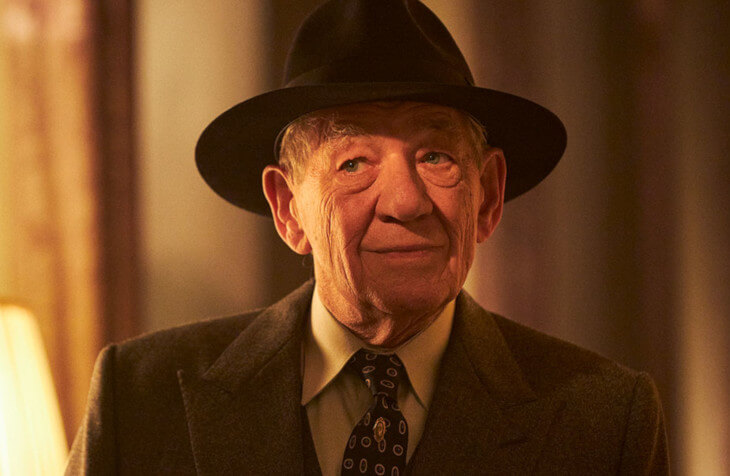
In The Critic, Jimmy Erskine (Ian McKellen) is a cranky theatre critic whose career is at stake. Then he hits upon a brilliant but horrifying plan to secure his future, but only if he can get theatre actress Nina Land (Gemma Arterton) to help him.
The Critic
Anand Tucker (director), Patrick Marber (writer), David Higgs (cinematography), Beverley Mills (editor)
Ian McKellen, Gemma Arterton, Mark Strong, Ben Barnes, Romola Garai, Alfred Enoch (cast)
September 11, 2023 (TIFF)
Content advisory: homophobia, racism, fascism, antisemitism, suicide
The Critic is the kind of film that screams festival movie. It has all the hallmarks that one would expect from such a film–it’s a period film, a British one at that, but created with a modern lens on discrimination. Plus, it has a large cast and unexpected twists. The film also struggles with another issue that’s cropping up in more and more festival-friendly fare—it tries to pack in too much and does none of its themes any real justice.
As the film began, I thought, at first, The Critic was making a poignant remark about the integrity of media, especially given how the world of journalism is getting smaller and smaller everyday and the loudest voices are the most problematic. That’s not what the film is about. I then thought the film was making a statement about navigating queerness and racism in the 1930s especially as right-wing groups hang out at street corners. That is also not what the film is about.
The Critic is primarily about two adversaries, theatre critic Jimmy and stage actress Nina. Jimmy has never written a good word about Nina, and Nina is beginning to question her career choice. One day, she decides to confront Jimmy about his vitriolic reviews of her. While he’s initially dismissive of her, the two wind up working together to try and save both their careers. All this goes down against the backdrop of the rise of a fascist political party in England, as well as a changing of the guard at The Daily Chronicle, the newspaper Jimmy works at, meaning that it is no longer tolerant of Jimmy’s ‘lifestyle.’
The premise in itself is intriguing (though the early scenes made me wish for something different). My interest in the film was especially piqued when I researched the book that it was based on, Curtain Call by Anthony Quinn (no, not that Anthony Quinn). The film, unfortunately, is far less delightful than the book seemed. It doesn’t work at all. For one, where’s the serial killer? And a lot of the characters, though sometimes in the same frame and seen conversing, do not interact with each other to advance the plot. This seems to be one of those adaptations that does the bare minimum to be referred to as such–you’ll find the same character names, setting, and some similar plot points, but the central story is different, and there is precious little characterization for most of the characters.
Watching this film reminded me a lot of last year’s TIFF film, Empire of Light. That film packed in more than it could chew and it meant the characters behaved in questionable ways. The Critic is no different. Motivations are absent, or appear after the fact. Some characters are there as little more than set dressing. We also lose sight of who the real bad guy is when one of the characters commits terrible crimes and pays the price for it; meanwhile fascism itself is not confronted within the context of the film. What are we trying to say here?
The problems with the film are heightened by poor dialogue and subpar performances. The only stand out is McKellen, who is great and effortless as the arrogant and annoying Jimmy Erskine. The rest of the cast falls flat. Mark Strong is so restrained, he’s almost wooden. Gemma Arterton is all over the place, and when her character is on stage, I could understand Jimmy’s criticisms of her talent. She comes across as a petulant child, not a complex person battling any range of emotion.
I think I’ve seen Ben Barnes play a similar role at least five times before. There’s nothing wrong with his performance, but he’s not doing anything new either. In his defence though, he may have been emoting his heart out in some of the scenes, but the screen was so dark that I couldn’t make out his expressions. I had the same issue with TIFF screenings last year, but I’m hoping the overly dark screen at The Critic screening is an anomaly this time around.
Alfred Enoch and Romola Garai are completely wasted in this film. Garai has one moment of snark that may have been incentive enough to join the film, but Alfred deserves better. This is another reason the film made me think of Empire of Light—adding a Black character to your period film is meaningless if you don’t give them substance. Why is Alfred’s character Tom Tunner hanging out with Jimmy? Is it because he gets to attend theatre premieres and have lavish experiences, or is there a bond between the characters that goes beyond their minimal interactions on screen? We have no idea what the answers are because Tom isn’t a person, he’s there to fill in the world of the story—he’s less than a member of a Greek chorus. I was so disappointed by how little Alfred was given to do on screen, especially when his and Jimmy’s relationship could have easily been at the centre of the film and made for a much more fascinating story.
The biggest issue I had with the film was that it was super-icky with its female lead. When you have one female character in a sea of mostly male ones, there’s a tendency to connect every character to that woman in a deeply misogynistic way. Jimmy coaxes Nina to do something against her wishes; and two different men are obsessed with her. I’m unsure how much of this is lifted from the book, but it made for unpleasant viewing. Nina ceases to be a character, and becomes more of an object after a while.
The third act really lost the plot for me. People suddenly claim to be in love with one another, people are forgiven for having an affair; someone who hardly has any lines is revealed to be right-wing, somebody else kills themselves over what would have been a complete triviality given their position of power, there’s a murder and a hanging. The Critic is too much, and yet it says so little. This cast of actors deserves so much more as do this setting and these characters. There’s an art to making adaptations, and The Critic proves that it’s tough to get it right.
