

By Solène Mallet Gauthier and Stephanie Halmhofer
This text contains spoilers
This post concludes a three part series! Read Part One here, and Part Two here.
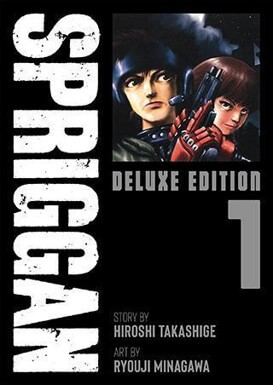
Spriggan made a comeback in 2022 with the release of a deluxe edition of the complete original 1989-1996 manga series (Seven Seas Entertainment) and a 6-episode Netflix animated series. In both the original manga and the recent Netflix adaptation, Spriggan follows the adventures of the special secret agent Yu Ominae, a teenager charged with protecting, or destroying, powerful artifacts associated with a mysterious ancient civilization from political and military forces looking to use these objects for their own interests. In Part Three of this three-part series, we explore how Spriggan presents contemporary issues in pseudoarchaology!
Then and Now: What Changed?
Pseudoarchaeology and Pop Culture
Overall, the treatment of archaeology and the usage of pseudoarchaeology in Spriggan is comparable with other popular action-adventure media. There are also no major changes in the way pseudoarchaeological themes are used in the story between the first two volumes of the re-released manga and the 2022 animated series. What also hasn’t changed much since Spriggan’s first publication is the real-world popularity of the pseudoarchaeological themes seen in the manga and animated series.
As fantastical as some of the elements of Spriggan may seem, the series draws inspiration from very real issues and beliefs. Pseudoarchaeology remains a major theme in popular culture today, likely due in part to its popularity in North American conspiracy culture. Beliefs about not only aliens and Atlantis but also history and archaeology, as well as long-standing global issues, serve as the core of many other action-adventure media (e.g., Indiana Jones). Pop culture draws from what is popular in our societies, and with the continuation of pseudoarchaeology in allegedly non-fictional books, television shows, youtube channels, and so on, we are bound to see it continue to be popular in fiction as well.
Pseudoarchaeology remains a major theme in popular culture today, likely due in part to its popularity in North American conspiracy culture.
Cold War Nostalgia and Modern Disasters
In both formats, Spriggan offers glimpses into contemporary anxieties through its exploration of fantastical topics. The disastrous effects of the powerful relics found in Spriggan are repeatedly presented as the results of the powers or the will of gods. Whether these “gods,” reimagined here as aliens or Atlanteans, were simply beings possessing advanced technology, or actually had magical powers remains unclear. However, beyond references to pseudoarchaeological beliefs, allusions to other contemporary anxieties are also seen in the discussions surrounding these ancient weapons. Indeed, their effects are often compared to those of nuclear weapons or described as environmental catastrophes, and can easily be associated with the disastrous impacts of pollution and climate change as well as with the dangers associated with nuclear power. These two issues, caused by humans instead of godly ancient weapons, were major sources of concern in Japan and across the world in the 1980s and 90s and remain important today.
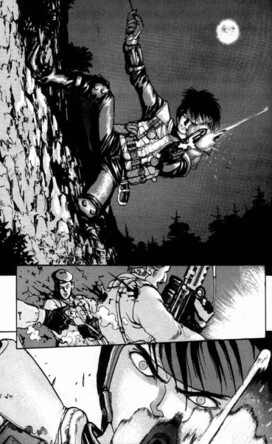
The depiction of political entities, such as the US, USSR/Russia, and the UK as power-hungry nations intending to become stronger using all means necessary is a recurrent theme in Spriggan. Their intentions are explicitly stated in the manga’s first chapter “First Mission” and in the introduction of the first episode of the Netflix adaptation, when the American military seizes a research center in Tokyo in an attempt to recover a powerful OOPArt. This theme is also seen in the “Serpent of Fire,” “Noah’s Ark,” and “Berserker” chapters and episodes. Although this type of representation may seem like a relic of the 1980s, it might not be completely irrelevant today considering recent events such as the Russian invasion of Ukraine. Overall, in Spriggan, countries are engaging in an OOPArt arms race using as an excuse the achievement of peace through a balance of power. It is easy to see, in this representation of the US and USSR/Russia specifically, a reflection of the state of Soviet-American relations at the time. Indeed, the early 1980s were marked by a renewed arms race and international tensions.
More generally, while the Netflix series successfully manages to retain some of the old-school flavor of the original manga and its bloody action scenes, it modernizes some of its elements (e.g., computers). A major difference between the manga and the animated adaptation lies in the main character, Yu Ominae. The skirt-lifting and breast-grabbing tendencies of the main character, a common trope found in other manga of the 1980s and 90s, are taken out, overall creating a more pleasant viewing experience and a more sympathetic main character.
The animated series brings Spriggan into 2022 by also taking out direct references to historical events such as the Gulf War. The context of the Cold War is thus lost, but it does not negatively affect the viewer’s enjoyment. Indeed, the 2022 adaptation makes Spriggan fit in today’s world. Russian-American tensions remain important, nuclear weapons and reactors are still a source of concern, and environmental disasters occur in increasing numbers and intensity. The manga and the Netflix series thus propose two different approaches to the same story: the manga appeals to readers looking for 1980s-1990s nostalgia, as it draws on themes of Japanese post-war anxieties and political events of the time; while the animated series aims to make the story more appealing to a contemporary audience.
The 2022 adaptation makes Spriggan fit in today’s world. Russian-American tensions remain important, nuclear weapons and reactors are still a source of concern, and environmental disasters occur in increasing numbers and intensity.
Conclusion
Spriggan is a fun action series. The release of a complete deluxe edition makes the classic manga series accessible to modern readers, and the Netflix adaptation includes important updates that modernize Spriggan without losing any of its original themes. Issues related to militarization, foreign politics, and climate change written into the original manga are still prevalent today, both in pop culture and the real world it exists in. As we have also shown, the seemingly random pseudoarchaeological themes found in Spriggan, like storylines about ancient aliens, Atlantis, crystal skulls, and Noah’s Ark, do not feel random when placed into the context of the real world, where they have been created and modified over centuries to suit the social climates they exist within. Seven Seas Entertainment’s description for the third and fourth volumes , released in February and June 2023, promises even more action and history, and we can’t wait to see what comes next!
References cited (but not linked)
Brasseur de Bourbourg, Charles-Étienne. 1868 Quatre lettres sur le Mexique: Exposition absolue du système hiéroglyphique mexicain, La fin de l’âge de pierre, Époque glaciaire temporaire, Commencement de l’âge de bronze, Origines de la civilisation et des religions de l’Antiquité. Auguste Durant et Pedone, Paris (France).
Charroux, Robert. 1963 Histoire inconnue des hommes depuis cent mille ans. Robert Laffont, Paris (France).
Donnelly, Ignatius L. 1882 Atlantis: The Antediluvian World. Harpers & Brothers, New York (New York).
Fort, Charles. 1919 The Book of the Damned. Boni and Liveright, New York (New York).
Leslie, Desmond and George Adamski. 1953 Flying Saucers Have Landed. Werner Laurie, London (UK)
Lewis, James R. 2012 Excavating Tradition: Alternative Archaeologies as Legitimation Strategies. Numen 59(2012): 202-221.
Pauwels, Louis and Jacques Bergier. 1960 Le Matin des magiciens, introduction au réalisme fantastique. Gallimard, Paris (France)
Tsuitsui, William M. 2010 Japanese Popular Culture and Globalization. Key Issues in Asian Studies No.6, Lucien Ellington (series editor). Association for Asian Studies, Ann Arbor (Michigan).
von Daniken, Erich. 1968 Erinnerungen an die Zukunft: Ungelöste Rätsel der Vergangenheit. Econ-Verlag, Berlin (Germany).

