
When I first heard about Embrace Your Size, I was super pumped and immediately shared it with a friend of mine. She and I read a lot of manga together, and we both noticed how rarely manga depicted anyone who looks like us. So for us, having body positivity be the central theme of a manga was amazing. However, we, as an ally to and a member of the fat community, each got something different from the book. A point that guest writer Katherine Brewer and I explore in our review.
Embrace Your Size: My Own Body Positivity
hara (creator), Athena (Translation), Alethea Nibley (Translation), Chiho Christie (Lettering)
Yen Press
22 November 2022

Content warning for the book and review: Fatphobia, eating disorders, mental health
Paulina: hara’s Embrace Your Size: My Own Body Positivity is an exploration of the author’s journey to practicing body positivity. While I am not plus-sized (the term the book uses) and never have been, I live in a fatphobic society. And I love seeing people of all shapes, sizes, builds, and beings live their authentic lives. Particularly when they’re a great “fuck you” to those societies. So I was excited to see a manga that might do that. And while it’s definitely about body positivity, I got ahead of myself and missed the subtitle “My Own Body Positivity” (emphasis added). Because that’s the real focus of the book, the manga wasn’t what I expected. Katie, what were your thoughts about the book after hearing about it?
Katie: I, too, was very excited to see a manga that depicts people who look like me. I don’t think I had any expectations one way or another about what hara’s work would look like or what the contents would be, and I certainly didn’t have expectations about quality. I guess, mostly, I didn’t want to get my hopes up. Often, as a fat person, you hear about some form of media that has a fat person in it, but when you watch or read it, the media is just disappointing in its fatphobia, such as Pitch Perfect, Avengers: Endgame, or The Whale. I tried to keep my expectations reasonable. Even fat people have internalized fatphobia, so works by a fellow fat person are better at representation but can still fall short of the mark.
Paulina: That makes a lot of sense! I actually didn’t realize I had expectations for the book until I read it and was really sad about my reaction because of my excitement. However, as I started writing I realized my feelings, as an ally, aren’t really the community this book is intended for, so, how did you feel about it after reading it?


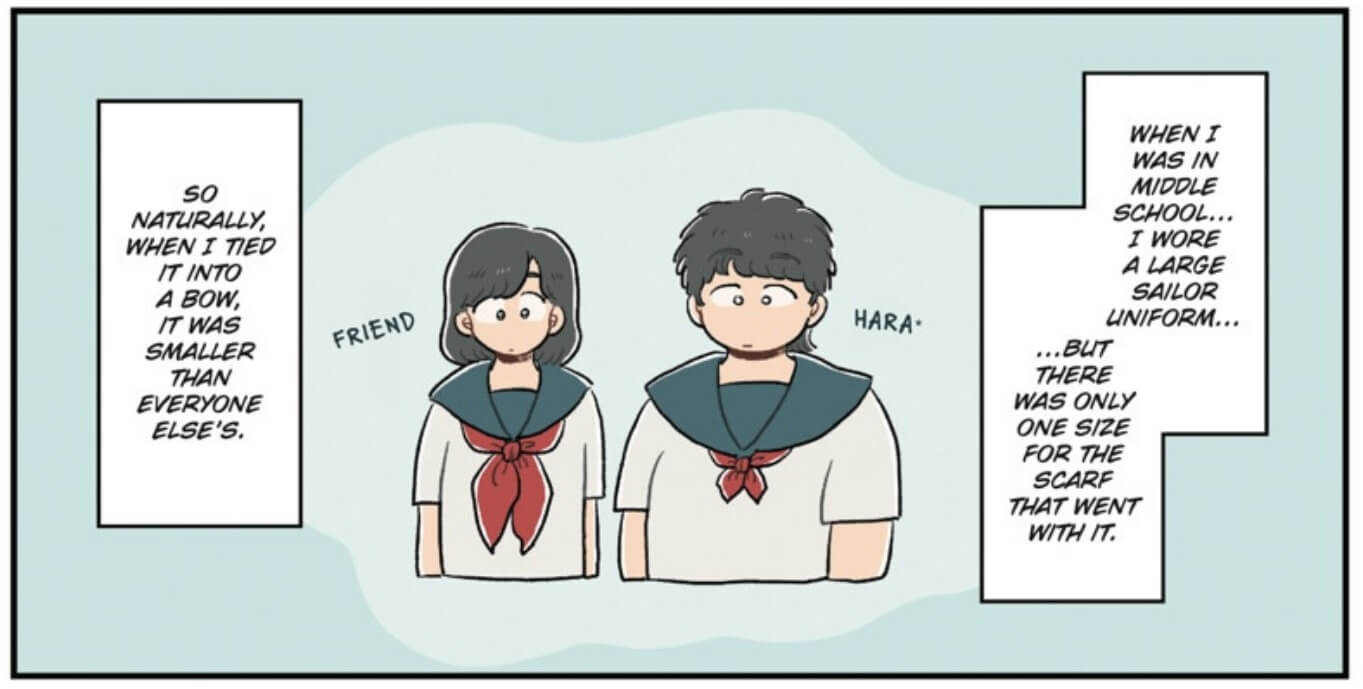
Katie: After reading Embrace Your Size, I absolutely love it. I can relate to hara’s entire story. Right from the start, hara’s experience with her school uniform hit me pretty hard. As a fat person, particularly one with larger breasts, clothes fit differently, usually designed for thinner bodies with smaller breasts. So, if friends want to wear matching outfits, or I like something a friend has worn and want to get something like it, it can be very difficult because it just doesn’t look the same on me as it does on them. That feeling of familiarity continued throughout the book: from weighing herself several times a day, to not wanting her picture taken because she hates how she looks in the outfit (or just plain hates how she looks in pictures), to keeping her shirt untucked so her stomach rolls don’t show. I never had an eating disorder, but I have struggled with disordered eating at different points. When hara talks about re-watching shows on TV that were fatphobic and realizing that it actually had bothered her but she was “numb to the pain” because it was just the reality of how fat people were treated on screen, I have felt similarly. Even hara’s body positivity journey struck a chord with me. As I read the manga, I found myself commenting along, like, “Yep, been there” or “The struggle is real.” In many ways, it validated my experiences and made me feel seen. As a thinner person, were you able to relate to the manga in any way, Paulina?
Paulina: There were aspects of the manga I related to. However, I know they don’t resonate with me in the same way as for plus-sized folks. I can understand seeing photos of yourself and not liking them. Or having the first thing you notice be your weight in an old photo. But honestly I’ve experienced few of the things hara illustrates. I don’t know if it’s because of that or because of my different expectations for the book–of a “how to for body positivity” generally versus one person’s journey–but although I know her stories are important, for me the collection doesn’t quite work. While the Embrace Your Size collection adds a comics intro and conclusion explaining that it collects previously separately published stories, those additions didn’t smooth out the volume. Specifically, the individual chapters have a high level of redundancy that lessened their impact for me. How did this read for you, Katie, did you have any particular frustrations with the work?

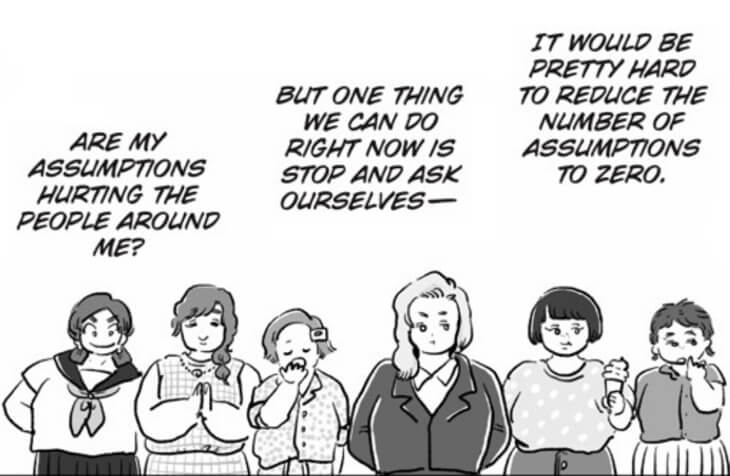
Katie: I would agree that the manga didn’t read as smoothly as it could. I think some transitions or a slight re-doing of the beginning panels of each chapter would have solved that issue. However, for me, it didn’t detract from the author’s main point of the chapters but was rather a slight jolt at the beginning that dissipated as I continued to read. The biggest frustration I had was actually the depictions of fat people. Don’t get me wrong, it was lovely to see fat bodies depicted, and I absolutely adored the range in sizes of those fat bodies. However, there were very few panels that showed the range of curves and rolls. While the reader can definitely see that the bodies depicted are supposed to be larger, it felt like all of the curvy bits were too smoothed out. hara drew one panel with a row of fat women, but only one of them uses curvy lines to show the rolls and depressions that represent many fat bodies. It might just be the style of art favored by manga, but the art felt like it still fell into the larger beauty narrative where any hint of un-smoothed out curviness is unattractive and therefore unworthy of depicting

Paulina: That’s such an important point about hara’s art. It reminds me a bit of Gordita: Built Like This, where Gordita talks about having the wrong body shape. Also, when hara talked about the plus-sized influencers that she follows, the examples she uses are very much folks who have the “right kind” of plus-sized body. On top of that they’re influencers, or other kinds of professionals. That means while they share a lot of experiences with other plus-sized people, they have more power and privilege than your average plus-sized person. Were there particular influencers that she mentioned, or referenced, that you felt spoke to this weird balance of privilege while also being plus-sized?
Katie: Oh, definitely! The author’s choice of Ashley Graham does not necessarily go against that. Yes, Ashley Graham has done a lot for the visibility of fat people and fat representation. However, Ashley Graham has a fat body that is still in proportion. It follows traditional beauty standards, with no fat poking out where people think it shouldn’t. No “excessively” flabby arms, etc. It feels almost like it’s okay to depict fat people, but don’t show any actual fat. However, it is also important to have people in the public eye that do not fit that mold. People like Lizzo or wonderful fat activists like Marquisele Mercedes (@marquisele), Ali Thompson (@Artists_Ali), and Dr. Asher Laramie (@thefatdoctoruk). Seeing or hearing from them can be that push you need one day when you are looking in the mirror and hating what you see: they are beautiful, and so the fuck am I. Attention should also be given to messaging put out into the world in addition to images. Seeing tweets everyday from the Ok2BeFat account started by Ali Thompson such as “Big fat bellies are awesome” or “Fatness is a normal human variation.” Just as with the negativity fat people hear, reading and hearing the positive comments over and over and over can start to stick too. How did you feel, Paulina? Is there anything you would like to have seen more or less of in the manga?

Paulina: Content-wise, I think that the manga has a lot to offer readers of any age. To rephrase my concerns in terms of more or less, I needed more organization/editing/revision in the work. Because the manga collected previously published separately comics as I read chapter-after-chapter, I got lost in hara’s journey, and not in a good way. She’d recount the same events in different orders in two back-to-back stories. Or she’d readdress something that an earlier comic resolved. For me, this detracted from the impact of the volume because I needed to reorient myself with each chapter. And while yes, the road to body positivity meanders, I doubt hara’s intended to use the reading order for this. For me, the introduction, which explains the themes organizing this collection of previously individually published comics, didn’t smooth out the transitions. Furthermore, additional editing could have distinguished this collected version from each chapter’s original releases. It’s a shame because there are parts I love. Her portrayals of her childhood self are cute and fearless. Furthermore, hara’s storytelling is awesome. She regularly leverages different visual structures to depict confusion rather than writing a disorganized story. Particularly, her illustrations and the lettering in some panels truly embody anxiety. Was there anything else you wished hara had spent more time on, Katie?

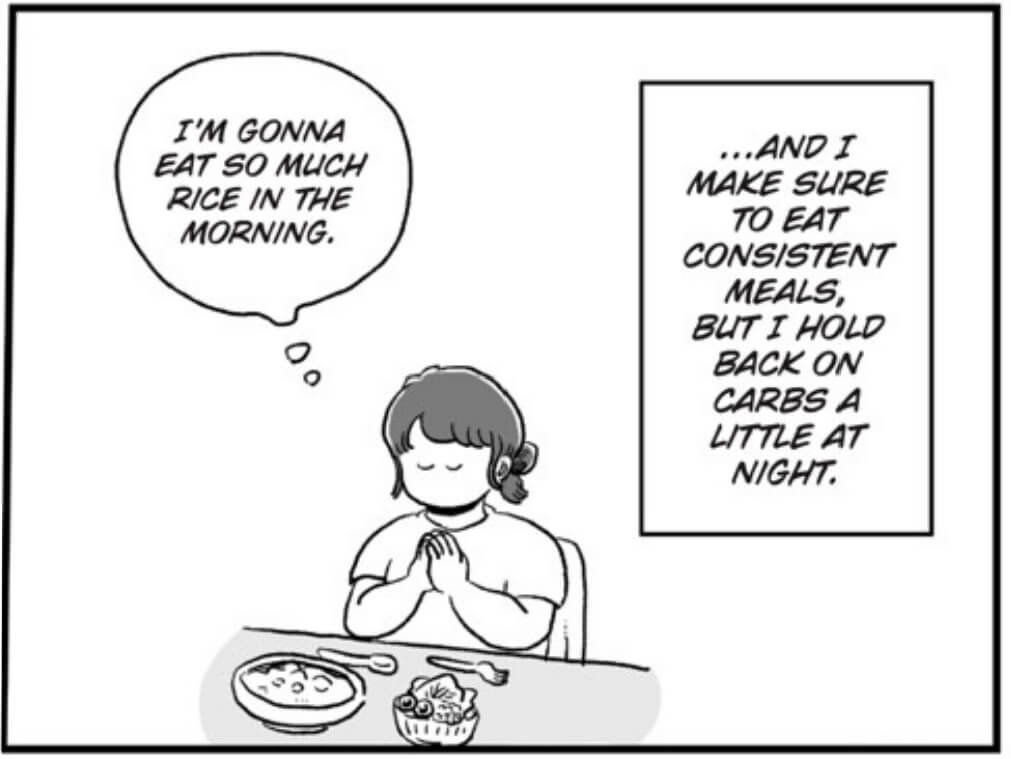
Katie: I was a little disappointed that there wasn’t much in the manga about medical fatphobia and how that might also have contributed to hara’s self-image and body positivity journey, though I know that hara’s focus was more on fashion. There is a panel at the beginning in which hara was sent to the school nurse because she lost “too much” weight, but that is it. Medical fatphobia can help to shape one’s self image from an early age, in addition to killing fat people, and this will only get worse in the future with the American Academy of Pediatrics changes in guidelines (for criticism of these guidelines, see Virginia Sole-Smith’s article). I would love to have seen a consideration of those effects in this manga. What I found more disheartening was hara’s commentary on dieting. I didn’t mind that she discussed body positivity not meaning you don’t work out if you want to, but she included not rejecting dieting in there as well. hara mentions restriction of carbs in the evenings, which felt unnecessary and counter to the rest of her story. hara goes on to mention she doesn’t step on a scale and she doesn’t diet to lose weight, but framing that as developing eating habits that make her feel good would have been better. Dieting has certain connotations directly connected with intentional weight loss and medical fatphobia. (Health is also a loaded term, so healthy eating habits isn’t a good way to frame it either). For me, the entire conversation around dieting could have been completely excluded and would have made for a better manga.

Paulina: Yeah! Especially because that’s such a huge part of the book in general. Particularly when it comes to behaviors that folks often default to when we frame fatness as “just an eating” issue. Having anxiety is one thing, but she didn’t explore how adults’ opinions harm children’s psychology. Specifically, she never identifies that psychological harm as a health issue for plus-sized children. Both when adults imply a need to lose weight to children, and also then also when they reprimand children for doing it, just like hara was. In the first chapter, as you mentioned, teachers said hara broke the rules because the ribbon on her sailor uniform was too short. Middle-school hara, who grew up in a fatphobic society, thinks “Well, I guess I could lose weight,” something her developing and impressionable child’s mind came up with. The ribbon is too small for her, and if it can’t change, she will. And committed to it. And then has a teacher reprimand her for that too. There’s no winning.

Katie: This, unfortunately, isn’t an uncommon experience. hara talks about it later in Embrace Your Size as well, how people, who would hesitate to comment on other physical qualities, have no such qualms about commenting on body size. This can be extremely traumatic as a child, especially when it comes from the “well-meaning” adults in your life. I, too, loved the panels depicting intrusive thoughts. You mentioned hara’s depictions of anxiety and intrusive thoughts and those were so accurate it actually brought back memories of the thoughts I had in the past.
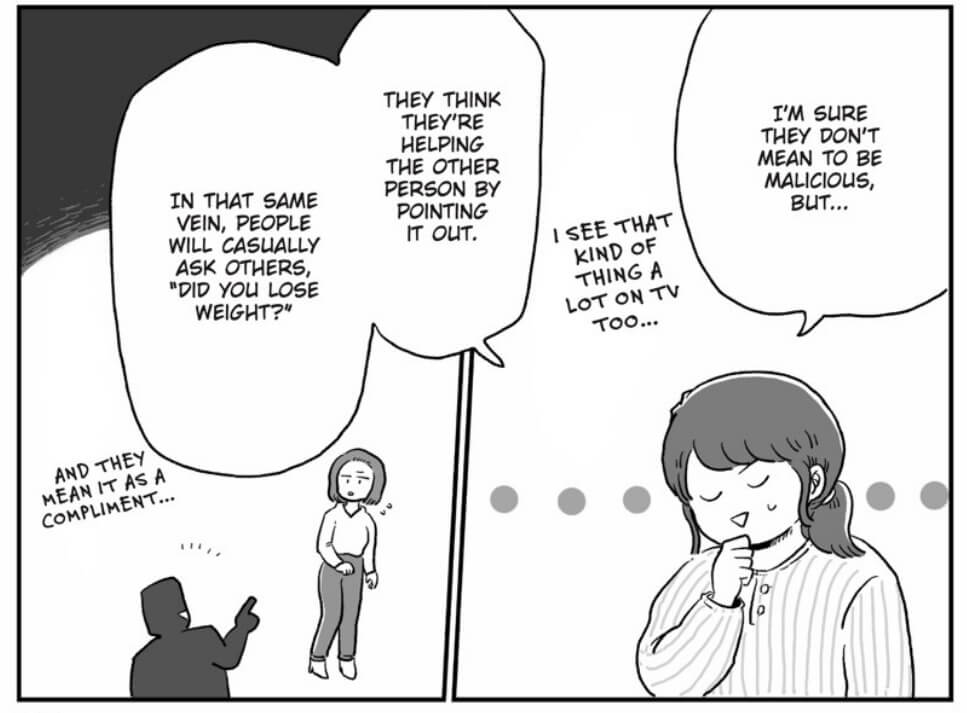
Paulina: I loved those moments. And she varies how she does them so well. Sometimes it’s leveraging high contrasts with single text bubbles on black backgrounds. Other times she uses panels without internal gutter divisions to portray the layered and intertwined process of dieting issues. It’s epic visual storytelling. However, hara balanced these cool aspects with a thing I found strange. Specifically, while each chapter depicts a sweet short uplifting story, sometimes the moral of the story feels a bit like “just do this!”
“Just add a few body positive influencers to your feed!”
“Just love yourself!”
“Just call out that bully!”
And that feels too close to “just lose some weight” for me. It’s an unhelpful phrase because there’s so much other work beyond “just doing X”. It made me think about how healing from the trauma of body shaming that fat people experience requires interrogating the kind of support communities give. Small actions are great but being seen is not the same as healing. And here’s where the manga’s reading issue gets me again. If I had read each comic separately, picking up each as a floppy issue, zine, or Webtoon episode, I doubt her suggestions would have the same impact. The repetition in storytelling would be subtler and it wouldn’t read like a book of “just do’s”. And while I embrace body positivity, as a collection Embrace Your Size undercuts itself by not following on the success of hara’s original publications as serialized comics. It brings it all together, but in a way that’s harder to love.
Katie: That is definitely a valid critique that should be discussed and done better in the future. I felt like any one chapter could have been a whole manga in and of itself (which I would have loved to see). I actually hope that hara expands on Embrace Your Size by going more in depth on specific parts of the manga in the future. However, I think Embrace Your Size hits differently for me. Part of it could be the lack of expectations I discussed earlier; part of it could be that I was just really excited to see a manga with people who look like me and that share my lived experience. I noticed the format and wanted more, but I didn’t mind so much. Yes, the steps hara talks about can feel like platitudes, but sometimes those platitudes are what you need to build the confidence to allow yourself to start on that healing journey. Those platitudes can get you through rough patches along the healing journey. I think the title of Chapter 4 sums it up pretty well: “What Gave Me Courage.” Whatever gives you the courage to take the steps towards accepting yourself and maybe even loving yourself. I also really loved that hara didn’t shy away from how difficult it can be. Even seeing the body positive fashion magazine didn’t instantly heal her. It truly is a journey with all the implied victories and setbacks.
Overall, we agree that Embrace Your Size has a lot to love. It’s a great work that we’re glad got translated so that more people can love it. Specifically, it illustrates many important aspects about the body positivity journey and doesn’t hide it’s difficulties. At the same time, she maintains an optimism for herself and the future. However, more editorial polish could have improved the use of the collected issue format. It, at times, felt disjointed and meandering. Despite its flaws, we hope that Embrace Your Size gives others courage whenever they may need it. That way, people can, as hara says, be “kinder…and more forgiving to [themselves] about [their] body and [their] mind.” We all deserve it.
