

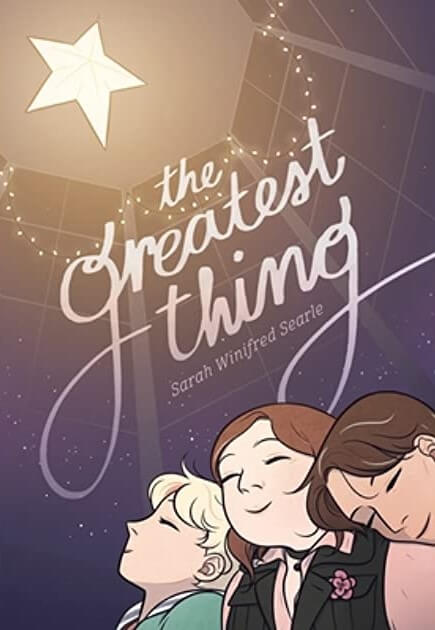
The Greatest Thing by Sarah Winifred Searle (Sincerely, Harriet; Patience and Esther; and a former WWAC contributor!) is a bittersweet story about an aspiring artist who channels her dreams and anxieties into a series of comic zines. With its honest writing and soft pastel art, this graphic novel explores the realities of being a queer teenager at the turn of the millennium while celebrating the exploration of identity through creative expression. Searle’s depiction of the era just before social media became mainstream will resonate with people old enough to remember questioning their sexuality without online resources, and its gentle enthusiasm for hand-crafted media will inspire younger readers interested in creating zines of their own.
The Greatest Thing
Written and Illustrated by Sarah Winifred Searle
First Second Books
February 8, 2022
Winifred is a sophomore at a public high school in a small town in New England. Her two friends from freshman year transferred to a private school in the city, but the tuition isn’t feasible for Winifred’s mother, who is raising her family on her own. Winifred feels like a stranger in her own body, and she’s too shy to make friends easily. As she creates her first series of comic zines, Winifred connects with new friends through her art and discovers her own unique voice, but she still struggles to confront her anxieties regarding her perception of herself as a person who isn’t allowed to take up space in the world.
Winifred’s younger friend April seems to have everything Winifred wants, but her advantages come at a cost. April’s parents are wealthy, but they’re bigots; she’s slender, but she has an eating disorder; and she’s willing to accept that she isn’t straight, but she doesn’t know what type of “gay” she is, or if she even identifies as “she” at all. As April takes steps forward to understand herself, she finds Winifred’s lack of emotional reciprocity frustrating.
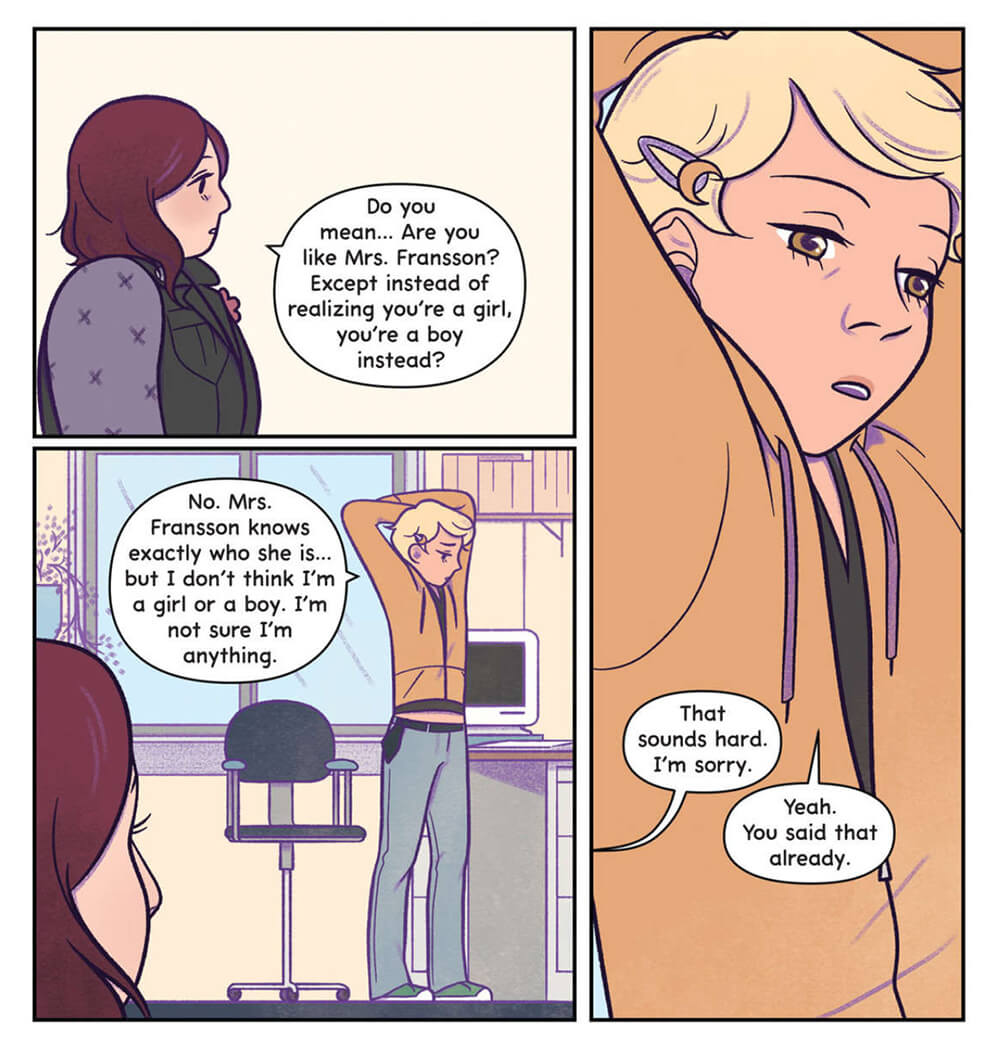
April’s friend Oscar has even more ambiguous sexuality, and he and Winifred eventually enter into a relationship. As teenagers who are not quite closeted but not yet out and proud, they make a heavily symbolic fantasy comic zine together, with Oscar writing the story and Winifred creating the art. Oscar abandons the imagined world of the zine after making a decision to be more engaged with the real world, which unfortunately means leaving his creative friends behind.
The Greatest Thing is primarily a story about friendship, and about how even strong and healthy relationships can shift and change because of difficult situations over which teenagers have little control. Winifred knows that she wants to enter the field of art and design, for instance, but she’s constrained by the limited course offerings at her public high school. Her mother and guidance counselor are concerned by the low grades she receives in remedial classes that don’t interest her, while Winifred is frustrated that she isn’t receiving the specialized education she needs to pursue a career path as an artist.
Winifred’s school allows her to enroll in an independent study, and her advisor encourages her to create a series of four comic zines. She initially works from Oscar’s script, but she creates the final zine as a solo artist. The Greatest Thing demonstrates that a zine doesn’t have to look professional or even be printed in color and that anyone can make something to give to their friends or even to drop off at the local indie bookstore or coffee shop.
The pages of Winifred’s zines are inserted directly into the graphic novel, including their back covers and interior cover pages. The simplistic and monochromatic line art of the zines hints at subtle anime references, and this style seems much more approachable and manageable for an aspiring artist than a full-color comic. This story-within-a-story is beautiful on its own merits, but it also has the benefit of serving as a concrete model for readers interested in making their own zines. In addition, Searle includes a brief how-to guide to making zines in the narrative, and the final page of The Greatest Thing takes the form of a short autobiographical essay about Searle’s own high school zines.

Alongside its practical advice for aspiring artists and zinemakers, The Greatest Thing uses its characters as models to offer concrete life advice to queer teenagers searching for healthier environments. We follow Oscar through his process of finding another school that better suits his educational needs, just as we follow April as she emancipates herself from her abusive family. Meanwhile, Winifred models conversations about breaking up with someone whose sexuality isn’t compatible with yours, coming clean about the lies you’ve told to disguise your sexuality and asking out your same-sex crush.
Searle paints a soft pastel portrait of what it was like to grow up in the 2000s before smartphones and social media. Relatively few people talked about what it means to be gay, but the queer kids nevertheless managed to find each other. The Greatest Thing has no epic kisses or dazzling rainbows or flashy pride parades, just a quiet and gentle acknowledgment that growing up means learning to be true to yourself.
The Greatest Thing is a fantastic resource for its intended young adult audience, but it’s so much richer and more interesting than “life lessons for troubled teens.” With her distinctive soft lines and vibrant color palettes, Searle offers readers of all ages a compelling story about characters who are impossible not to root for as they make tough decisions on the road to embracing their creativity while accepting themselves.

