

Women Write About Comics celebrates the 150th anniversary of J. Sheridan Le Fanu’s Carmilla with a series of posts on female vampires in nineteenth-century literature.
When is a vampire story not a vampire story? This is a question that will be asked by anyone delving into the genre’s history. There are many works of supernatural fiction that contain the core elements of the vampire theme (the dead rising to drain the living) and sometimes also the secondary elements (Ifor example, the living dead as seductive tempter) yet make no specific mention of vampires, and give no indication that the authors even considered themselves to be writing vampire literature.
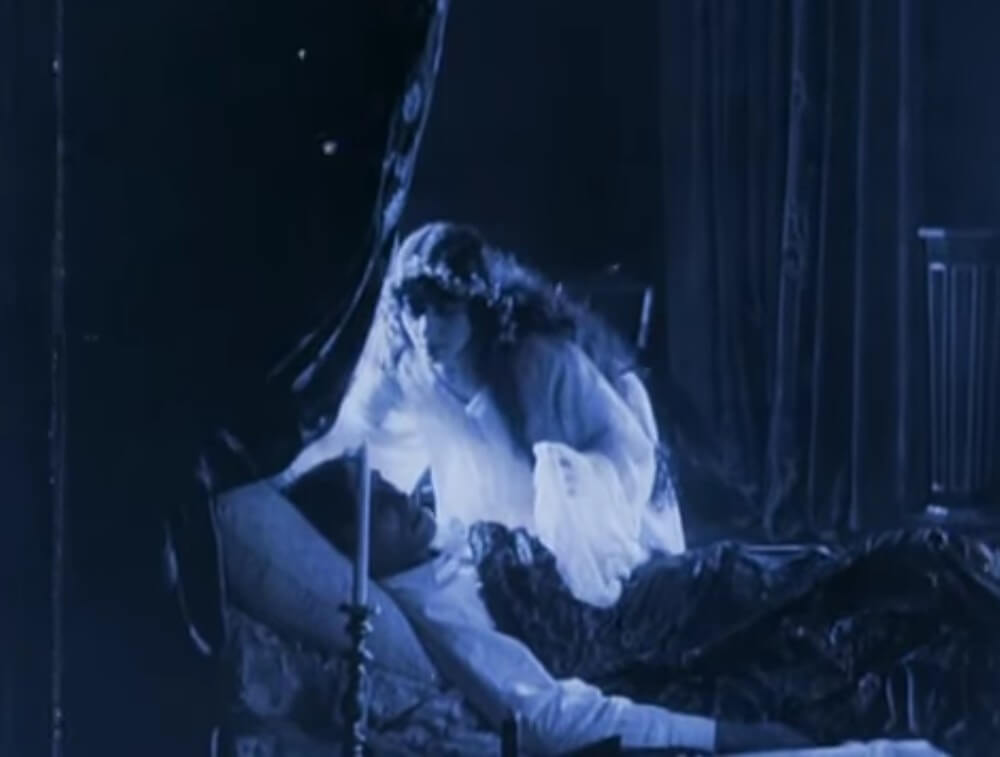
This brings us to the Russian author Ivan Turgenev and his novella Clara Mílitch – or Klara Mílich, both renditions having been used in the English-speaking world – which was published in 1883. An English translation by Isabel Florence Hapgood followed as part of the collection A Reckless Character and Other Stories. The tale was also adapted into a 1915 film, Pósle smérti (After Death).
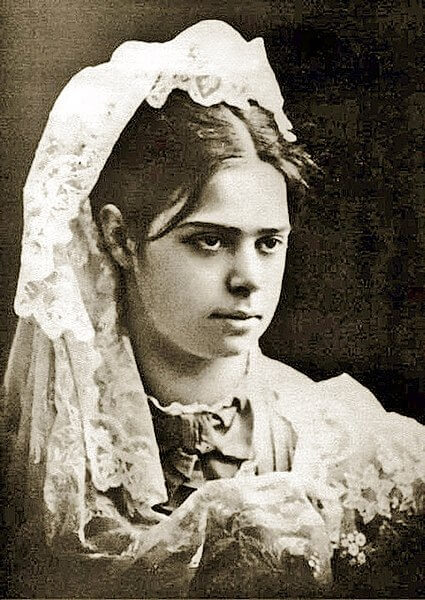
In writing this novella, Turgenev was influenced by a recent series of real-life events that began with the suicide of opera singer Evlalia Kadmina, as described on the Russian-language website Magisteria:
The fact is that on November 3, 1881, Evlalia Kadmina committed suicide by taking poison during a performance on the stage of the Kharkiv Theatre, where she played the title role in Ostrósky’s play Vasilis Melentiev, thereby killing herself in the same manner that is written for that play’s heroine.
The most curious thing is that after this suicide, the aforementioned zoologist Vladimir Alenitsyn began to show signs of obsessive love for the deceased artist, which apparently, had begun some time previously but now reached the scale of a real psychosis. According to the recollections of his contemporaries, Alenitsyn experienced some sort of fixation on Evlalia Kadmina and was treated for an extended period, earning a reputation in St. Petersburg as a strange man in love with the deceased.
Turgenev was aware of this history, and rather persistently asked for details of these events from his artist acquaintances Savina and Nelidova, who were familiar with Evlalia Kadmina.
The basic details of this tragedy are clearly recognisable in Clara Mílitch; but Turgenev adds a supernatural twist to the narrative, edging it towards the territory of vampire fiction.
The story is set in 1878 and focuses on Yákoff Arátoff, a twenty-five-year-old Moscow bachelor. Arátoff is effete, anxious, and asthmatic; his nature makes him a recluse, closer to his aunt Platonída (“with whom he exchanged barely ten words a day, but without whom he could not take a step”) than to any of his fellow students at university.
That said, he does have one friend: Kupfer, “a German who was Russified to the extent of not knowing a single word of German, and even used the epithet ‘German’ as a term of opprobrium”. Rather more outgoing and introverted than Arátoff, Kupfer shares a social circle with a middle-aged princess from Georgia. Intensely shy around women, Arátoff is reluctant to meet the princess; but after pressure from both his aunt and his friend, he allows himself to be introduced to her.
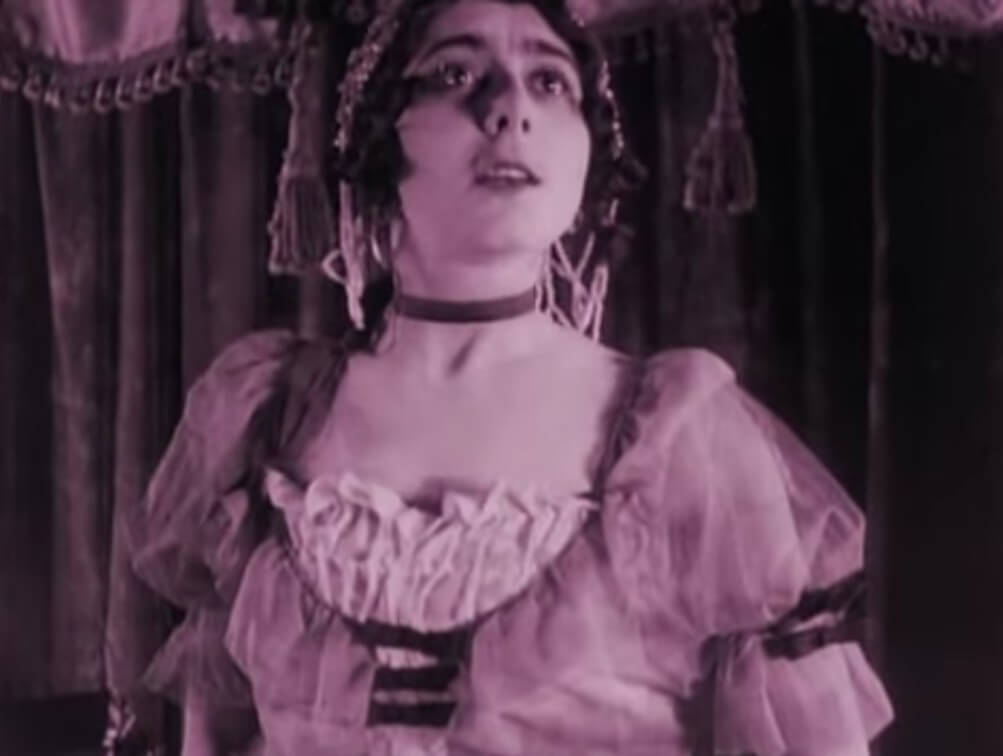
However, the female lead of the story turns out to be not the princess herself but rather a young singer taken under her wing. Arátoff becomes deeply agitated upon hearing that this girl is called Clara Mílitch: her name reminds him of Clara Mowbray, a character who meets an unhappy end in Sir Walter Scott’s 1823 novel Saint Ronan’s Well. Later, Kupfer takes him to a performance in which Clara performs on stage:
She was a girl of nineteen, tall, rather broad-shouldered, but well built. Her face was swarthy, partly Hebrew, partly Gipsy in type; her eyes were small and black beneath thick brows which almost met, her nose was straight, slightly upturned, her lips were thin with a beautiful but sharp curve; she had a huge braid of black hair, which was heavy even to the eye, a low, impassive, stony brow, tiny ears …. Her whole countenance was thoughtful, almost surly.
She sings works by Glinka and Tchaikovsky, followed with a reading from Pushkin which she ends up fumbling. Arátoff has mixed feelings about Clara’s singing ability; he considers her general presentation to have something of a sleepwalker about it, and finds her physical appearance unattractive (the ethnic prejudice of the character, and perhaps also the author, plays a part here.)
Yet he becomes fascinated by her general aura and believes that she had been glancing his way during the performance. He cannot understand why, but her face haunts him:
But this was a black-visaged, swarthy creature, with coarse hair, and a moustache on her lip; she must certainly be bad-tempered, giddy…. “A gipsy” (Arátoff could not devise a worse expression) – what was she to him?
And in the meantime, Arátoff was unable to banish from his mind that black-visaged gipsy, whose singing and recitation and even whose personal appearance were disagreeable to him.
While the vampiric aspects of the story are not yet apparent, we see here a common aspect of the vampire motif: the combination of the seductive and the repellent. Clara can be seen as an inversion of more stereotypical vamps – rather than an outwardly beautiful figure who is corrupted inside, she has an unappealing exterior with a strange allure beneath.
Clara later writes to Arátoff and the pair meet up. Given Arátoff’s reclusive nature, particularly where women are concerned, the two may as well be speaking different languages, and he comes to see the arrangement as a cruel prank: “You may turn out a good actress, but why have you taken it into your head to play a comedy on me?” On his way home, he feels anger at the encounter; yet he also feels flattered that Clara showed any interest in him at all.
His mixed emotions gnaw at him until he reads in a theatrical journal that Clara has committed suicide, poisoning herself on stage – and is rumoured to have done so out of unrequited love.
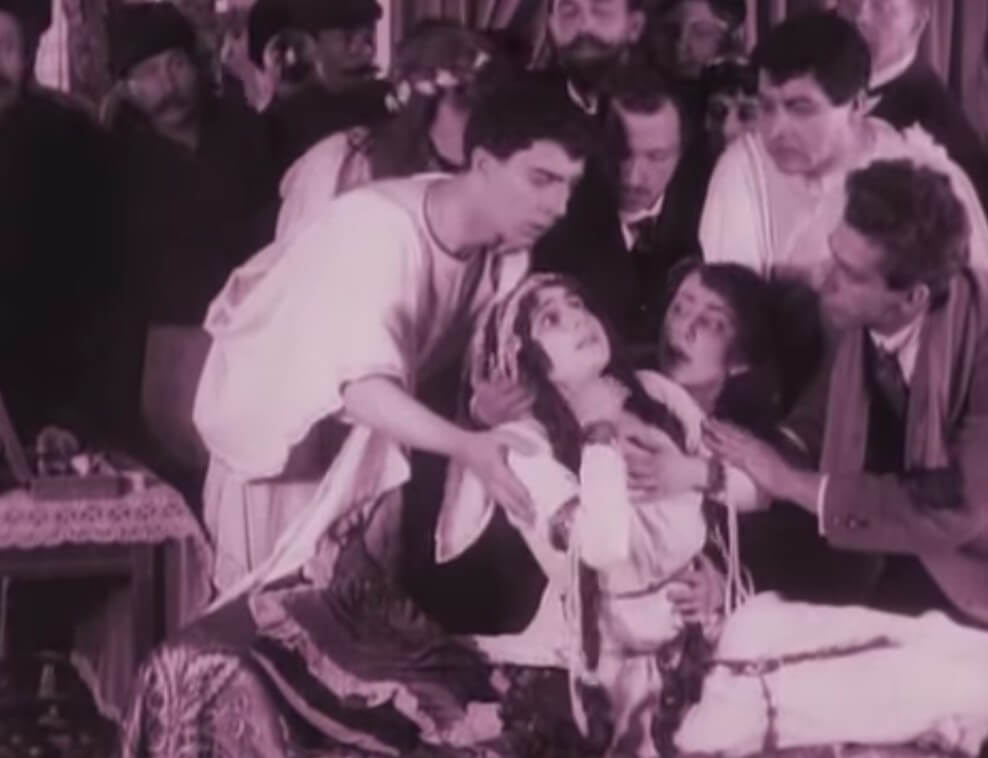
In shock, Arátoff goes to Kupfer, who confirms that Clara is indeed dead. He also divulges her personal history. Her real name, it turns out, was Katerína Milovídoff; her father was a drunken art teacher, her mother “a thoroughly stupid female, straight out of one of Ostrósky’s comedies” (note that it was an Ostrósy play in which Clara’s real-life model poisoned herself). At the age of sixteen, she ran away with an actress.
“With an actor?” asks Arátoff
“No, not with an actor, but an actress; to whom she had become attached” clarifies Kupfer.
A modern reader might see a hint of something sapphic in this briefly-sketched relationship, although it is unclear whether this was intentional on the author’s part. Instead, the general implication is that it was indeed a man who had captured Clara’s attention
But Arátoff is characterised as being too “chaste” (naive, perhaps) to contemplate the possibility that he was the subject of Clara’s desire, and so does not blame himself for her suicide. Instead, his fascination with her increases as he now sees her as a puzzle to solve: “She ran away from home with a kept actress… she pleased herself under the protection of that Princess, in whose house she lived,–and had no love-affairs? It is improbable!”
Clara enters his dreams; in one ominous nightmare, he sees her white-faced and her pose statuesque. She sinks down onto a rock resembling a tombstone and Arátoff finds himself joining her, “outstretched like a mortuary statue,–and his hands were folded like those of a corpse.”
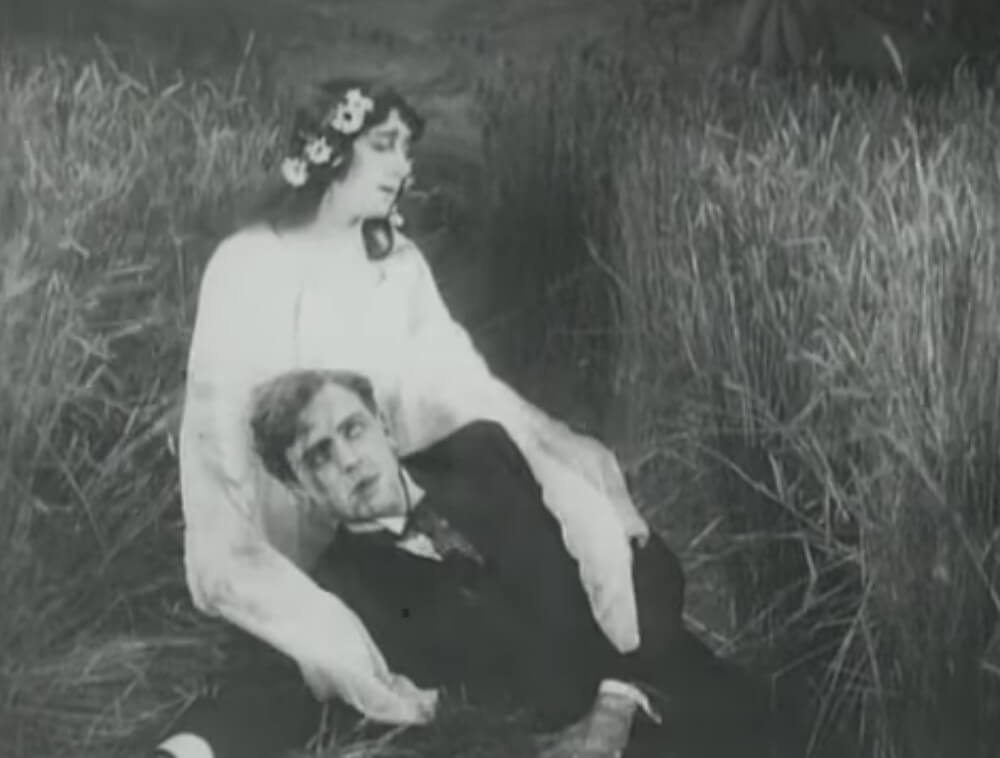
Hoping for answers, he tracks down Clara’s surviving family, who willingly divulge her life story. He hears that she received no love from her late father, who tried to suppress her musical talents and insisted that she was an illegitimate birth (“Who was the father of that black-visaged little devil of thine?–I was not!”). As for her other relatives, Clara’s attitude was distinctly conflicted:
Clara had loved her mother… in a careless way, as she would have loved a nurse; she worshipped her sister, although she squabbled with her, and bit her…. It is true that afterward she had been wont to go down on her knees before her and kiss the bitten places. She was all fire, all passion, and all contradiction: vengeful and kind-hearted, magnanimous and rancorous; “she believed in Fate, and did not believe in God”…
She was at one point engaged to a man but ended the relationship by punching him in the face. “If he were a real man he would have thrashed me,” she explained at the time, “but as it is, he is a wet hen!” Above all, it transpires that Clara was an unhappy youth: “I cannot live as I wish,” was her adage “so I will not live at all.”
Returning to Moscow, Arátoff struggles with his emotions. He decides that he cannot truly be in love with her as it is impossible to be in love with the dead; yet he has to admit that, somehow, she still holds an influence over him:
Yes; her body was dead …. But how about her soul?–Was not that immortal …. Did it require bodily organs to manifest its power? Magnetism has demonstrated to us the influence of the living human soul upon another living human soul …. Why should not that influence be continued after death, if the soul remains alive?–But with what object?
The mention of magnetism here clearly refers to so-called animal magnetism, or mesmerism – although the story is delving into supernatural themes, it is doing so using the language of pseudoscience, another detail in which it differs from conventional vampire literature.
After a night of dreams that seem to prefigure some impending disaster, Arátoff directly addresses the spirit of Clara, imploring her to return. She apparently obliges as he sees an apparition of her. The ghostly Clara is black-clad and initially mournful of face, but comes to smile when he shows attraction. Then he tries to kiss her, and the story makes its most direct engagement with the vampire motif:
“I am forgiven!”–cried Arátoff.–”Thou hast conquered… So take me! For I am thine, and thou art mine!”
He darted toward her, he tried to kiss those smiling, those triumphant lips,–and he did kiss them, he felt their burning touch, he felt even the moist chill of her teeth, and a rapturous cry ran through the half-dark room.
Platonída Ivánova ran in and found him in a swoon. He was on his knees; his head was lying on the arm-chair; his arms, outstretched before him, hung powerless; his pale face breathed forth the intoxication of boundless happiness.
After this, he fast declines. “What does it mean, O Lord!” thinks his aunt Platonída. “There isn’t a drop of blood in his face, he refuses his beef-tea; he lies there and laughs, and keeps asserting that he is quite well!” As he lies on his deathbed Arátoff compares himself to Romeo, relishing the prospect of his impending fate on the grounds that, if he should die, he shall finally be with his beloved black-haired Clara. A doctor diagnoses him with an inflammation of the heart, but is unable to provide treatment.
Finally, he dies – and a lock of black hair is found to have somehow materialised in his hand.
Until this final detail of the hair, Clara Mílitch is a psychological ghost story, leaving it ambiguous as to whether the phenomena are genuine or occurring entirely within the protagonist’s head. This places it in a very different class to “The Viy” by Turgenev’s fellow writer of Russian letters, Nikolai Gogol (an author who, incidentally, is mentioned in passing in Clara Mílitch, albeit in his capacity as a humourist rather than a horror writer). Gogol’s tale did not play with such uncertainty, instead dropping the reader directly into a weird realm of supernatural beings.
Yet Turgenev and Gogol have something in common in that each produced a vampire-adjacent story without indicating that they had any conscious intention of doing so. The tragic heroine of Clara Mílitch and the unnamed witch in “The Viy”, for all of their differences, both embody major elements of the vampire motif: they rise from the dead, or appear to do so; they drain the life of the living (although Gogol’s witch, unusually, feeds on blood before dying) and they each have the touch of the temptress about them.
Of the two, “The Viy” is the one most often cited as part of the vampire genre — but perhaps Clara Mílitch warrants mention along the same lines.
Next week: The final instalment of this series…
