

I really wanted to like Barbarian. It does some creative things and establishes some great character work. Unfortunately, it’s also a complete mess.
Barbarian
Zach Cregger (Director, Writer), Zach Kuperstein (Cinematography), Joe Murphy (Editor)
Georgina Campbell, Bill Skarsgård, Justin Long, Matthew Patrick Davis, Richard Brake
September 9, 2022
This review contains spoilers.
Content warning: rape, gendered violence.
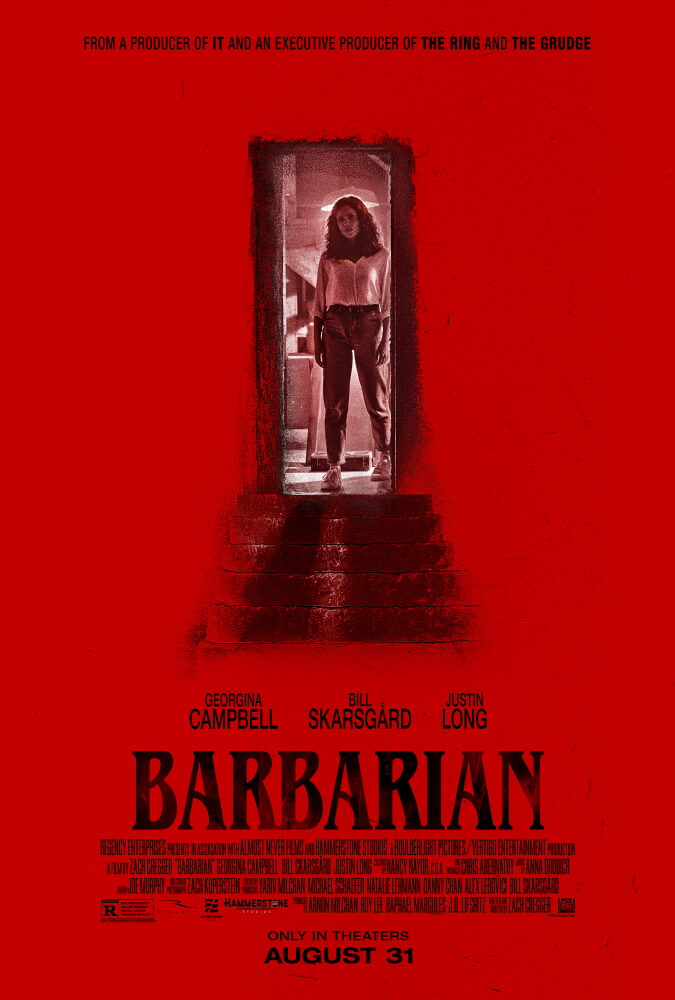
The product of The Whitest Kids U’Know co-creator Zach Cregger, Barbarian is ostensibly a horror movie about gendered violence. In it, a young woman named Tess (Georgina Campbell) makes the decision to split a short-term home rental with a stranger (Bill Skarsgård) after a double-reservation mishap. That elevator pitch is compelling, certainly; a woman traveling alone, having to contend with the threat of a strange man? It’s enough to immediately put any of us on guard, ready to imagine all sorts of lurid crimes that could occur, and as a film viewer, I was ready with all sorts of guesses as to how the “mishap” might have arisen. Did the man orchestrate it in order to isolate the woman? Does he secretly own the home? Does he secretly work for the rental company? There are all sorts of potential explanations here. In one of the better twists of the film, it eschews all of them: the man is simply a man, and the mixup is just that; a benign error. His name is Keith, he gives Tess the bedroom and takes the couch, they have a nice, if awkward, evening chatting before she has a job interview the next morning (this is why she’s traveling).
It’s not until after she goes to bed that strange things start occurring. Her bedroom door is opened in the middle of the night, and she thinks Keith might have done it, but he’s sound asleep (with night terrors, even). The next day, after her interview, she explores the basement, only to find a hidden doorway that leads to an underground complex. It’s here where the true mystery of the home is revealed: years ago, a man named Frank (Richard Brake) owned the home, kidnapped local women, imprisoned them, and forced them to bear his children. Keith disappears in the complex, and when Tess goes after him, he’s murdered before her eyes by a naked, super strong, female monster (credited as The Mother). This is the last we see of Tess for a while, as the film cuts immediately to an entirely different locale: actor AJ (Justin Long) is driving in his convertible as he gets a call informing him that he’s being removed from a television pilot after accusations of sexual assault arise from one of his costars.
Long’s character is complex, and he’s well-cast in the role. The accusations already look bad, and he denies them outright, in a way that might almost seem convincing, were it not for his immediate recourse of calling his accuser a bitch. The accusations are bad enough though that his agent drops him, as does his accountant. Facing a drastic loss of income, his recourse is to go back to his hometown and look into selling an old piece of property in his name, which of course is the same house under which Tess has disappeared.
That’s where I’ll stop recapping what happens in the plot, because those are the details necessary to understand why this movie fails as a whole. There are three specific invocations of gendered violence in this film; the averted one in Keith’s story, the factual one in Frank’s, and the hinted one in AJ’s. Frank’s, by dint of being the reason the entire underground complex exists, is the most relevant, but it’s clear that Cregger, the film’s writer and director, doesn’t really understand the gendered impact of what he’s working with in the story. The Mother is the result of several generations of inbreeding; Frank having children of rape born of children of rape, treating women as nothing more than disposable baby factories for his use. We don’t learn any of these women’s stories; they’re all gone by the time of Tess’ disappearance, and only The Mother remains.
The Mother can’t speak; she has no real form of language save the repetition of ‘Baba’ as she tries to compel her victims to nurse, whether from a bottle or from her own breast. She is, in every sense, a victim of Frank’s despicable level of evil, a sympathetic creature attempting to fulfill the only purpose she’s ever been given to know; to raise children. She has the instincts of a mother, the strength to crush skulls or remove limbs (both rendered in graphic-yet-cheesy horror fashion). When AJ encounters Tess (still alive, thankfully), Tess has survived by feeding from the bottle when it’s offered to her, and by otherwise staying quiet and docile. When the Mother’s rage is invoked, it’s terrible, but it’s key that she only seems to display it when attempting to protect those she views as her children; it is invariably deployed against those she sees as attempting to remove others from her care (consider the stories of mothers lifting entire cars in order to save their children).
Frank, it turns out, is still alive. Bedbound and nonverbal, we’re treated to a scene of AJ encountering him and learning of his crimes. AJ’s hypocrisy is on display; he calls Frank a monster, as though he himself did not sexually assault a woman (a fact we have already learned by this point). It’s at this point that Frank takes his own life, shooting himself in the head. It’s unclear why; the guilt of his crimes was not enough to motivate him to do this for literal decades, and he’s had only a brief interaction with AJ.
I couldn’t help but view this film in the context of Jordan Peele’s 2017 classic, Get Out. They’re very different, of course, but they both, at surface level, present horror stories about marginalized experiences. However, whereas Get Out takes its time threading the story of white colonization of Black bodies and crafts a metaphor that’s impossible to miss, Barbarian fails in that aim, bluntly presenting multiple instances of gendered violence without drawing any kind of line between them; the men of all three stories are all killed by the film’s end, as is the Mother. Nevermind that Keith has done nothing wrong; his only crime was the spectre of violence by virtue of being a man alone with a vulnerable woman. Similarly, the film’s monster is herself a victim, given no justice; had she not died at Tess’ hand she would have been left alone to flounder, Frank being dead at this point.
In fact, it’s questionable if Tess at any point understood the actual story she was in; after averting the threat of violence with Keith, she’s witness to his murder, trapped by the Mother, and then nearly sacrificed by AJ. At no point does she encounter Frank or learn the truth of her situation as AJ does, and at no point does AJ educate her; he lets Frank’s crimes die with him and chooses only his own salvation, attempting to sacrifice her in the film’s climax. She survives, but it’s through luck; The Mother saves her, then she shoots the Mother after AJ is killed. If the film has a narrative conclusion, it’s that patriarchy kills, even when it’s trying not to, but it doesn’t even seem like its creator is aware of that; nearly every man in the sparse cast dies, regardless of whether they’ve actually committed a crime. Tess is given virtually no agency once she’s trapped in the story’s middle act; her salvation is at the hands of others in every instance, and when she finally has a moment of power at the film’s end, she uses it to end the life of the Mother.
It’s not that this act is morally reprehensible; the Mother has no options here. She wants Tess to stay, presumably to be fed and used as another breeding agent in Frank’s regime, because that’s the only life she knows. Frank is dead, though, and so the Mother has no caretaker. We don’t know how else she managed to get food; Frank was no longer able to provide for her, if he ever actually did. She knows nothing except the underground where she’s lived her whole life; she has no concept of societal norms, of the monstrosity of what she’s been subjected to, and it’s doubtful she has the capacity to learn or understand those things. Emergency services refuse to enter the area, a destitute wasteland left over by the crash of Detroit’s automotive industry some decades before. Her death is a small mercy in that context, both for her—a quick end rather than a slow, agonizing one of starvation and untreated injury—and for any other unfortunates who might venture into the area. With her death, the entire legacy of Frank’s monstrosity ends for good, and no one else can fall subject to her mistaken ministrations. Unfortunately, so too does any chance she might have had for justice. Justice has already been denied to all of Frank’s other unnamed victims. We can presume that Tess might try to bring light to what happened, but we’re already shown by the film that the police won’t believe or help her.
That’s the crux, I think, of why this movie doesn’t sit right with me, despite some wild thematic swings—it fails the women of its narrative, even as it purports to be about the violence done to them.
