

Women Write About Comics celebrates the 150th anniversary of J. Sheridan Le Fanu’s Carmilla with a series of posts on female vampires in nineteenth-century literature.
Born in Scotland, moving to Australia in his teens and eventually returning to the United Kingdom, Hume Nisbet certainly led a varied life. His wide-ranging existence is reflected in his similarly broad body of writing which spans genres from thrillers set in Australia to ghost stories set in Britain – not to mention volumes of poetry and non-fiction on the topic of art.
Amongst Nisbet’s horror stories is a short tale entitled “The Vampire Maid” which was published in 1900. The story’s protagonist is a man who feels a “strange unrest… the mood which comes upon every sensitive and artistic mind when the possessor has been overworked or living too long in one groove.” Seeking a change of surroundings, he heads to the countryside of Westmorland, and travels until he comes across a promising-looking cottage that stands alone.
The owner, Mrs. Brunnell, allows him to stay in her cozy home. He learns that she has a daughter named Ariadne – although as the latter is unwell, the traveller does not meet her until his second day at the cottage:
Ariadne was not beautiful in the strictly classical sense, her complexion being too lividly white and her expression too set to be quite pleasant at first sight; yet, as her mother had informed me, she had been ill for some time, which accounted for that defect. Her features were not regular, her hair and eyes seemed too black with that strangely white skin, and her lips too red for any except the decadent harmonies of an Aubrey Beardsley.
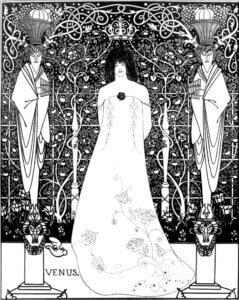
The protagonist is entranced by this sickly girl, who strikes him as a “modern poster-like invalid” and “weird embodiment of startling contrasts.” She grows even more fascinating for him when he shakes her hand:
This contact seemed also to have affected her as it did me; a clear flush, like a white flame, lighted up her face, so that it glowed as if an alabaster lamp had been lit; her black eyes became softer and more humid as our glances crossed, and her scarlet lips grew moist. She was a living woman now, while before she had seemed half a corpse.
He begins having dreams of Ariadne – dreams that somehow sap him of his energy in the waking world:
It was a rapid, distracting, and devouring infatuation that possessed me; all day long I followed her about like a dog, every night I dreamed of that white glowing face, those steadfast black eyes, those moist scarlet lips, and each morning I rose more languid than I had been the day before. Sometimes I dreamt that she was kissing me with those red lips, while I shivered at the contact of her silky black tresses as they covered my throat; sometimes that we were floating in the air, her arms about me and her long hair enveloping us both like an inky cloud, while I lay supine and helpless.”
While the narrator becomes more languid each morning, Ariadne’s health continues to recover. He remains entranced by her, and the two walk together by the moors at night. Then, after one such walk, the protagonist goes to bed and has another dream of Ariadne; but this time, she is distorted into a monster.
He dreams of being attacked by a bat with Ariadne’s face and hair, which bites his arm in what reads like an account of eroticised sleep paralysis: “I seemed chained down and thrilled also with drowsy delight as the beast sucked my blood with a gruesome rapture.” On the floor around him are the bodies of young men, each bearing a red mark on the arm. He then wakes from the nightmare to catch Ariadne in the act:
As I woke I saw her fully revealed by the midnight moon, with her black tresses flowing loosely, and with her red lips glued to my arm. With a shriek of horror I dashed her backwards, getting one last glimpse of her savage eyes, glowing white face and blood-stained red lips; then I rushed out to the night, moved on by my fear and hatred, nor did I pause in my mad flight until I had left miles between me and that accursed Cottage on the Moor.
“The Vampire Maid” shares a few elements with certain earlier vampire stories. The depiction of the vampire attacks as dream sequences recalls Carmilla, while the plot detail of the protagonist being drugged to sleep each night with a nightcap draught may have been borrowed from E.T.A. Hoffman. Yet despite this, what shines through most of all is Hume Nisbet’s visual imagination.
The vampire Ariadne is described in terms of graphic art. She is compared to the work of Aubrey Beardsley – an artist associated with the Decadent movement of the late nineteenth century – and also to modern posters, at the time under the sway of Art Nouveau and the elfin women that came with it. It should not be surprising that Hume Nisbet used art as a motif, given that he himself was a painter.
The theme of artwork is front and centre in another vampire story by Hume Nisbet, again published in 1900: “The Old Portrait.” This is, like “The Vampire Maid,” a brief story. The narrator is an artist who appreciates old-fashioned picture frames, and so buys low-quality paintings second-hand so as to re-use their frames. The protagonist’s latest purchase is a crude painting showing “the bloated, piggish visage of a publican… with a plentiful supply of jewelry displayed, as is usual with such masterpieces” – but, as it happens, this ugly image was not the first portrait on the canvas.
Noticing a marking under the coating of paint, the narrator realises that another image must lie below and decides to reveal it with wine spirits and turpentine: “I began to demolish the publican ruthlessly in the vague hope that I might find something worth looking at underneath.”
Sure enough, another image is revealed below – the bust and head of a young woman, painted “as only a master hand can paint… as perfect and natural in its somber yet quiet dignity as if it had come from the brush of Moroni” (this comparison indicates that we have moved from the Decadent era of Aubrey Beardsley to the Late Renaissance). The protagonist spends whole paragraphs describing the portrait, praising the woman’s intent face, white complexion, lusterless hair, and a black velvet dress that complements the gloomy background to form “symphonies of ebony… wondrously suggestive and awe-inspiring.”
Yet, as beautiful as the painting is, the subject has a disturbing quality:
It was an eerie looking face that I had resurrected on this midnight hour of Christmas Eve; in its passive pallidity it looked as if the blood had been drained from the body, and that I was gazing upon an open-eyed corpse. The frame, also, I noticed for the first time, in its details appeared to have been designed with the intention of carrying out the idea of life in death; what had before looked like scroll-work of flowers and fruit were loathsome snake-like worms twined amongst charnel-house bones which they half covered in a decorative fashion; a hideous design in spite of its exquisite workmanship, that made me shudder and wish that I had left the cleaning to be done by daylight.
As the clocks strike midnight outside, the artist falls asleep and has a dream of the woman emerging from her portrait:
I thought that the frame was still on the easel with the canvas, but the woman had stepped from them and was approaching me with a floating motion, leaving behind her a vault filled with coffins, some of them shut down whilst others lay or stood upright and open, showing the grizzly contents in their decaying and stained cerements. I could only see her head and shoulders with the sombre drapery of the upper portion and the inky wealth of hair hanging round.
The woman approaches the protagonist for a kiss, and the dream becomes a nightmare when the narrator describes a chilling effect: “As I breathed she seemed to absorb it quickly into herself, giving me back nothing, getting stronger as I was becoming weaker, while the warmth of m contact passed into her and made her palpitate with vitality.”
The painter then awakens to find that the portrait has transformed. Like the picture of Dorian Gray in reverse, it has gained health: the dark eyes now glitter, the once-white skin is now flushed with redness – and a drop of blood has appeared on the lower lip. The story ends with the terrified narrator slashing and burning the picture. “I have that frame still,” runs the final line, “but I have not yet had courage to paint a suitable subject for it.”
It is common for the motifs of portraits and reflections to turn up in vampire fiction, from Dracula’s invisibility in a mirror to the old family portraits that expose Carmilla and Varney’s longevity. As a painter, Nisbet tended more toward heavily atmospheric landscapes than figures. As a writer, however, he painted two striking portraits of the literary vampire.
Next: The Woman with the Oily Eyes…
