

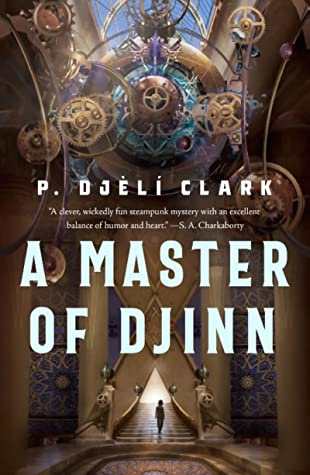
A Master of Djinn is the first full-length novel in the series that started with the short story “A Dead Djinn in Cairo” and continued with the novella The Haunting of Tram Car 015. The setting is an alternate timeline where Egypt was able to successfully rebel against the British Empire with the aid of magic attributed to the ninth-century author al-Jahiz.
This magic drastically reshaped the world: various subspecies of djinn now walk the Earth alongside humans, and magic has become so commonplace that supernaturally-controlled robots – “boilerplate eunuchs” – are everyday sights. The widespread existence of magic has also impacted the worlds of crime and of law enforcement.
This third trip to a djinn-filled Cairo kicks off when a certain Hermetic Brotherhood – a group of mostly-European occultists, led by Lord Alistair Worthington, who have adopted Egyptian trappings and iconography – receives an unexpected visitor. Clad in black, this man purports to be none other than al-Jahiz himself: “Masr has become a place of decadence”, he declares. “Polluted by foreign designs. But I have returned, to see my great work completed.” Whether or not he is telling the truth, he certainly has strange gifts: he is able to multiply his form as he lays waste to the Hermetic Brotherhood, finally wiping out the gathering in a deadly fire.
The Egyptian Ministry of Alchemy, Enchantments, and Supernatural Entities responds to this mass killing by sending detective Fatma el-Sha-arawi to investigate. While Fatma was introduced earlier in the series, she is here teamed up with a new partner named Hadia – a partner who she initially finds to be a little bit inexperienced, leading to some strife between the two as they learn to work together.
Hot on the tales of Project Hail Mary, A Master of Djinn is another pulp throwback in the running for the Best Novel Hugo. In contrast to the Campbellian hard science fiction of Andy Weir’s novel, however, Master of Djinn homes in on a very different area of pulp SF/F: an area in which derring-do is paramount and genre after genre can be cribbed from to provide the hero with a worthy toybox. In this case, author P. Djèlí Clark waves together elements from detective fiction, urban fantasy, occult literature, steampunk and the Arabian Nights in creating a glittering Cairo of alt-1912.
At the same time, the series carries out a surgically-precise removal of the uglier aspects of pulp adventure fiction. Many commentators on both the left and right have (for different reasons) argued that racism, colonialism and other such vices are inherent aspects of the pulp mode, but Clark’s Cairo stories run counter to this claim.
European colonialism is removed from the world before the story begins – this is surgery that comes with anesthetic – and we are left with a fantastical Egypt that is, crucially, viewed not as an exotic “other” but seen from the perspective of its inhabitants. These are people who have come to find everything from “thoroughly modern” women like Hadia in her sky-blue hijab, through to goat-headed djinn who wear tweed jackets and read newspapers, as part and parcel of their changing society.
This process of decolonisation is symbolised by the novel’s prologue, where the Hermetic Brotherhood – which resembles the real-world Hermetic Order of the Golden Dawn in its fetishism of Egyptian iconography as a shorthand for all things occultic – is portrayed as rather pitiful and anachronistic prior to being wiped out. “You know how Occidentals like playing dress-up and pretending they’re ancient mystics”, remarks Fatma’s liaison Aasim.
It would be a disservice to portray A Master of Djinn merely as a corrective to earlier, more reactionary pulp adventures, however, when it works so well as a good, ripping yarn in its own right. This is a cake with a tasty, three-layer sponge base in the form of the buddy-cop dynamic between Fatma and Hadia; the intriguing whodunnit narrative; and the rich cast of potential suspects. It then treats us with a thick, gooey layer of fantastical icing.
As the first full-length novel in the series, A Master of Djinn takes the opportunity to expand upon its setting. We see that Egypt is far from the only country where magic exists: China has its dragons; Kaiser Wilhelm II is accompanied by a Germanic goblin; and in America, magic is a means to fight back against racial oppression (“Benny and the others still whispered wide-eyed about a sorcerer named Robert Charles who’d nearly brought New Orleans to its knees. They claimed this Buddy Bolden worked another kind of magic with his music, and had suffered dearly for his gift”).
Cairo itself has also expanded. We are allowed to spend more time in the subculture of the so-called Idolators – those who cling to the worship of Egypt’s pre-Islamic pantheon. Fatma’s girlfriend Sita belongs to their number, as does a certain individual named Ahmad who styles himself high priest of the Cult of Sobek – and over time, starts to take on something of that deity’s crocodilian aspect.
There is a lot going on in A Master of Djinn, and such an onslaught of fantastic beings risks numbing the reader. But like all successful urban fantasies of this sort, the novel realises that it needs to show a spectrum of the magical.
Yes, it has its share of the demythologised supernatural: witness the comical, Pratchett-esque scene where an Ifrit is introduced to the concepts of philosophy and pacifism; or the creatures designed primarily as fetching bad guys in action scenes, like the ghuls stuffed with explosives. But there is yet room for wonder. The series has already established that, even in this djinn-haunted world, the existence of ghosts – discarnate spirits of the human dead – remains unprovable. A Master of Djinn applies a similarly hands-off approach to the world of the divine, hinting at the Egyptian gods and Abrahamic angels that may or may not be hiding just beyond the visible.
The figure of al-Jahiz is central: even if the individual who attacked the Hermetic Brotherhood was an imposter, al-Jahiz himself retains tremendous power as a symbol. The protestors who take to the streets following the attack do so in his name, after all: magic and politics are intertwined.
As an attempt to adapt the world of “A Dead Djinn in Cairo” and The Haunting of Tram Car 015 into a full-length novel, A Master of Djinn is a success. It works on its own terms as a self-contained story, and bodes well for future adventures in the series.
