

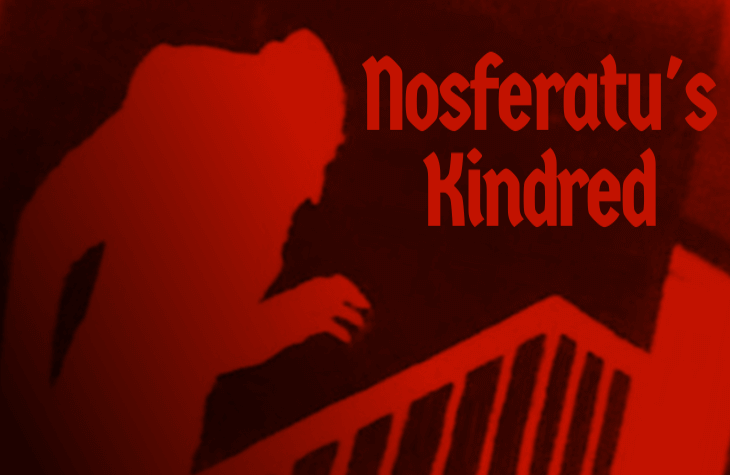
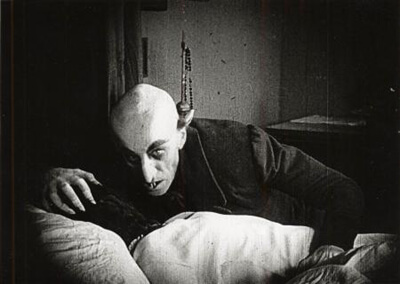
A century ago, in March 1922, the silent German film Nosferatu was released, and audiences were given an unforgettable display of the vampire legend’s continued endurance. A full-blooded adaptation of Bram Stoker’s Dracula, the film showed the advantages that German horror cinema had over its American counterpart: the closest thing to Nosferatu to come out of silent-era Hollywood was London After Midnight, a film in which the vampire was exposed as a fake.
This was not the first example of Germany being more forthright than the Anglosphere in terms of horror. The lineage of the English-language horror novel is typically traced back to Horace Walpole’s The Castle of Otranto, published in 1764; this tale of ghostly goings-on was deemed so suspect in its time that its author initially passed it off as a medieval manuscript that he had found. Meanwhile, the genre it spawned was given the rather quaint label of “Gothic story” – referring more to the architectural backdrop than the creepy and gruesome occurrences. Once the genre arrived in Germany, however, it received a straight-to-the-point term: Schauerroman, literally “shudder-novel”.
Small wonder, then, that Germany was also ahead of the curve in terms of vampires. This theme would not make its first significant appearance in English literature until 1819 with John Polidori’s story “The Vampyre”. By this time, however, German writers had already seen and exploited the potential of the vampire. The earliest literary ancestors of Nosferatu can be found in the poetry of eighteenth-century Germany.
Somewhat incongruously, the German verse-vampire made its debut in the 25 May 1748 edition of a scientific journal entitled Der Naturforscher. This may seem bizarre until we consider the wider context: as Rebecca Tille points out in her book Der Vampir als Element der Literaturgeschichte (2013) the journal’s editor Christlob Mylius was in the habit of printing poetry themed around the topics being discussed in the articles; and, circa 1748, vampires were quite topical. The previous decade had seen a spate of allegedly true vampire sightings, inspiring such volumes as Michale Ranft’s 1734 compendium of vampirism and Antoine Augustin Calmet’s 1746 dissertation on angels, demons, spirits and vampires. Something was clearly happening, and even if that something was no more than a mass delusion whipped up by bungled post-mortems and poorly-diagnosed diseases, it was still a legitimate subject of enquiry for a scientific journal.
And so, Der Naturforscher came to print not only an article about vampires but also a poem on the subject: Heinrich August Ossenfelder’s “Der Vampir”.
This poem has had a sketchy history in the English-speaking world. Montague Summers included it in his influential book The Vampire: His Kith and Kin (1928) but, uncompromising polyglot that he was, decided to keep the entire piece in German. A literalistic translation ran in Roxana Stuart’s Stage Blood: Vampires of the 19th Century Stage (1994). A 2005 Dictionary of Literary Biography volume focusing on Bram Stoker’s Dracula has a looser but more aesthetically-attuned translation of the poem; this has been published in many places in print and online – typically without any sort of attribution – and appears to be accepted as the standard English translation
The central character in the piece is Christianchen (a diminutive of the name Christine), who holds a firm belief in the teachings of her pious mother. The poem compares her faith to the belief held by Völker an der Theyse – that is, people who live near the river Tisza – regarding the existence of vampires. The poem’s narrator is attracted to Christianchen; but she does not return his affection, presumably because her mother disapproves of him. And so, he announces that he shall have a vampiric revenge: “Ich will mich an dir rächen/Und heute in Tockayer/Zu einem Vampir trinken.” These three lines have proved troublesome for English translators. Roxana Stuart renders them as “I will have my revenge on you/And drinking the Tokay wine [of your blood]/I will become a vampire”. The looser, more popular translation runs “Till I myself avenging/To a vampire’s health a-drinking/Him toast in pale Tockay.” He then declares that while Christianchen sleeps, he shall kiss her as a vampire – als ein Vampir – and drain the colour from her cheeks. The final lines of the poem offer a macabre description of the heroine sinking like a corpse – Gleich einer Todten sinkest – as the narrator asks her a final question: “Sind meine Lehren besser/Als deiner guten Mutter?” (“are my teachings better than those of your mother?”)
The poem does, in some ways, reflect its immediate cultural context. The vampire accounts that inspired it – the most prominent being the cases of alleged vampires Petar Blagojević and Arnold Paole – came out of Serbia and were documented in German by Austrian authorities, and so would have been associated with the beliefs of foreign lands outside but adjacent to the German-speaking world. Ossenfelder plays up this exoticism with a few brief references that cluster around Hungary – which, like Austria, fell under the Habsburg monarchy that also claimed Serbia as a province from 1718 to 1739. The poem compares the blood consumed by vampires to Tokay, a Hungarian wine; it locates belief in vampires near the river Tisza, which connects Hungary with Serbia; and it describes this belief as “Heyduckisch” – literally, “like a hajduk”, a hajduk being a variety of militiaman associated with Hungary and Serbia.
The poem does, however, depart from its source material in one major respect: Ossenfelder makes his vampire an erotic figure. The accounts coming out of Serbia, describing bloody corpses emerging from their graves to feed upon villagers of varying age groups and genders, were not particularly sexual in connotation; yet “Der Vampir” finds in them an apt symbol for the destructive urges of an unrequited lover.
This metaphor has since proven itself to be a durable one. In the following century, John Polidori would stumble upon the idea of using the vampire to caricature the womanising ways of his acquaintance Lord Byron; since then, the fatal lover has been a role shared by many of the best-known vampires on page and screen. This twenty-four line poem, published simply as a diverting appendix to an article in a German scientific journal, laid out the bare elements of a genre that continues to thrive today. What Nosferatu did for vampire films, it could be claimed that “Der Vampir” did for vampire literature.
Next: How Gottfried August Bürger wrote one of the most significant vampire poems never to mention vampires.

