

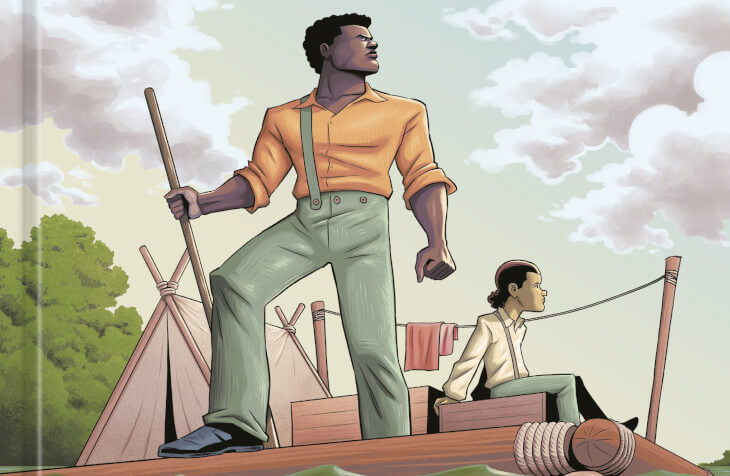
You thought you knew the story – a 14-year-old boy escapes his abusive father to go on a grand-adventure with an enslaved man accused of murder. But what if Mark Twain’s Adventures of Huckleberry Finn told the wrong story? Big Jim and the White Boy revisits Twain’s classic tale from a fresh perspective and a historical lens.
Big Jim and the White Boy: An American Classic Reimagined
Marcus Kwame Anderson (Artist), Isabell Struble (Colours), David F. Walker (Writer)
Ten Speed Graphic
October 15, 2024
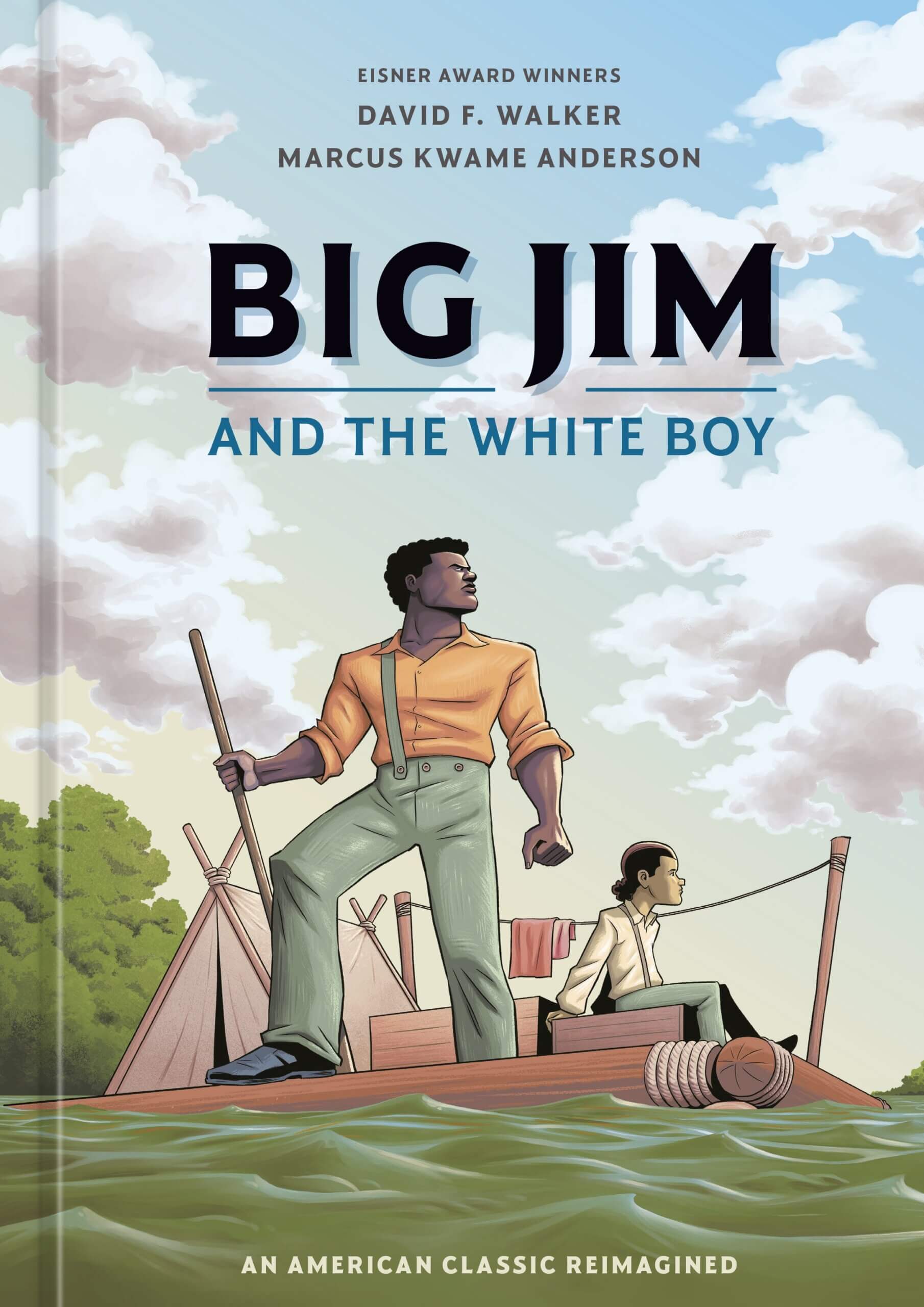
Big Jim and the White Boy is the Adventures of Huckleberry Finn like you’ve never seen it before. In this book, runaway slave Jim takes centre-stage as the hero of the story, equally a protector of ‘Huck,’ and a man on a mission to save his family. How does this story of love, loss, racism, and humanity retell Mark Twain’s classic with Jim as its protagonist?
I grew up obsessively reading Mark Twain’s The Adventures of Tom Sawyer. I hadn’t actually read Adventures of Huckleberry Finn and remember being surprised that Sawyer’s weird friend had got a book of his own. I did read the book in anticipation of Big Jim and the White Boy, and I’m relieved I never read it as a child. This book has not aged well. Like, at all! The derogatory use of the n-word and the caricature of Jim as uneducated and docile makes it practically unbearable to read. The book is screaming for an upgrade and a change of perspective.
That’s what Big Jim and the White Boy does—it centres Big Jim by giving him a backstory, a family, and an actual connection to Huckleberry Finn while grounding Twain’s adventure tale in the harsh realities of the 1850s. For readers who may be alarmed by the use of the n-word in the original, be warned that this book also uses it. However, I appreciate writer David F. Walker explaining why he included the word in the introduction for the book. There’s historical context to preserve, while erasing the word entirely makes it easier to forget that racism existed. In the copy I was sent, the word was crossed out, so I knew it was there and could better identify the vile characters using it, but was provided some distance from the slur.
Big Jim and the White Boy employs a non-linear style of story-telling to show readers the history of the American Civil War and US race-relations through events in the 1850s–which is when the original book was set–the 1930s, where a 101-year-old Jim tells his great-grandchildren about his adventures with Huck; in the 1980s, where young Almena Burnett learns about ‘Papa’ Jim from her grandmother; and the 2020s, when Almena, now a professor and author, shares Jim’s story with us and the world.
In the original book, Jim was known only in relation to Huck. But in this book, through Jim and his descendants’ eyes, we see him as a strong man with a great deal of love for his mother, sister, wife, and children. We also see him as a man who opposes the subjugation he and his loved ones have been forced to live under. This is a politically-charged retelling that doesn’t hold back from the horrors of slavery—be it the physical violence, sexual abuse, lynchings, or family separations. The parts of slavery that Adventures of Huckleberry Finn glossed over drive much of the story here.
Big Jim and the White Boy introduces Jim and Huck during a pivotal and familiar moment from the original book—living on a raft, Jim and Huck encounter the Walter Scott, a steamboat that’s crashed against some rocks. But unlike the story that was written by Twain, in this retelling, Jim is the one to jump on the boat in search of provisions. Through this boat adventure, the book establishes the dynamic between Jim and Huck. Jim, the cautious, strategic go-getter, and Huck, the adventurous spirit who leaps before he looks. It’s a dynamic that runs through the graphic novel and forms the basis of much of the hilarious banter between the pair as they get older.
But this book also unpacks the rewriting of history that was achieved through books by Mark Twain and his fellow authors, as well as by Confederate sympathizers. The sections of Big Jim and the White Boy where Almena is educating her students—and as a result, the readers of this book—will be particularly informative for anyone curious about the whitewashing of American history.
There are parts of Big Jim and the White Boy which are tough to read, and anyone who doesn’t flinch reading the depictions of slavery should probably get help. Equally affecting are Almena’s forays into the history of her family—there’s a classic 9-panel comic page that made me feel like I was in the room with Almena, listening to her talk about Jim. This book is much more than just a retelling of Twain’s book—it’s a celebration of the character of Jim and everyone whose story never got told. The last page of the book drives that point home, and it made me tear up. Because there are so many stories that have not been told. Yet!
Big Jim and the White Boy is a marvel of the graphic novel format. Not only does the creative team expertly wrangle four different timelines, but they’ve given the book several narrators who use the power of oral storytelling to share stories through the generations until it reaches us, the reader. Walker has crafted a tale that will resonate with so many people in North America, but also beyond. Marcus Kwame Anderson’s luscious art brilliantly captures the different eras the characters inhabit with Isabel Struble’s colours bringing the locations and people of this book to life.
If you love classics, history, or a good story that will make you think and feel, Big Jim and the White Boy is what you need. I was emotional reading it. I was also angry and sometimes despondent. But this book gave me hope because it exists, and there are people who are going to read it and see themselves in it. Which could be the starting point they need to tell their own stories.
