

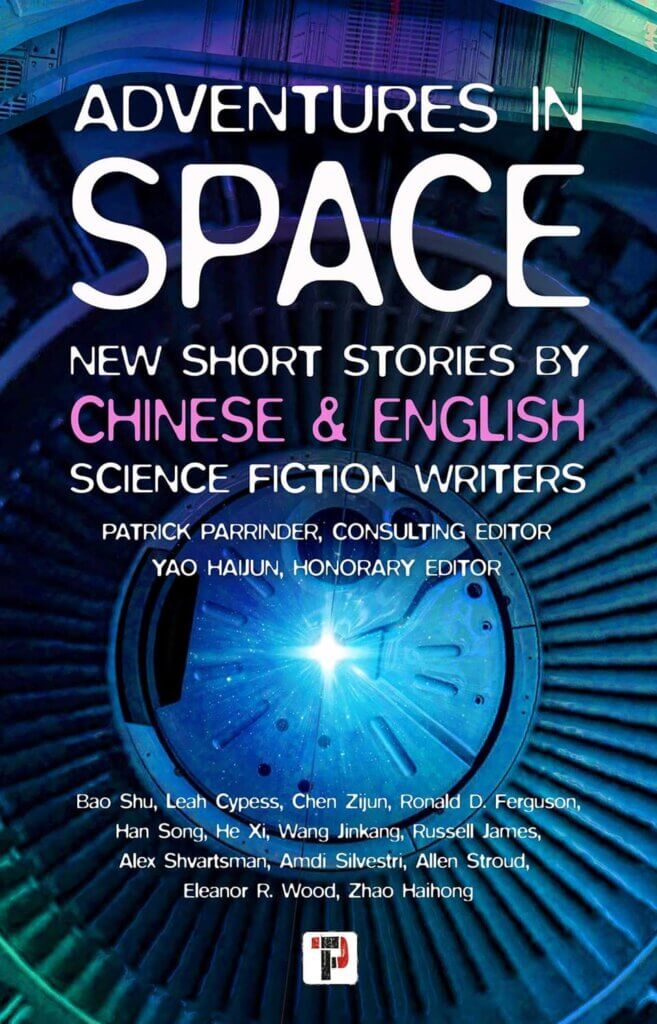
Last year, Flame Tree Press published Adventures in Space: New Short Stories by Chinese & English Science Fiction Writers. In this anthology, consulting editor Patrick Parrinder and honourary editor Yao Haijun assembled a set of Chinese stories, all newly translated by Alex Woodend, and placed them alongside new (or, at least, fairly recent) English-language work by American and European authors.
The book gained newfound relevance this year when three of its Chinese stories became finalists for the Hugo Awards. Indeed, it is by virtue of their English translations appearing in this volume that they were eligible for the 2024 Hugos, their original publication dates ranging from 1995 and 2010. The stories in question were written by Wang Jinkang, Han Song, and He Xi, a group of heavy-hitters who, in China, share reputations as members of science fiction’s “Four Heavenly Kings” (the remaining member of the group, Liu Cixin, is not found in Adventures in Space, although he is represented on the Hugo ballot by a comic adaptation of his work).
For those unaware, members of the 2023 Worldcon – which was held in Chengdu, China – were eligible to nominate for the Hugo Awards at the 2024 Glasgow Worldcon. As a result, this year’s Hugo ballot contains a mixture of Chinese and English-language stories, with a total of five Chinese works in the prose fiction categories.
As a result, the Adventures in Space anthology and the 2024 Hugo Award ballot share a similar transcultural ambience, each representing a meeting point between the Anglophone and Sinophone science fiction worlds – each of which has, in turn, been shaped by outside influences as well as local traditions.
Taking a close look at the three Hugo finalists of Adventures in Space – “Seeds of Mercury” by Wang Jinkang, “Life Does Not Allow Us to Meet” by He Xi, and “Answerless Journey” by Han Song – a remarkable detail emerges. While the works clash with the tone of typical Hugo-nominated works of recent years, they would have been right at home in an earlier era of the awards. Their tone harks back to the time when English-language SF was dominated by its own “Heavenly Kings” – Campbell, Heinlein, Clarke, and Asimov – who brought with them nuts, bolts, and a sense of wonder.
So, with a particular eye on the Hugo contenders, let us take a closer look at Adventures in Space…
Adventures in International Space
While we should be wary about reading too much into the cultural implications of the stories chosen for publication – which are, after all, shaped ultimately by the personal tastes of the individual editors – it is notable that the Anglophone stories tend to share a certain dourness and doubt, the romanticism of Golden Age SF having long since faded.
Amdi Silvestri’s “Minuet of Corpses,” built around the eerie discovery of weird alien bodies drifting in space, begins with its protagonist monologuing about the words famously attributed to Socrates: “I Know that I Know Nothing.” Russell James’ story “The Emissary” is even more forthright, opening with its protagonist meditating on how, back in the early 1970s, he would watch space launches with excitement and awe – emotions that he no longer feels now that his dreams of becoming an astronaut are crushed.
Granted, that particular character’s life soon becomes more interesting when he is abducted by men in black and forced into a secret mission involving extraterrestrial life. But even so, it is hard to miss a certain fatigue that runs through many of the book’s English-language stories, as though they are haunted by J. G. Ballard’s famous 1979 observation that the Space Age is over.
Take, for example, Alex Shvartsman’s “The Race for Arcadia,” about a terminally ill astronaut heading for an Earth-like exo-planet to ensure that Russia can finally win a space race. The story begins with an oft-repeated anecdote about NASA wasting its time developing a special space-pen when the Russian space programme understood that the humble pencil would be sufficient; Shvartsman then skewers this as a myth, summing up the general approach of a story that deliberately avoids romanticism, sentimentality, or whimsy. Rather than a heroic martyr, the astronaut is depicted as an unfortunate man ground up to provide the oligarch class with a propaganda coup. Also focused on the human cost behind each Giant Leap for Mankind is Allen Stroud’s “The First,” in which astronauts who believe themselves to be the first on Mars meet the survivor from an earlier expedition carried out in secret.
If the future looks bleak, then one viable response is to revisit tried-and-true themes of past SF. Ronald D. Ferguson’s “Cylinders” is written from the perspective of an android designed to act as a surrogate father; the girl he looks after has now hit her teens and, if this were not trouble enough, the two become embroiled in mysterious acts of sabotage. The story is heavy on machinery and light on characterisation, with much of its emotional heft reserved for the final twist; while well-composed, it offers little new.
The Chinese stories chosen for Adventures in Space are a different matter. They look forward to a Space Age which, for all of the hazards that it might pose, is still worth striving for.
Representing a strain of hard SF is Chen Zijun’s “Shine.” This takes a premise broadly similar to that of Andy Weir’s The Martian (a lone astronaut is stranded and Earth’s space forces attempt a rescue), adds a network of competing agendas among the earthbound characters, and tackle the possibility of life on Europa. The result is the sort of science fiction that includes footnotes to clarify some of its technological concepts.
But there is more to these tales than a Gernsbackian fascination with gadgets; for proof, we need only look at “Doomsday Tour” by Bao Shu (an author who, incidentally, also made the 2024 Hugo ballot, albeit for a different story). Originally published in 2013, this is a riff on the theme of the 2012 apocalypse: humanity has decided that the world will be destroyed, even though nobody knows exactly how. Although it reaches an outrageously comedic conclusion involving aliens, the story also achieves some genuinely poignant moments as various characters quietly observe the last days of planet Earth.
So, the two traditional poles of hard SF and emotionally-driven narratives are clear to see – and between them, we find the three Hugo finalists: “Seeds of Mercury” by Wang Jinkang; “Life Does Not Allow Us to Meet” by He Xi; and “Answerless Journey” by Han Song.
“Seeds of Mercury” by Wang Jinkang
Wang Jinkang’s story is set in 2032 (bear in mind that it was originally published in 2002) and opens with successful businessman Chen Yizhe receiving an unexpected inheritance. His late aunt, a scientist named Sha Wu, has bestowed upon him a project that she left incomplete at the time of her death – a nanotech lifeform:
“This is the amoeba Ms. Sha created, some kind of nanomachine or nanolife. Self-organizing activity at this scale integrates the two concepts of machine and life into one,” Mr. He said. “It’s hundreds of nanometers in dimension, can replicate itself, can metabolize with the outside through the membrane. But it eats food just to provide materials, especially solid-phase elements, to repair its body, not to provide energy. It actually feeds on light. On its membrane there are countless photoelectric converters which propel its internal metal ‘muscles’ to move with electric energy.”
I gazed closely at the screen, mumbled, “Unbelievable, really unbelievable!”
“Yeah, completely different from life on Earth. The way it dies and reproduces is even stranger. An amoeba’s lifespan is only twelve to sixteen days. During this period, they wiggle, eat, grow, then curl into a ball to harden their shell. In the hardened shell, matter ‘explodes’ and reassembles into several small amoebas. As for how information passes to the next generation during the explosion, Ms. Sha was unable to figure out before her death.”
There is one drawback to Chen’s involvement. The research is costly, and keeping the nanotech beings alive will require spending his current wealth. Nevertheless, he agrees, and becomes embroiled in a project that will lead the nanobots to an ecosystem in which they can live and thrive without human aid: the surface of Mercury.
The near-future story of Chen is interspersed with a narrative of the far future. Here, Chen’s aunt Sha Wu has become mythologised as the Great God Shawu, a being who originated “on Father Star’s third star” before travelling to a new world, Planet Shawu, and creating life there. An entire church, complete with scripture and moral mores, is focused on this deity:
On the way to the North Pole, Tu Lala saw countless drop-dead – generations of devout believers, which according to the teachings of the Holy Book had followed the holy ropes from the holy altars to the North Pole in search of the God Shawu’s Holy Palace. As they slowly moved away from Father Star’s illumination, their physical energy gradually drained, and finally they collapsed. Regarding these drop-dead, the Church had always been deeply reticent. Because before dying those people hadn’t found a death partner, hadn’t exploded, their souls would not reincarnate. This was the first major sin of the three sins in the holy commandments (Though [sic] shalt not drop dead, shalt not believe in false gods, shalt not touch holy altars or holy ropes). But these people were also respectable martyrs. Should the Church damn them or praise them?
“Seeds of Mercury” confines most of its hard SF elements – the basic workings of the nanobots, the engineering issues that they raise, the reason for them being suited to the climate of Mercury – to its early portions. After this, the story’s main focus is on social attitudes.
In the Chen narrative we are shown the world’s reaction to the development of the nanobots, a matter treated with a degree of humour. When Chen appears on a TV talk show and discusses the prospect of the nanobots eventually evolving into sapient life, the host quips that humanity would become “a four-billion-year-old grandpa [with] a ten-million-year-old grandkid – too distant even for love, how could they compete?”
The Mercury sequences, likewise, go into comparatively little detail about the nature of the artificial life (aside from certain specific details, such as the implications of their requirement to destroy themselves as part of reproduction) and instead follows their religious development. When we meet them, they are in the throes of a Darwinian revolution, having hit upon the idea that they are the products of evolution. Yet they are also faced with the fact that their holy text – which, as the reader knows, is a distorted account of their actual origin on Earth – has so far tallied up with their astronomical discoveries.
Both strains are characterised by a giddy enthusiasm for invention, discovery, and exploration, with narrative conflict generated by the more aggressive aspects of society. The nanobot beings have religious dogmatism, while Chen’s endeavours have benighted human attitudes. The latter theme is handled in a somewhat shaky manner via the not-entirely-convincing character of Hong Qiyan, Chen’s Stephen Hawking-esque financier.
The story establishes that the hostility Hong receives for his disabilities has left him a misanthrope. In a questionable piece of pop-psychology, the combination of his essential optimism and his resentment towards humanity is presented as his motive for giving sapient life a fresh start on Mercury. “A malformed body may make for a malformed personality,” says one character. “His mind is dark, resentful of all normal people, but his nature is kind, born with a benevolent heart. He is a bundle of deformities, but a cocoon of benevolent love encompasses his desire for revenge.”
“Seeds of Mercury” has its shortcomings, but these are shortcomings that have been prevalent in science fiction for decades, if not centuries: its imagination outstrips its grasp of humanity.
“Life Does Not Allow Us to Meet” by He Xi
He Xi’s story starts out steeped in intrigue, with the two reader-identification characters stealing data from a research facility. This turns out to be a hook for a much broader narrative, the pair soon meeting the real protagonist – who happens to share the author’s name, He Xi.
The ensuing narrative leans further into hard SF than does “Seeds of Mercury.” It focuses primarily on an attempt to colonise a planet called Caspian Sea with the aid of genetically-engineered humans, dubbed “pioneers,” a project that is introduced via lengthy discussions among the earthbound characters. Through these, the story takes its time to articulate such concepts as wormholes, terraforming, quantum communication, and the understanding of animal intelligence as applied to extraterrestrial life. Occasionally surfing amongst the scientific discourse is a dash of emotional melodrama, with the He Xi character reminiscing about the woman he loved, an astronaut named Yu Lan:
“Know where I’m going?” Yu Lan’s voice was as sweet as the sound of a wind chime. “Caspian Sea, in Orion, which ancient Chinese called Shen. And you are going to Bohai, in Lyra, which ancient Chinese called Shang.”
He Xi suddenly understood something. Life does not allow us to meet. Like Shen and Shang, we go separate ways. Shen was in the west, Shang was in the east. When one rose, the other set. For eternity they couldn’t meet. For hundreds of years, people on Earth had never seen Shen and Shang at the same time.
Yu Lan let out a fatalistic sigh inside.
Of the various concepts examined in the story, the most significant turns out to be the clash between optimistic versus pessimistic stances on humanity’s (still hypothetical) first contact with intelligent alien life. The optimistic viewpoint is that sapient species can coexist in harmony; but the pessimistic counter-opinion, which the story establishes as having been accepted by the Earth Federation, points to the tooth and claw of nature along with Earth’s own genocidal history and concludes that, if humans meet intelligent aliens, then it will be a kill-or-be-kill situation.
The story’s intricate conceptual puzzle-pieces all come together to reveal a chilling question: once the genetically-engineered pioneers have served their purpose in preparing Caspian Sea for habitation, a process that has given them time to build a society of their own, will Earth deem them too alien to keep alive? The climax places He Xi and his love interest Yu Lan, now reunited at long last, at opposite sides of this moral chasm.
“Answerless Journey” by Han Song
Reading through Adventures in Space, it is hard to miss how many stories involve the characters having their entire reality pulled out from beneath them.
Leah Cypess’ “On the Ship,” set on a spacecraft for refugees, is written from the viewpoint of a child who is unclear as to exactly what her people are fleeing – and has a major surprise in store for her when she finds out. Zhao Haihong’s “The Darkness of Mirror Planet,” which segues from a tech-driven to a philosophy-driven narrative as its astronaut protagonist meets a mind-reading doppelganger, has a similar twist; and Eleanor R. Wood’s “Her Glimmering Façade” is about a character waking up in an unfamiliar and baffling location.
Which brings us to Han Song’s “Answerless Journey,” the only one of the anthology’s reality-questioning stories to make the Hugo ballot.
Here, the occupants of a crashed spacecraft try to piece together exactly what happened, their memories being so badly damaged that even their species is a matter of uncertainty (the main character identifies himself as Creature and his companion as Same Kind). Are they explorers, fugitives, or subjects in some sort of test? Is their predicament the result of an accident or something deliberate? And what should they make of the evidence that a third crew member was at one point aboard their ship? The story is a lot shorter than the other two Hugo finalists (it was up for Best Short Story rather than Best Novella) and further analysis will risk giving away the plot, but suffice to say that in his case, the process of scientific inquiry leads to some grim places.
Looking to the Future(s)
Returning to the 2024 Hugo ballot, we find that, as has been the case for some time, the English-language works encompass a mixture of fantasy and science fiction. Aliette de Bodard and Ann Leckie revisit their successful space opera universes; Ai Jiang and Naomi Kritzer tackle the topical theme of AI; and P. Djeli Clark pays homage to the anti-colonial themes of Jules Verne. Elsewhere, T. Kingfisher reimagines Sleeping Beauty while Rachael K. Jones uses motifs from children’s fantasy to articulate the all-too-real subject of school shootings. Encores from favourite authors, return visits to past classics, and contemporary social issues to grapple with – all of this is what twenty-first-century Hugo-watchers will have come to expect and appreciate.
The three finalists that appeared in Adventures in Space have a different feel to them. They hark back to the spirit of 1953, the year in which the Hugos were first founded: a time when the space race lay in the future and there were still new worlds to explore. And this is no bad thing. The more variety in how the future is envisioned, the more vital the Hugo Awards will be.
