


This summer, whether you want a young adult murder mystery set at a summer job, engrossing sci-fi full of future tech, or a bad girl hell-bent on revenge, there are great options headed your way. Maureen Johnson’s Death at Morning House; Codie Crowley’s Here Lies a Vengeful Bitch; a new edition of The Fortunate Fall by Cameron Reed; and North Continent Ribbon, a collection of linked stories by Ursula Whitcher, are all worth getting excited about ahead of time.

I stayed up way too late finishing Death at Morning House, a new standalone YA mystery by Maureen Johnson coming out August 6th from HarperCollins. It is a ton of fun.
Johnson follows the now-familiar formula she developed in the Stevie Bell books, wherein chapters alternate between narrating the events of a historical murder and the contemporary teen learning about what happened. Tensions mount in both timelines. In Death at Morning House, our point-of-view character is Marlowe, a smart, observant, and hilarious girl with a giant crush on her classmate Akilah. On their very first date, Marlowe accidentally sets the house on fire with an exploding overpriced scented candle, and mortified, takes a job for the summer on a remote island.
While Marlowe is jokingly self-deprecating, she’s actually really smart and socially competent and a joy to hang out with for a few hundred pages. When she gets to the island, she meets the other teenagers working there as well as the scholar-in-residence researching the deaths that took place on the island decades ago. The scholar asks Marlowe to tell her if anything about the other employees seems … “off,” and this ominous tone ramps up as threats materialize in their current day. I was wrong about who the murderer was in the contemporary timeline and the 1932 one! Both were well-constructed, satisfying solutions to the mysteries.
Death at Morning House will be a perfect summer camp read.
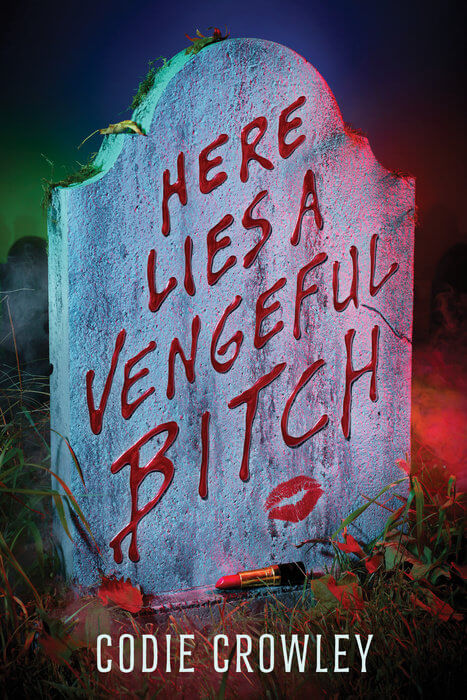
Here Lies a Vengeful Bitch by Codie Crowley also comes out on August 6th; it’s a good day for YA intrigue plots. In Crowley’s novel high school student Annie Lane wakes up in the river; cold, wet, and without relevant memories of the previous night. She claws her way onto the bank, spewing water and algae, knowing only that she was with her shitty ex-boyfriend at the club. Whatever that asshole did to her, she’ll get revenge, she vows.
Stumbling back into town, she meets up with a group of sweet misfit teenagers who have made their home in an abandoned building nearby and speak in 1950s slang. They help her out.
As Annie fights to keep from dissolving, she smokes their cigarettes, drinks their liquor, and gets a ride back into town to confront her ex. She quickly learns, however, that her best friend Maura is missing, and Annie’s rebellious reputation means she is suspected in the disappearance. The stakes are raised.
What happened to Maura? For that matter, what really happened to Annie? How was Annie’s ex involved? Will Annie’s abusive mom fuck right off? Was Annie’s outfit of a black slip with a flannel over it stolen directly from my own teenage closet? Why the hell did Annie’s ex call his band Werewolf Fetus?
These questions will keep you reading, riveted to the page. It’s a fast-paced and satisfying read from Disney Hyperion. And it has way more swears, sex and violence than I ever would have expected from the publisher Disney Hyperion, though the group Annie befriends does have some Lost Boys [as in Peter Pan, not the vampires – Editor] vibes. Basically, if the title appeals to you, the book delivers.

The following week, The Tor Essentials Edition of The Fortunate Fall by Cameron Reed will come out on August 13, and I’m so glad it will. This 1996 cyberpunk novel is absolutely due for star treatment in a reprint. It feels devastatingly timely, and the writing is beautiful and fresh. The dialogue is terrific. The Fortunate Fall takes place in a dystopian future, where human bodies are dripping with tech, and surveillance and regulation is both pervasive and invasive.
Our main character is a Camera: a journalist whose job is to record her experiences via brain implants and broadcast her personal associations and reactions to things along with her sensory experience of them to an audience. She tells us in chapter 1 that we all think we know her story because we’ve slotted her famous recordings into the ports in our heads, but she’s going to write down the whole story to set the record straight.
That declaration sets the reader on a trajectory of investigation, as Camera chases down the lead for the story of her lifetime, uncovering shocking realizations about her personal history and her world along the way.
This edition has an introduction by Jo Walton, who mentions what it feels like to go back and reread the first chapter once you finish and know the end. Reader, I immediately did this, and it was so satisfying. I highly recommend this book!
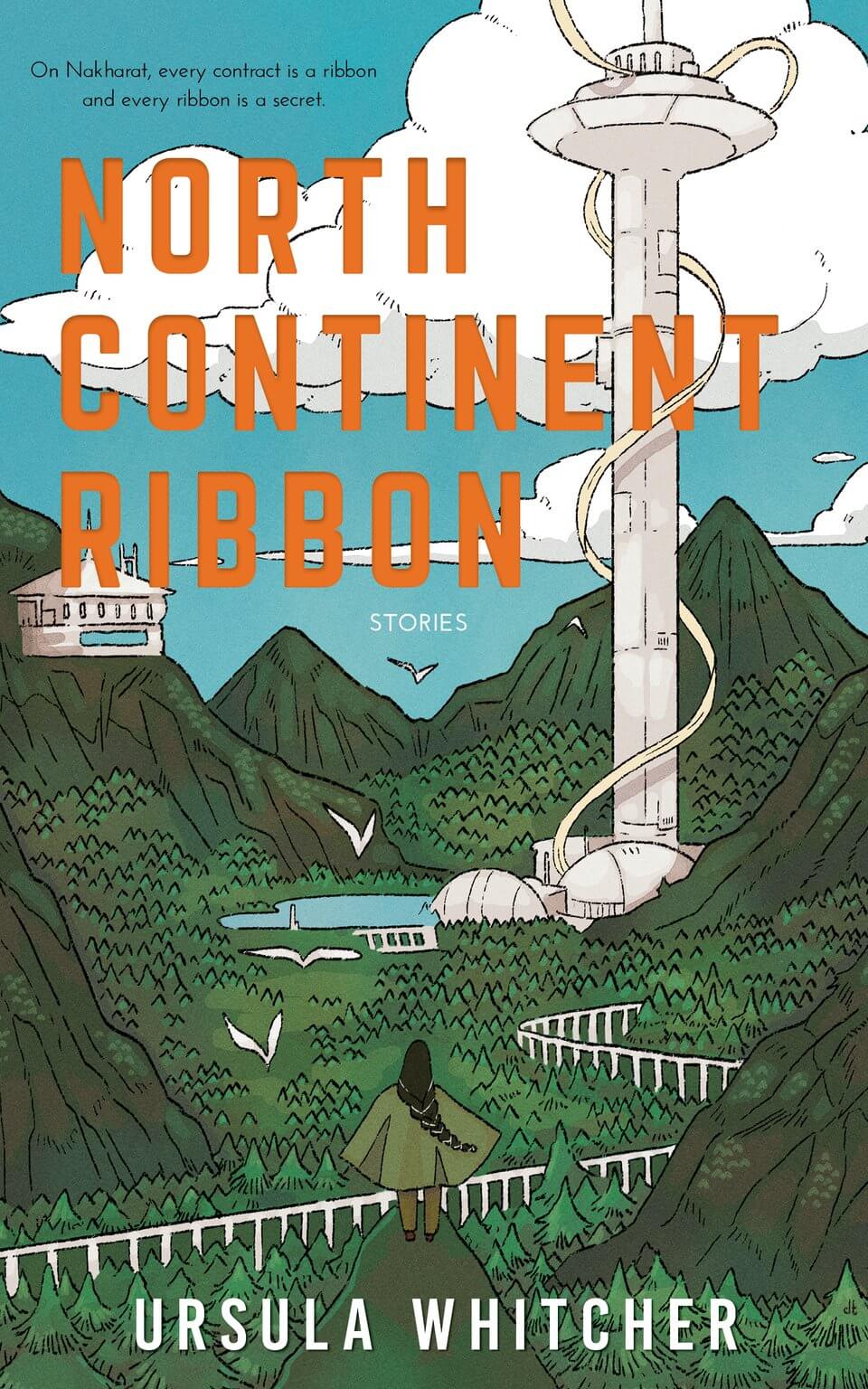
North Continent Ribbon by Ursula Whitcher, which comes out from Neon Hemlock on August 20th, presents another kind of tech-drenched future. The book is a collection of six linked short stories illuminating the far-future world of Nakharat, where contracts, advanced technology, and corporate fealty shape people’s lives. On Nakharat, once you leave childhood, you begin to braid your promises, in the form of colored ribbons, into your hair. Remove someone’s turban or headscarf and you see their life’s allegiances color-coded on their head.
Truly, a society in which everyone’s hair is so big because it is full of secrets. These ribbons indicate all kinds of commitments—familial, corporate, romantic, military—and Whitcher’s stories deal with the intersections of these ties that bind.
North Continent Ribbon spotlights characters across the spectrum of its populace in its linked stories. Everyone from judicial authorities to a sex worker, from military grunts to corporate Company elites, gets a part to play. As the stories unfold, readers get a rich and nuanced view of Nakharat culture that will appeal to fans of Ann Leckie and Arkady Martine.
The first three stories could be loosely categorized as love stories, about choosing personal connection over the “right” career move or political strategy. Then the rest focus more on charting the rise of challenges to the status quo on Nakharat. However, because Whitcher’s characters are so fleshed out and her worldbuilding so thorough, they are all personal; they are all political.
I already knew Ursula Whitcher (who has the absolutely ideal name for speculative fiction authorship) was an excellent writer from reading her book reviews, and it’s fabulous to see that skill carry over into fun, engrossing fiction. When I read collections of short stories, I try to pace myself and read one story per day. With this collection, I could not pace myself, and finished the whole thing in two days. You should feel warned that you’ll get sucked in.
I hope you enjoy the reading August has in store for you!
