


Anybody familiar with the weirder corners of Reagan-era pop culture must surely be aware of a notorious group by the name of Bothered About Dungeons & Dragons (BADD). Founded in 1983 and incorporated as a non-profit entity the following year, BADD was built on the premise that fantasy role-playing games were turning youngsters towards black magic and Satanism.
In an introductory letter, the group boasted of appearing on media platforms from The 700 Club to Newsweek and offered a range of materials to concerned parents and even law-enforcement personnel. Behind the group’s bizarre ramblings about “the worship of occult gods in role playing situations” lies a real-world tragedy. BADD’s founder, Patricia Pulling, lost her 16-year-old son to suicide; the letter asserts that the boy’s death was “directly related to the game of Dungeons & Dragons.” Exactly how this suicide was related to role-playing is not explored in the text, yet the association stuck within the religious right. Jack Chick’s much-ridiculed comic tract Dark Dungeons, published two years after the founding of BADD, depicts a teenage girl hanging herself after her character dies in Dungeons & Dragons.
As per usual with moral panics, all of this faded from view as the years passed and finally ended up looking rather quaint. Yet the spirit of BADD never died; it merely migrated to different issues and different media.
If you spend enough time looking at the commentary of the gender-critical movement, members of which believe that children are being “groomed” by a pernicious transgender lobby, you will find statements that could almost have come from Patricia Pulling’s group. A few terms have been switched around as though in a game of Mad Libs, but the thrust is the same. Teenagers are no longer being turned into Satanists by Dungeons & Dragons; rather, we are told, they are being turned transgender by anime.
From BADD to PITT
A rich vein of such material can be found in a Substack newsletter by the name of Parents with Inconvenient Truths about Trans (PITT), which has over 12,000 subscribers. Here, transphobic parents of transgender youth write anonymously about their experiences and share theories as to what caused their children to fall, as the proverb goes, so far from the tree.
Typical of the newsletter’s content is a post from January 2023, originally written as a guest contribution to the Substack of screenwriter-turned-gender critical figurehead Graham Linehan, entitled “How to deprogram a ROGD teen.” “ROGD” stands for rapid-onset gender dysphoria, the dubious and controversial hypothesis that a social contagion is causing young people to adopt transgender identities. The author offers a number of steps by which ROGD can be cured, one of which is to “Turn off the Poison Tap:” that is, to prevent teenagers from stumbling into such rabbit holes as “porn, gender ideology, perverse anime, etc.” As well as general comments like this where the author describes in tones of fear and disgust the social circle in which her ROGD-deprogrammed teenager once moved:
One ex friend deserves special mention. She is the most dangerous trans ally of all, an active recruiter. She calls herself non-binary but makes absolutely no effort to present as anything other than sexy anime girl.
These contemptuous references to Japanese animation recur across PITT’s descriptions of trans youth subcultures. Searching the newsletter’s archive for “anime” will turn up 39 articles; to put that in context, a search for “movies” turns up only 20 hits.
In the March 2023 post “My Son’s Story, and the Breakdown of My Family,” a parent relates how their 19-year-old came out as trans and the events that followed. An example given of the teenager’s social difficulty is that they were “on the internet constantly, and obsessed with Anime, cosplay and role-playing in addition to a lot of comic-style pornography.” In the May 2023 post “Forks in the Road,” a parent tells us about their trans 16-year-old, who “has been trans-identified for over 2 years now, starting with middle school peer group influence, and the customary deep-dive into internet/social media/anime during Covid.”
Another article from the same month, “No Contact,” is by a parent trying to diagnose the cultural influences on their transgender 18-year-old; the author touches upon school classes, drag queens, video games and – once again – anime:
How do these anti-parent voices penetrate through to our children? There are lots of vectors, it turns out: pornographic books in school libraries, drag queens teaching sex classes […] He loved video games and playing with his male friends. He never had female friends. I never imagined that there would be porn or trans ideas embedded into all these video games. How naive I was. It didn’t occur to me that anime would plant the next idea. I thought anime was innocent.
It goes on. A June 2023 post, “Now it’s Time to Save our Brothers!,” promotes an upcoming documentary that will “delve into the differences in what drives a boy or young man to seek to transition, from anime and porn to neurodivergence and the effects of societal influences on the male psyche.”
Some of the PITT articles have an overtly religious aspect, making the similarities to BADD all the clearer. In “I Cry on the Beach” from July 2023, a father relates his struggles with a transgender child of around 30: “we see his body as the Temple of the Holy Ghost, not to be defiled with blockers, fake body parts and genital amputations.” And where did the idea for this defilement come from? Japanese animation, it would seem: “This interest spread into anime during his pre-teen years. I would not have allowed these types of child entertainment had I known what I know now.”
All of the above posts are from 2023, but PITT’s preoccupation with a supposed connection between watching anime and becoming transgender predates that year. The April 2022 post, “Texan parent, trapped in the middle,” laments that: “These kids are influenced by pornography, anime and social media. But you can’t get anyone in mainstream media to talk about any of this.” A post from the same month, “Death Cults and Unicorns,” mentions: “social contagion… beginning with a penchant for Anime, as in so many cases.” The author of “Becoming a light for our wayward son,” an August 2022 post, briefly mentions that their 15-year-old trans daughter’s new persona “appears to be more like an anime character than an actual woman.”
A particularly remarkable post is “Bowing to Gessler’s hat,” from December 2022, which includes anime in a list of inherently negative influences on youth: “Years of bullying, frustration, teenage angst, porn, anime, brainwashing in school and social media, and lockdown isolation had damaged my child in a way I could not have imagined.” Also noteworthy is the September 2022 post, “Be Prepared: The Boy Scouts Motto,” which takes aim at Magic: The Gathering, the fantasy card game described as “another trans gateway drug similar to anime.” In the evolution from BADD to PITT, this post could almost be a transitional fossil.
The narrative shows signs of spreading beyond PITT. A website called ROGDboys.org, which lists PITT articles as sources, includes this detail on its profile of boys deemed susceptible to rapid-onset gender dysphoria: “They tend to be frequent users of social media and gaming platforms and often show a strong interest in anime.”
The Germ of the Idea
The PITT writers looked at their transgender offspring, asked themselves “where did this idea come from?” and hit upon anime as a viable answer. Somebody skeptical of the newsletter’s ethos, however, might find themselves asking another question: where did that idea come from? When did the gender-critical movement start pinning its hatred on Japanese animation?
Searching through the PITT archives, we find a possible source for the connection in an October 2021 post called “Transgender’s Connection with Pornography: It’s Undeniable.”
The article is presented by its author as being: “the journey of how my daughter was groomed into being a trans identifying child at the age of 13.” It describes how the 13-year-old, who had largely unsupervised Internet access, befriended a 16-year-old transgender boy. The older teenager was reportedly interested in hallucinogenic drugs, true crime writing on serial killers, “the dark arts” (the post does not elaborate upon what this means), and sexting, having supplied the younger adolescent with a masturbation video. The article also contains descriptions of social media groups visited by the 13-year-old, where members allegedly discussed selling pornographic selfies to older men.
Now, it should be stressed here that, yes, the Internet is a dangerous place for children. This account is in many ways a perfectly valid testament to the importance of child safeguarding. But even so, it is remarkable that the author’s lengthy descriptions of drawn and written pornography take up almost as much space as her account of the 16-year-old friend’s behaviour:
The history on every device was filled with pornography, and the porn was mostly guy-on-guy. It was violent porn. It was anime porn with rape scenes, pregnant cartoon men being sodomized, gang bangs with cartoon children. There were internet sites that contained written porn, with beatings, followed by forgiveness and sex. […] There were images of cartoon dogs giving oral sex. My daughter started drawing penises on her walls in her room, her shoes and her pants.
Given the author’s assertion that her 13-year-old was communicating with actual predators (she mentions “the pedophiles and groomers with whom she was in contact”), this pornography is surely one of the less concerning aspects of the story. It is, after all, hardly unexpected that a 13-year-old with unsupervised Internet access might look at porn. Yet porn – specifically, cartoon porn – dominates the narrative. In the final paragraph, the writer frames her teenager’s simple desire to go back online as evidence of a porn addiction:
[M]y daughter offered to transform back to being a traditional girl – wear bras, grow her hair out, wear stereotypical female clothes, tell everyone to use her female name – in exchange for access to the internet with limited controls. Is she so addicted to porn that it trumps her alleged “trans identity”? Is she merely offering to bide her time until she is 18 to transition again?
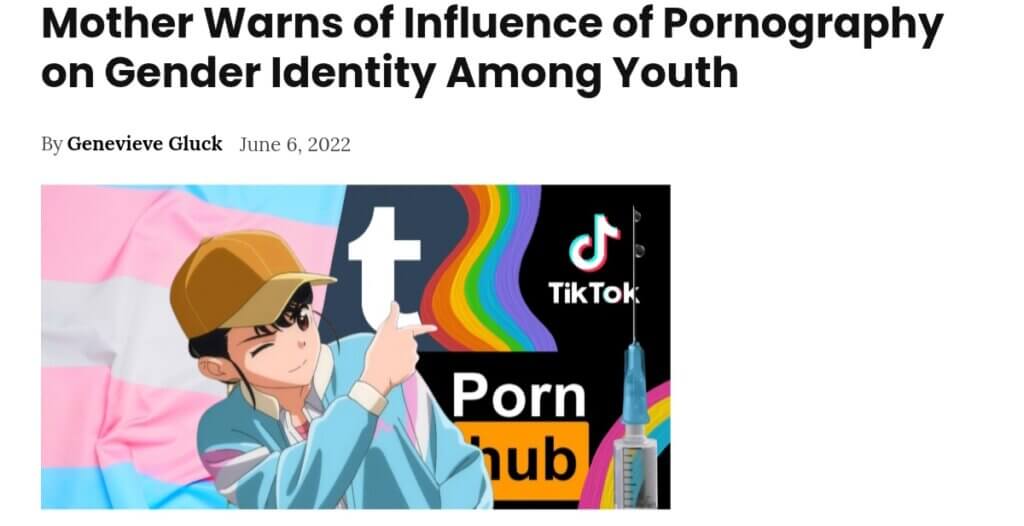
The author was subsequently interviewed by the anti-transgender site Reduxx, which played up the supposed anime connection. The article’s header image shows an androgynous anime character clad in the colours of the trans pride flag and pointing at the logos of various social media sites (including Pornhub) along with a syringe.
“Anime is a huge component and it turns into gender-bending themes pretty quickly,” the mother is quoted as saying. “Again, the girls in the anime are highly sexualized, and no girl wants to be that. They want to be the guy. My daughter thought she was a gay boy because she likes boys but she didn’t want to be a girl.” (The implication that girls who enjoy anime are driven to body dysphoria by “highly sexualised” female characters ignores the fact that many popular anime, such as the films of Studio Ghibli, have heroines who are not overtly sexual in design.)
Despite their stated aim, neither the PITT article nor its follow-up at Reduxx established an “undeniable” connection between being transgender and consuming pornography. Yet they presented three dots – trans youth, porn, and anime – that were duly connected by the other PITT contributors. To some writers, one of these elements, porn, was disposable: watching anime and being trans was sufficient for the narrative.
This is evidenced by the post “Your Son Is Going To Be A Girl?,” published in September 2022, a comparatively early point in PITT’s crusade against anime. The article was written by a mother who describes their teenager coming out as a trans girl in 2016 aged 13. Later, when the teenager was nearly 18 and still interested in transitioning, the mother found that her child had been active on Reddit since 13, discovering “tons of trans identified teenagers giving my son advice on how to become feminine.”
The article shows an overwhelming hostility toward letting the teenager transition, and its author describes meeting with other parents in a similar position: “it was like our sons had been taken over and brainwashed.” Like the author of “Transgender’s Connection with Pornography: It’s Undeniable,” the mother drastically reduced her teenager’s internet access. This time, though, the post makes no indication that the youngster was communicating with predators. Instead, the focus is on anime:
I agreed to watch [anime] on the internet with him. I wasn’t impressed and remember thinking how depressive and angry the theme was, this kind of viewing wasn’t any good for anyone’s mental health and I told him. We argued about it and he ended up running away. The police brought him home but things got worse. I very quickly realised he had an addiction to the internet and specifically anime. He was acting like a drug addict whose drugs had been withdrawn. He was extremely agitated, restless and exhausted.
I found myself constantly searching for answers, trying to understand what was going on in these kids’ heads, especially boys and there was a constant common theme. Anime. Then it dawned on me, as I scrolled though [sic] a trans subreddit, boys dressing as anime girls and adopting anime names. My son also wanted to be an anime girl. […] With this new information, I doubled down on the anime restrictions and I did not hold back my hatred for it either, in just the same way I would for drugs or alcohol if that was what my son was addicted to.
The article repeatedly associates the teenager’s entertainment consumption with their psychological state, positive as well as negative: “we watched movies as a family – so many movies, funny ones mostly. He started to calm down and to like a normal person.” The account ends with the teenager apparently detransitioning, something which their mother connects to a loss of interest in anime – or, as she puts it, having “come out of the anime trance.” The connection also turns up in the post’s comments section: “What is it about Anime that fosters this trans thing?” asks one poster. “Its obvious that it does, but I don’t get why.”
Unlike “Transgender’s Connection with Pornography: It’s Undeniable,” this post makes no mention of anime porn. Instead, the author presents anime as a sort of mind-altering drug, one that poisoned her teenager’s brain with its “depressive and angry” themes. Here, we see an early and very clear portrayal of anime – not pornographic anime, but anime in general – as a “poison tap” that makes teenagers transgender.
Anime Girl Philia: Attempts at Diagnosis
No body of gender critical writing would be complete without some invocation of Ray Blanchard’s “transsexualism typology,” an immensely reductive model that frames transgender women as being either autogynephiles (straight men indulging a fetish fantasy for presenting as women) or gay men who desire feminine relationship roles. This model has received substantial criticism, not least the reams of anecdotal evidence from trans women who, while attracted to women, find nothing sexually exciting about getting dressed in the morning. Nonetheless, it is widely taken as gospel truth by the anti-transgender lobby, members of which frequently use the labels “autogynephile” or “AGP” to deride trans women.
In September 2022, PITT published “Think my son is AGP? Prove it!” The author lists a number of potential influences on youth who are being “radicalized into believing they are transgender.” One of these is, of course, anime. “Could our boys be experiencing a form of internet induced online body dysmorphia?” asks the writer. “The immersion in anime and the presentation as anime characters seem to provide some anecdotal evidence that this may be true.”
While describing the transition of their teenager, who came out as trans at 15, the author reworks the “autogynephilia” model to incorporate the supposed influence of anime:
Also like many other boys, the type of woman he seems to want to portray is essentially an anime character. He does not want to look like a real woman, he wants to look like an anime doll. For these boys, the acronym AGP really means ‘Anime Girl Philia’.
To be fair, not all of the people pushing this narrative are total outsiders to either anime fandom or online trans communities. One of the above-mentioned PITT articles (“Your Son is Going to be a Girl?”) cites an article from a separate, now-deleted Substack called “My experience with Anime and how it impacted my life,” written by a pseudonymous detransitioner who describes becoming fixated on anime as a means of escaping from an abusive home environment. Yet, despite having been immersed in both trans and anime communities, at no point does the author provide evidence for a cause-and-effect connection between the two. Instead, they merely give the same sort of vague theorising as the gender-critical parents:
You are terminally online and consume Anime in unhealthy amounts. You only watch Ecchi Anime, maybe some Hentai. You get aroused by it. But instead of imaging [sic] yourself as the boy/man during your sexual fantasies, you imagine yourself as the girl. Now we have autogynephilia, but not the typical autogynephilia. Instead we have anime girl autogynephilia — getting aroused by the thought of yourself as a cute anime girl. The key component of this paraphilia is Anime, not the AGP. Without the Anime the entire thing falls apart, because real woman are not interesting for these kind of people. It’s all Anime induced! Their image of reality and how humans look is disturbed.
Such comments, unlike those of the PITT parents, may be coming from anime-culture insiders; yet they make the same dubious identification of causation where there may be only correlation.
Reality Check
If we are to accept the hypothesis that transgender youth have a higher predilection towards anime fandom than youth in general – itself a questionable premise, given the complete lack of statistical research provided by PITT – then we are left with a chicken-or-egg situation. Is it not possible that trans youth generally have trouble fitting in at school, and so are prone to finding acceptance in niche online communities, including those focused on anime? Surely this is at least as plausible as teenagers desiring to change gender as a result of watching anime?
Even if there is truth in PITT’s description of trans teenagers modelling themselves directly upon anime characters, this is hardly remarkable. Adolescence naturally comes with an urge for personal reinvention, and generations of teens have tried to emulate the fashions of film stars, singers, and athletes; a teenager who likes anime, transgender or not, is apt to adopt anime aesthetics to some degree. If the trans youth described by PITT had no access to anime or similar comics, cartoons and video games, then they may well have ended up emulating Kim Kardashian or Timothée Chalamet instead.
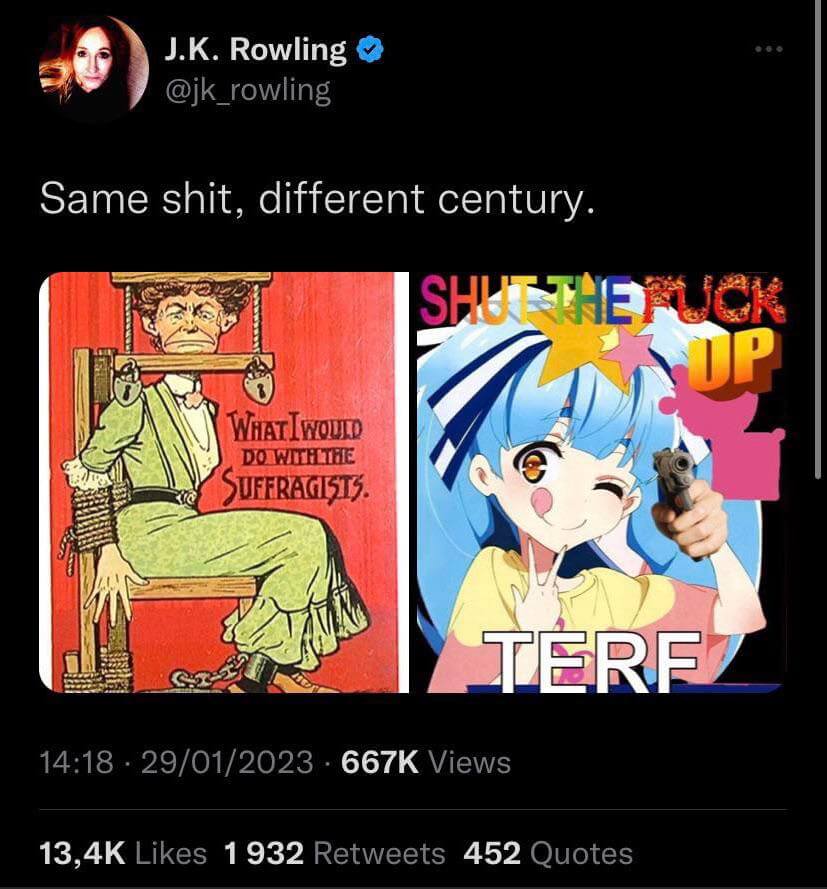
Some might point to the fact that transgender activists have been known to use anime imagery in getting their messages across online. A well-known example is the widely-disseminated meme showing a character from the anime Zombie Land Saga brandishing a gun with the caption “Shut the Fuck Up TERF.” This was criticised on Twitter by J.K. Rowling and displayed by British politician Joanna Cherry in a Parliamentary meeting.
But this should be weighed against the various other movements and subcultures that have adopted similar iconography, not all of which are exactly noted for supporting transgender people. Gamergate had a cute anime girl as its mascot. Tatsuya Ishida’s webcomic Sinfest, which frequently ridicules transgender people and endorses the gender-critical movement, is drawn in a similar manga style. Indeed, given how outright neo-Nazis have embraced characters from My Little Pony, it should be clear that this cute, colourful, wide-eyed imagery is now a default aesthetic across a significant portion of the Internet. It is by no means tied specifically to the transgender scene.
Moral Panics of Eras Past
The narrative of anime making kids transgender follows a similar pattern to many past moral panics, going back far beyond BADD. Consider the notorious piece that ran in the 5 September 1956 edition of Britain’s Daily Mail, which attacked rock and roll as “sexy music,” “the music of delinquents” and even “a communicable disease.” The Mail’s ranting is characterised not only by aesthetic conservatism but also by overt racism and perhaps even a superstitious fear:
It is deplorable. It is tribal. And it is from America. It follows rag-time, blues, dixie, jazz, hot cha-cha and the boogie-woogie, which surely originated in the jungle. We sometimes wonder whether this is the negro’s revenge.
While the Mail’s contempt for rock and roll was rooted in blatant anti-Black racism, PITT’s fear of anime does not appear to derive from anti-Japanese racism (searching the newsletter archive for “Japan” or “Japanese” turns only brief, trivial mentions, indicating that the authors are uninterested in anime’s precise cultural origins). Nonetheless, we see a clear element of hatred, of fear of those different from oneself.
The PITT parents, in their hand-wringing responses to their teenagers coming out as trans, never appear to consider the possibility that these youngsters might actually be better off left to express as they choose; that they could grow up to live like the many trans adults who have been allowed to lead fulfilling lives. Instead, being trans is treated as a doomsday scenario, akin to how a fundamentalist Christian might view the prospect of their children joining a cult of devil-worshippers. Indeed, this analogy appears not to be far from the minds of the PITT writers, judging by the references quoted above to death cults, dark arts, and defiled temples. Such a narrative requires an adversary: a devil, a tempting Mephistopheles.
Faced with the suicide of her son, Patricia Pulling blamed Dungeons & Dragons for the tragedy. The PITT writers face scenarios which they appear to see as tantamount to suicide: their teenagers coming out as transgender. And, like Pulling, they have turned a piece of popular culture into a fantasy villain that can take the blame – an easy response to a complex situation.
As it happens, examining one’s own prejudices is a lot harder than booing and hissing at a cartoon.

