

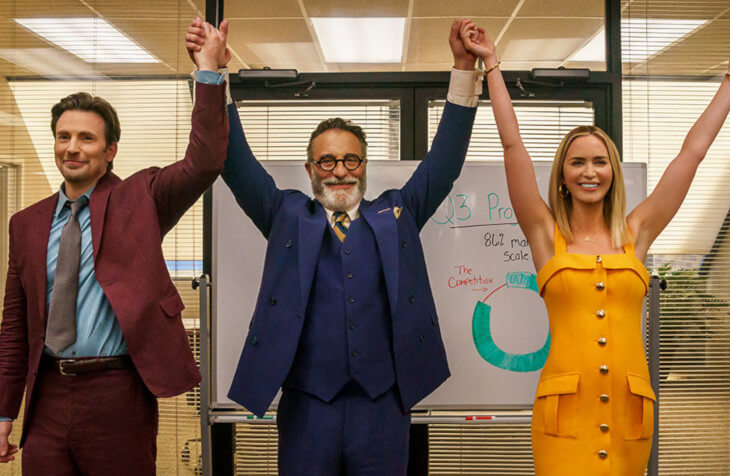
Based on real events, Pain Hustlers follows the story of Liza Drake (Emily Blunt), who starts working with big pharma and revels in her success before things start falling apart.
Pain Hustlers
David Yates (director), Wells Tower (writer), George Richmond (cinematography), Mark Day (editor)
Emily Blunt, Chris Evans, Andy Garcia (cast)
September 11, 2023 (TIFF)
Content advisory: drug use, medical abuse, childhood sexual abuse
The opioid crisis is a subject that many North Americans would be familiar with, and unfortunately, experienced in some way. I’m not originally from this region, so films like Pain Hustlers help me understand how this crisis has gotten as bad as it has. The film certainly piqued my curiosity to learn more about the real people behind the story, but as a film, I think Pain Hustlers fails the subject matter.
Based on Evan Hughes’ 2020 non-fiction book, The Hard Sell: Crime and Punishment at an Opioid Startup, the film follows Liza Drake, a high school dropout who winds up working at a failing pharmaceutical company. She is dogged and makes a breakthrough the rest of her colleagues haven’t been able to. Liza proceeds to make bank, as does her greedy startup, and the equally greedy doctors who start encouraging doctors to prescribe, and eventually overprescribe the company’s drug. It’s the consequences of overusing this drug that they don’t think about. Do they get their comeuppance?
Pain Hustlers tries its hardest to make sense of such insensible greed. It also tries to explain just how such blatantly evil practices are allowed in the US. It’s horrible and horrifying, and yet, I feel like the film falls into the trap of glamorizing this evil. I understand that sometimes people can be naive or get swept up in messes and end up being on the wrong side of history, but to that I say, let’s reserve the sympathy for the patients who were lied to and died, leaving distraught families, and not for the maniacs who literally killed people.
Pain Hustlers is directed by David Yates, and it is one of only three films that he’s directed in nearly a decade that isn’t part of the franchise-that-shall-not-be-named (you know the one). This departure from CGI-heavy, action-oriented fare shows his rustiness, unfortunately.
I couldn’t help but compare this film to The Wolf of Wall Street, another film about evil people making money in an underhanded fashion. Both films show audiences the ingenuity and cunning that goes into being the bad guy, as well as the highs of luxury. I didn’t like The Wolf of Wall Street either, but what this film lacks is the slick and effortless direction of Martin Scorsese. A ridiculous comparison, I know, but the topic and story are simple, so telling it in a clean, non-contrived way should also have been easy. It’s not. We have talking head interviews, voiceovers, and a linear story, but no emotional heft. Instead, there is the strange intrusion of levity, and a general lack of attention on the actual victims. To top it all, the sound design was abysmal in many scenes and the music completely drowned out the dialogue.
To drive home the point, the most memorable moments during my screening of Pain Hustlers was when the Netflix logo popped up on screen and someone in the audience yelled, “Hey Netflix, pay your actors.” And yes, then we clapped. Friday evenings really bring out the best in TIFF audiences, apparently. That was the highlight of the screening for me.
Pain Hustlers gets in its own way when telling the story. The film starts off with the characters doing talking head interviews, but when it transitions into a linear narrative, the voiceovers and interviews start interrupting the flow of the story. We also have a strip club scene early on and there’s some unnecessary nudity thrown in. Let’s not even get into the casual way a character reveals that they were sexually assaulted as a child, which is soon followed up with the same character presenting themselves as a gift soon after. These are throwaway lines that portended the lack of emotional weight in the film.
Even the performances in Pain Hustlers leave much to be desired. The first of the interviews we see are with Pete Brenner, played by Chris Evans. Evans, not Brenner, has a very trademark way of saying, “whoa whoa whoa,” which he usually does with a particular hand movement. He opens the film with this gesture and I could not stop seeing Chris Evans as a heartless sales rep, instead of the character he was playing. This isn’t Evans’ best work. I’ve seen a lot of his performances, and he’s the kind of actor who deserves more credit than he gets, but his turn in Pain Hustlers is not the kind that’ll change people’s minds. He’s funny at times, but a little too blank at other times. I don’t think the odd washed-up makeup helped him. He also had a lot less screen time than promotional materials led viewers to expect. There is a short sequence in the final act where Evans comes alive, and I wished we had got to see more of that passion during the rest of the film.
Emily Blunt is good, but there were a few times when she seemed completely lost. She’s a really good actor, and I’m surprised she isn’t at her best in this film. But she has this ease with which she carries an accent, and the weight of her character‘s decisions, so it’s not hard to become invested in her character’s journey. I thought her chemistry with Chloe Coleman, who plays Liza’s daughter Phoebe, was the winning partnership of Pain Hustlers. Their scenes together added the only emotional beats to the film.
I couldn’t get a handle on what we were supposed to take away from Pete and Liza’s relationship. People aren’t predictable, but the filmmakers throw the kitchen sink at the pair. Because the narrative focus is on Liza, Pete’s characterization is all over the place—I think showing these two characters’ viewpoints working in tandem would have benefited the storytelling.
Pain Hustlers puts the spotlight on the people who were part of a devastating crisis, but its lackadaisical direction and underwhelming performances do the subject matter no justice.
