

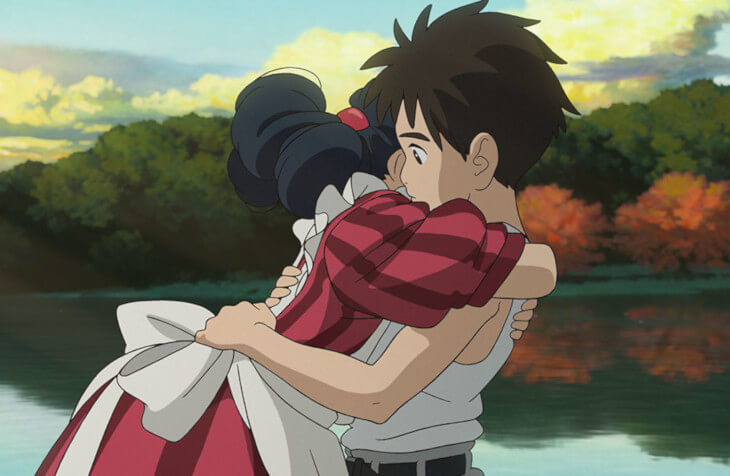
A grieving boy finds himself on a wild adventure to save his stepmother in Hayao Miyazaki’s latest Studio Ghibli film, The Boy and the Heron. There was understandably a lot of hype around The Boy and the Heron at TIFF 2023 as this was supposedly the last Studio Ghibli film by Hayao Miyazaki. However, Miyazaki has since said that he will be returning to the studio to work on another film, which is exciting news for Studio Ghibli fans.
The Boy and the Heron
Hayao Miyazaki (director and writer), Genzaburô Yoshino (original story), Atsushi Okui (cinematography), Yôji Takeshige (art direction), Noboru Yoshida (art direction)
Soma Santoki, Masaki Suda, Aimyon, Yoshino Kimura, Shōhei Hino, Ko Shibasaki, Takuya Kimura
September 7, 2023 (TIFF)
I honestly didn’t think I’d get a ticket for The Boy and the Heron at TIFF 2023, but I luckily did get probably the last one available in my press slot. Imagine my surprise when I arrived for the film screening, only to find several empty seats all around the theatre. Sigh.
The Boy and the Heron was introduced by TIFF CEO Cameron Bailey and Junichi Nishioka, operating officer for overseas promotion from Studio Ghibli. Nishioka mentioned that The Boy and the Heron is the international title for the film, which was changed from the original Japanese title, “How Do You Live?”. I found that an interesting change and it did impact how I viewed the film.
The Boy and the Heron follows Mahito (Soma Santoki), whose mother dies in a fire during World War II. Mahito’s world is further turned upside down when his father, Shoichi (Takuya Kimura), marries his late wife’s younger sister, Natsuko (Yoshino Kimura). Shoichi then moves to Natsuko’s home in the countryside with Mahito, where the boy learns that he is soon to have a sibling. That’s a lot of changes for a young child who’s still grieving.
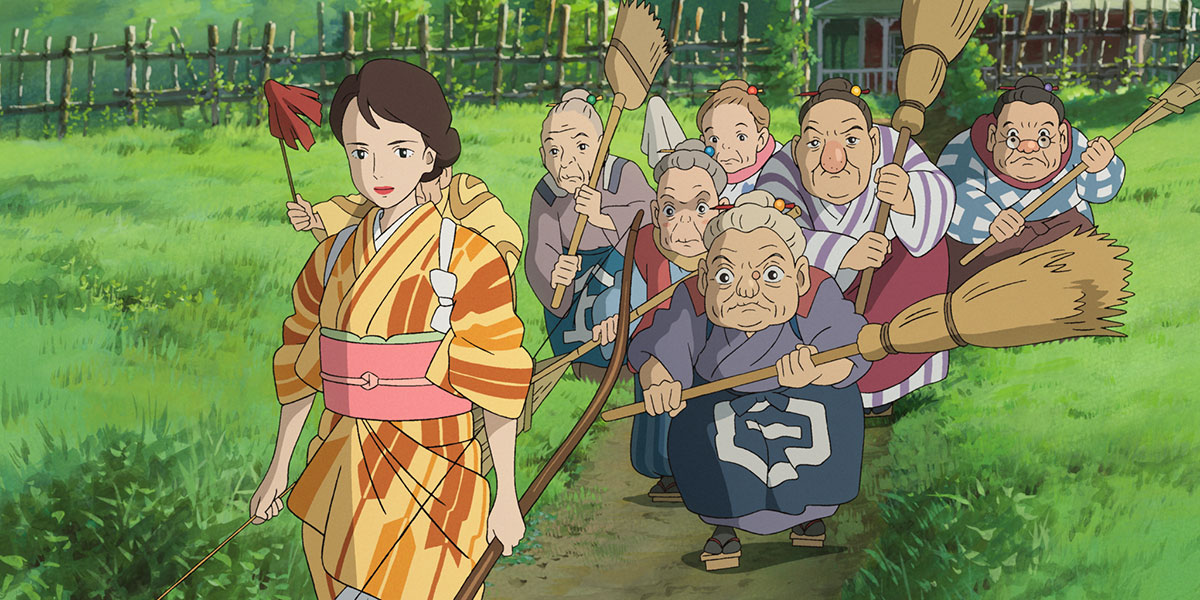
Natsuko’s ancestral home is a sprawling complex, run efficiently by a gaggle of hilarious elderly maids and a manservant, all of whom would do almost anything for a cigarette. Mahito quickly learns to get what he needs and stay in their good books.
As if having his entire life upended isn’t bad enough, Mahito is tormented by a gray heron (Masaki Suda), who simultaneously terrifies him and invites him on an adventure. When Natsuko subsequently disappears, Mahito realizes he needs to take the heron up on his offer if he is to save his aunt and stepmother.
I’ve never seen a Studio Ghibli film on the big screen and it’s certainly a stunning experience. Despite my rather lousy seat, I was completely captivated by the world of The Boy and the Heron and its incredible visuals. I’ve always been taken by the detailed art of Studio Ghibli films and here, as well, I often had to remind myself that I was watching animation and not live action. It’s the little things that always strike me. The bathroom tiles, for instance, are so carefully rendered that it looks like Mahito is standing in someone’s actual bathroom. There are shelves full of crockery that are so realistic, I swear I’ve seen them in my grandmum’s cabinet. The landscapes of the countryside are, of course, a feast for the eyes—the luscious greenery against the bright blue sky and the streams dreamily flowing by. Even the grotesqueries are gorgeous! The Boy and the Heron is another exquisite entry in the Studio Ghibli oeuvre.
And the imagination of The Boy and the Heron is out of this world. If you loved the dust bunnies in films like My Neighbor Totoro or Spirited Away, get ready to adore the equally cute warawara. The use of birds in the other world versus in Mahito’s reality were so funny and creative—I won’t go into too many details because you need to see it! Such a spectacular experience to see such creativity on the big screen.

What didn’t work so well was how The Boy and the Heron was effectively divided in two parts—Mahito’s move with his father to Natsuko’s home and Mahito’s journey in the fantastical other world to find Natsuko.
For me, the most interesting aspect of the story was Mahito and Natsuko’s burgeoning relationship. Mahito is clearly grieving his mother, yet he’s being asked to accept a new mother in a new home and a life far away from everything that’s familiar to him. This part of the story felt very undercooked to me. There’s a heartrending scene where Natsuko combats her own loss of her sister and how that’s making it harder for her to accept Mahito. But it’s resolved almost immediately and not mentioned again. I would have liked to spend more time with Mahito’s barely-restrained grief and to understand how Natsuko is processing the death of her sister and the immense changes in her own life. But these are left by the wayside in favour of the spectacle of another world.
I also felt like The Boy and the Heron had one too many visual throwbacks to previous Studio Ghibli films. I understand that Miyazaki may well have visualized this film as his swan song, and in that sense, the throwbacks make sense. But there were a few times when I felt like I could predict plot points because they were similar to what I’d seen in earlier films. There’s a character with fire abilities that immediately took me back to Calcifer in Howl’s Moving Castle. The rural setting looks similar to what we’d encountered in My Neighbor Totoro and a number of characters in the other world came across as sinister versions of the forest spirits in that film. A shadowy character who ends up playing a major role in The Boy and the Heron harked back to similar beings in both Howl’s Moving Castle and Spirited Away, so much so that I knew exactly what the character wanted from Mahito.
As much as I wanted to live in the emotion of The Boy and the Heron, I can’t deny that Studio Ghibli films are about the experience of escaping into another world, even when that world can be a bit scary. And that’s what this film is about—learning to live through the unimaginable pain of losing a loved one and accepting a new life with new people. In that sense, the original Japanese title How Do You Live makes more sense to me—because it asks not just Mahito, but the audience, how should we live when there has been so much upheaval in our lives? As we learn to accept living in pandemic conditions and the immense losses suffered as a result of it, this is a question we all need to ask ourselves.
