

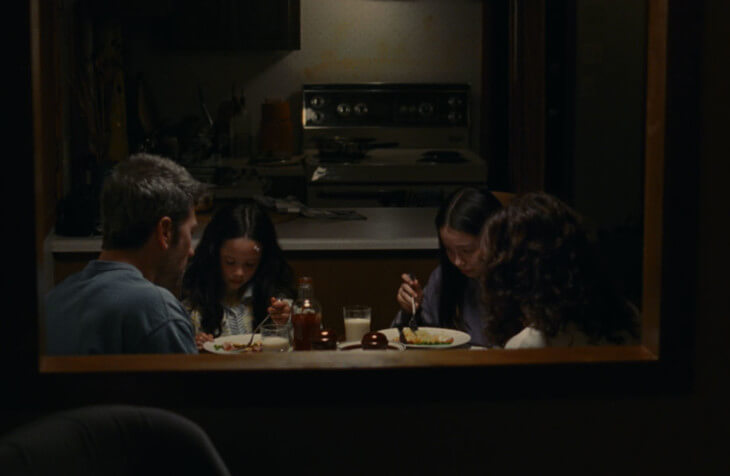
In Seagrass, Judith (Ally Maki) and her husband Steve (Luke Roberts) try and save their marriage at an unconventional couples’ therapy retreat, but they may not like what they discover about their relationship.
Seagrass
Meredith Hama-Brown (writer and director), Norm Li (cinematography), Kane Stewart (editor), Shun Ando (editor)
Ally Maki, Luke Roberts, Nyha Breitkreuz, Remy Marthaller, Sarah Gadon, Chris Pang (cast)
September 8, 2023 (TIFF)
Content advisory: grief, racism, talk of internment camps
My first film at the 2023 Toronto International Film Festival (TIFF) was the quiet and intriguing Seagrass. The debut feature film by Meredith Hama-Brown was part of the Discovery programme, and it follows a biracial family dealing with newly-discovered turmoil. Judith has just lost her mother, and it’s making her question everything, including her relationship with her husband Steve. Steve is reticent, on cruise control with his family. They have two rambunctious, but loving daughters, Stephanie (Nyha Breitkreuz) and Emmy (Remy Marthaller), who join the pair at a couples’ therapy retreat. While the children enjoy swimming and exploring the Pacific shore, the couple participates—or tries to participate—in group therapy.
It’s not long before tensions rise. The children start acting out, while Judith and Steve feel nascent peer pressure from therapy stalwarts Carol (Sarah Gadon) and Pat (Chris Pang) to be more open about their issues. There’s a hint of jealousy, and a lot of questioning about personal histories.
Seagrass is a beautiful film to look at; cinematographer Norm Li juxtaposes the vivid colours of the children’s outfits against the shadowed interiors of the family’s lodge. The ocean is wild, the grass is stunning; visually this film is almost serene. But this juxtaposition is intentional, because there is a hint of the supernatural in the film as well, and Hama-Brown and Li capture that off-kilter, eerie feel with some old school aerial point-of-view shots, like an out-of-body experience. I almost wish they’d leaned more into that aspect of the film, but then again, this is a character study, not a horror movie.
The performances are superb. Where has Ally Maki been all this while? She’s had a big year in 2023 with the recently-released Shortcomings and The Big Door Prize, and now she puts in a stellar turn in Seagrass. Her sadness and vulnerability are palpable in every scene she’s in and she’s the perfect foil to Luke Roberts, who is purposefully restrained. The two children are absolutely brilliant—their performances are perfectly loud when needed but also really nuanced. I was impressed by how natural their reactions were. Credit goes to Hama-Brown for bringing out such excellent performances from young actors. The two daughters’ relationship was often a highlight of the film; you can see such a massive amount of love between these two children, but they’re not without their flaws and often hurt each other as much as they love each other. Hama-Brown knows how to write relationships, and that’s particularly obvious in the way she tells Stephanie and Emmy’s story.
I didn’t quite understand the therapeutic methods as seen in the film. Not everyone is comfortable with talking about their personal lives and issues in front of a group of strangers, nor are people all that comfortable with being physically and emotionally open with said group of strangers, so I don’t know if Judith and Steve did any research on the programme before entering or were simply taken by surprise. I also noticed that Steve and Pat had to do a lot of the heavy-lifting when it came to participating in the sessions, while their wives, Judith and Carol, didn’t. Was it supposed to be a gendered exercise? In the end, I wasn’t sure what role the retreat was supposed to play other than being a venue to house the story. A couples’ retreat lends itself to a comedic trope; but in a drama like Seagrass, it hits differently.
Seagrass shines when its lens is on racial dynamics. The main themes of the film, like couple’s crises, peer pressure, and grief, have been addressed across pop culture in a similar fashion, but what sets the story of Seagrass apart is that Judith is Japanese Canadian, and her children are biracial. Their heritage plays a significant role in developing the interactions we see in the film. Very often, pop culture views non-white cultures as a monolith—this film shows us that even when there are two people who both hail from Asian heritages, they have vastly different histories and connections to that heritage. This would be the default thinking for a film focussing on white people, but Hama-Brown is deliberate in demonstrating how different Judith and Pat are. I really liked that aspect of the film, and wish we had more of it because watching the dichotomy of Judith and Pat’s relationship with their culture felt like the most authentic part of the story – which isn’t a surprise as it appears that Hama-Brown brought a lot of her own personal history to the making of Seagrass.
Hama-Brown doesn’t shy away from showing us how microaggressions creep in across ages, and just how ignorant people, even those you love, can be around people of colour. While these moments in Seagrass are few in number, they could be traumatic to Asian communities who have faced something similar in real life, so beware of that when tuning in.
While the film had a strong start with a wistful sense of youthful play, I felt like most of Seagrass was too cliché. There are story beats that occur in this film that unfortunately have already made appearances in every such character study, and the third act culminates in a contrived scene of imperilment. We could have done without that since the denouement is so quiet and heartbreaking—it is unexpected and almost feels undeserved. A character has a revelation, but there wasn’t enough of a build-up of their personality for us to truly understand why they make this declaration. And yet, it took me aback, so maybe that’s enough of a sign of a job well done.
