
A down-on-his-luck writer decides to create the most cliché novel possible about the Black experience in the US in American Fiction. But his experiment to indict the literary industry may have ensnared him in a trap instead.
American Fiction
Cord Jefferson (director and writer), Cristina Dunlap (cinematography), Hilda Rasula (editor)
Jeffrey Wright, Tracee Ellis Ross, John Ortiz, Erika Alexander, Leslie Uggams, Adam Brody, Keith David, Issa Rae, Sterling K. Brown (cast)
September 8, 2023 (TIFF)
American Fiction is journalist, essayist, and television writer Cord Jefferson’s directorial debut, based on Percival Everett’s 2001 novel Erasure. Thelonious “Monk” Ellison (Jeffrey Wright), is an American fiction teacher who finds himself on the wrong side of university policies when he upsets one too many students with his bluntness. In his defence, some of his students are overly sensitive and extremely stupid. The film starts off with a white student being offended by an old Southern book that uses the n-word, even though Monk has chosen to teach it specifically to highlight the racial atrocities at that time.
The university administration decides to send Monk on a leave of absence since he’s anyway attending the Boston Book Festival. Not that Monk is happy about it — he hates Boston and also his family, who live in Boston. But alas, he’s committed. And so begins the first half of Monk’s travails in American Fiction—his family, consisting of hyper-competent and recently-divorced sister Lisa (Tracee Ellis Ross), newly queer and also recently-divorced brother Cliff (Sterling K Brown), matriarch Agnes (Leslie Uggams) who has started suffering the early effects of Alzheimer’s, and lovable housekeeper Lorraine (Myra Lucretia Taylor). And then a family tragedy upends the entire Ellison family, also revealing the need for a large inflow of cash.
This is where Monk starts thinking of creative ways to tackle the second half of his problems in American Fiction—aka, his books not selling. He hasn’t had anything published in a decade, and his latest work has been passed over by all publishers. The reason? Nothing Monk writes has to do with the Black experience—never mind that Monk is literally a Black man writing the books.
Monk realises that he can, in fact, do something different, something a little satirical, and maybe show the industry up. As a lark, Monk pens an entire novel written in AAVE, or at least a version that films and books like to think Black people use, with every trope ever—dead mother, deadbeat father, gangster son, murder by police, you name it! Surely nobody is going to want such an obviously pandering book? American Fiction has a lot of fun with that premise.
I thoroughly enjoyed this film. I laughed so hard at the dry humour because this film is hilarious. Honestly, I ended up missing some lines of dialogue because the audience was all laughing so much. What I loved about American Fiction is that the humour is satirical—and it expects the audience to be knowledgeable. The film isn’t going to stop and tell you why a certain slur is bad or why Monk should be recognised for his work, even if it doesn’t sound like white people’s idea of Black communities. American Fiction just throws the joke at you and if you don’t get it, well, I hate to break it to you, but you are literally the person the film is making fun of.
Jefferson has had a long career working across genres, from writing for Gawker to The Nightly Show with Larry Wilmore to The Good Place to HBO’s Watchmen, and it shows. The jokes are tight and well-timed, and never overplayed. American Fiction is also very clever, beyond the comedy. There’s a fantastic scene when Monk is ideating this bonkers new text that was so effortlessly cool that I could happily watch a whole film using that technique.
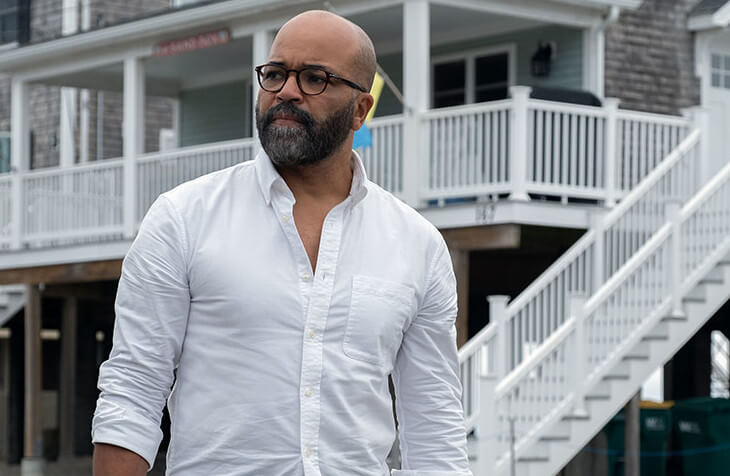
But what makes American Fiction such a joy to watch is Wright. He is so dry and believable as Monk. You can’t help agreeing with him, but there are times when you want to bonk him on the head for being so pedantic. The thing is, Monk is a smart man but also a complete disaster, especially socially. He could hold his tongue, but he chooses not to because if someone is wrong, he absolutely must let them know. I love how Monk won’t write what the audience expects him to write; he only writes for the audience in his mind. Yet he wonders why his books don’t sell. I totally understand where he’s coming from but it’s amusing seeing Monk be so critical of fellow author Sinatara Golden (Issa Rae) for succeeding by giving the audience exactly what they want to read.
Amongst all of this is a burgeoning romance between Monk and his neighbour Coraline (Erika Alexander), an equally smart woman who is also quick to put Monk in his place. It’s really with Coraline that we see how inept Monk can be in social situations, despite the fact that Coraline is very into him. I do wish American Fiction had given us more insight into Coraline’s life—she’s not a manic pixie dream girl, thank goodness, but we never know much about her life beyond one conversation about her job as a defence counsellor.
One of the roles I was concerned about in American Fiction was Lorraine, the housekeeper. A large Black woman who takes care of the house could easily be a stereotype or a one-note role. But American Fiction makes the unusual, and sweet, choice to give Lorraine a whole love story. I tell you, I loudly aww’d—it was so adorable to watch Lorraine find love in a hopeless place (yes, I dropped a Rihanna lyric in this review, and I am proud of this).
I was excited for American Fiction because of Jeffrey Wright—he’s usually the best part of whatever he’s in. And he is absolutely incredible and funny to watch. There are amazing performances from all the cast, including Adam Brody as the most clueless white saviour producer. But the humour is to die for—so dry, so tuned into the cultural zeitgeist, so perfectly timed. I enjoyed myself so much and I cannot wait for more people to encounter this film, now that it’s won TIFF 2023’s People’s Choice Award.
