

Editors Note: This review is part of a series of reviews from the Hot Docs Festival that took place from April 27th to May 7th 2023 in Toronto, Canada.
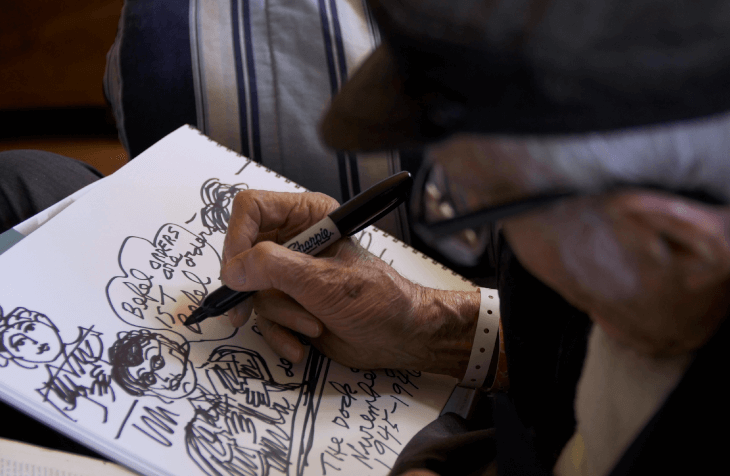
As a young adult, Nathan Hilu was tasked with guarding war criminals and perpetrators of the Holocaust. He spent his life documenting his experiences through his unusual art. NATHAN-ism examines that life, Hilu’s art, and what it says about a pivotal time in history.
NATHAN-ism
Hectah Arias (animator), Jason Blevins (cinematographer), Elan Golod (director and editor), Héloïse Dorsan Rachet (animator)
Nathan Hilu, Eli Rosenbaum, Laura Kruger, Jeannie Rosenfeld, Megan Harris, Gustavo Stecher, Lori Miller (cast)
April 30, 2023 (Hot Docs)

Nathan Hilu, a Syrian-Jewish immigrant to New York, USA, was assigned at the age of 18 with guarding prisoners at the Nuremberg Trials. He came face to face with some of the most terrifying and remorseless Nazis—Hermann Goering, head of the Nazi Air Force, the Luftwaffe; Albert Speer, a member of Hitler’s inner circle; and Julius Streicher, a leader of the Nazi propaganda machine. NATHAN-ism explores the nonagenarian Hilu’s extraordinary life and the art he felt compelled to create.
I was sent a screener of NATHAN-ism, which is showing at Hot Docs 2023, and it was certainly an interesting experience. What starts off as the discovery of Hilu, an “outsider artist” heretofore unknown despite how prolific he was, turns into a study of memory and history.
‘NATHAN-ism’ is the term Nathan Hilu applied to his own style of rendering memories in art. Using black markers, Hilu created sketches of his experiences, many around his time as a guard at the Nuremberg Trials. Hilu would then add pops of colour using either coloured markers and sometimes even crayons. There’s a childlike quality to his art, and at first, his drawings are easy to dismiss. Yet the subject matter is anything but childish. Hilu’s art was also text-heavy—he mixed words and images, but oftentimes, his art looked more like essays with an illustration than drawings with smatterings of words.
Hilu’s memories of the Nuremberg Trials, and his part in keeping those dangerous men safe, were so vivid that he was creating art about them well into his 90s—he was also sharing those tales with anyone who would listen. The stories he shares in NATHAN-ism are incredible—he talks about being inspired by Speer of all people to record his memories. In the film, we see Hilu draw Goering’s last days and talk about how he was there when Goering’s wife possibly slipped Goering the cyanide pill he took to end his life instead of facing the gallows. Hilu has entertaining stories of taunting the men who killed his people.
NATHAN-ism feels like listening to the stories of one’s grandparents, or great-grandparents. The Nuremberg Trials were such a powerful moment in history and it’s very important to relive those stories, especially from the people who were there to witness it. As many of the people in the documentary state, we’re living in a time when people actively deny events like the Holocaust even happened, despite the amount of proof available. Nazis are widely active and White Supremacy has multiple platforms to spew hatred. Now more than ever, we need to hold onto tangible proof of those events.
But while watching NATHAN-ism, I kept thinking to myself, “this sounds too good to be true.” Hilu’s memories, even when he was past 90, were so detailed. He was so closely involved with numerous monumental events during the Nuremberg Trials, it beggared belief.
NATHAN-ism understands viewers will feel this way. In this age of misinformation, we have to double-check everything, question everything. Nothing can be taken at face value. Does that mean questioning a 90+ man about whether the amazing scenes he draws really happened? Unfortunately, yes. Because the truth does need to get in the way of a good story.
In the director’s statement, shared as part of the press materials, Elan Golod wrote about wanting to make NATHAN-ism because Hilu’s work acts as a vehicle to evoke empathy for marginalized communities. But also, because the elderly in New York have so little recourse for connection and to be heard. Golod captures some of Hilu’s need to be listened to through a series of voicemails Hilu left him. His desperation is obvious, and it feels disingenuous to question such an elderly person.
But as much as Hilu wanted to, and deserved to, be heard, we can’t take his art and stories at face value. So Golod does question the elder man’s memories. To do so, Golod and his crew interview archivists, looking for proof that Hilu actually witnessed the extraordinary events he’s spent his life recounting. The results are mixed, and I don’t know how I’m supposed to feel about that. Marginalized communities are always held to higher standards—whether they’re Jewish like Hilu, women, genderqueer, BIPOC, LGBTQIA+, disabled, fat, or living in any of those intersections. Marginalized people need to be perfect, or the entire community gets vilified. Any story shared by a marginalized person needs to be backed by hard evidence or every story will be considered suspect. We don’t get to be individuals—we are always spokespeople for our communities.
So, Golod finds himself interrogating Hilu in NATHAN-ism, something he found very difficult, as he explains in the press materials. But it is very hard to argue with a forceful elderly person and I’m not sure Golod achieves the effect he aimed for. However, he does share multiple perspectives via the various people he interviews throughout the film. Some believe Hilu’s memories are fine as they are—more folklore than fact. Others are riddled with doubt and embrace their skepticism. And there are people in Hilu’s life who are happy to accept his art as he intended them—a reflection of his life the way he saw it.
With NATHAN-ism, Golod embarks on his first feature-length documentary, but he isn’t a stranger to narratives about interrogating the stories people tell. His 2010 short film, Exclusive, follows a journalist uncovering the real story behind an ordinary man’s heroic actions. We see some of that same interrogative work in NATHAN-ism when Golod confronts Nathan, reluctantly, about his artworks.
Documentaries are an interesting format—the writers and directors tell a story but they’re not usually in it. I do feel that NATHAN-ism would have benefited from Golod putting more of himself in the film. He’s really only in it right at the end but as he mentions in the press materials, he knew Hilu for quite a few years. The documentary was only made possible because he managed to become friends with Hilu, but that friendship isn’t evident in the film. Did Hilu’s closeness to Golod impact how comfortable he was telling his stories? There’s a scene that suggests as much but the film doesn’t delve deep enough into it. I would like to know if Hilu would have been more reticent about some of the more extraordinary aspects of his life had there been more of a disconnect between him and the director.
I am glad I watched NATHAN-ism. I certainly feel like I learned about elements of the Nuremberg Trials that I didn’t know before. I do believe we need to document the experiences of people who were at these historical events—but we also need to investigate and verify the stories before we tell them.

