

As I stated in my coverage of the Building Your Own Themyscira panel, ECCC’s Pro Track of panels is a series of panels focused on the industry behind comics. I find topics like this fascinating, because comics don’t just magically appear out of thin air, they take work. It’s great to see a convention focusing hard on what kind of work that is. The second such panel I attended was Authentic and Effective Social Media marketing, the first of five panels hosted by comics marketer Jazzlyn Stone. Social media is kind of a double-edged sword when you’re working in a public sphere, even one as comparatively small as comics, so discussions about how to market your work are as important as discussions of the work itself.
When Stone asked the panel to introduce themselves, she also requested they list the social media platform they most hate, leading to a bit of laughter. The winner(?) by far was Twitter, as answered by cartoonist Joe Eisma, man-of-all-trades Fabrice Sapolsky, and writer/editor Eric Palicki, with only ReedPop Marketing Director Fallon Prinzivalli answering Facebook. It’s hardly surprising, as it was regularly referred to by users as a “hellsite” even before meme-stealer Elon Musk took over ownership. Still, this is a panel about marketing comics, not the man currently in the news for mocking a disabled employee, and who once was photographed hanging out with Ghislane Maxwell. So let’s move on to the panel itself!
Stone followed up the fun with a more serious question, asking each panelist which platforms or channels they were most excited about. Prinzivalli eagerly answered first, saying that while she enjoys Instagram, she spends hours on TikTok and is thrilled about its potential as a platform for talking about comics. Palicki agreed about Instagram, saying it’s the platform that makes the most sense for comics, being so solidly focused on visual presentation. Eisma thirded the Instagram nomination but confessed he isn’t great at the “social” part of social media, and so he wondered how effective he really is with it.
Eisma also took the time to highlight Facebook, for a very specific and practical reason: brand recognition. Facebook is a known quantity the world over, and that makes it huge for connecting with artists internationally, who are often only on that site.
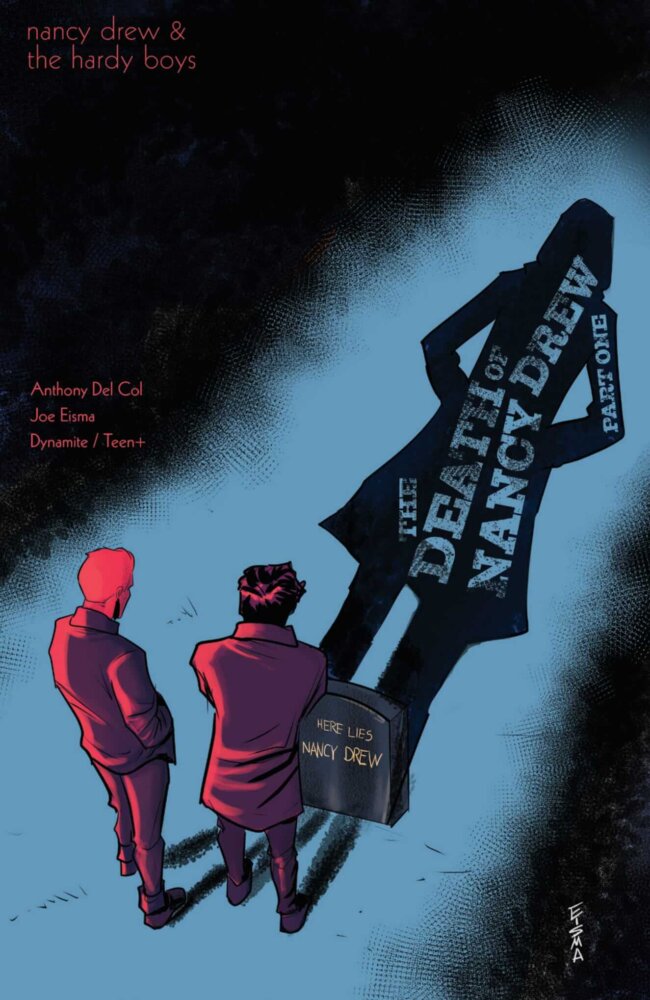
Stone followed up by asking next what social media channels the panelists are most avoiding, to which Eisma said Twitter, stating that he got death threats over the reveal of his Nancy Drew comic. Sapolsky says he got them as well, over his involvement with an NFT project. He quit Twitter over it, he said, maintaining his publisher’s account but deactivating his personal one. As a contrast, Palicki still uses Twitter regularly, but acknowledges the platform’s increasing problems, saying for now he’s avoiding the “fads” of newer platforms like Mastodon or Hive and waiting until the dust settles on a new dominant platform before moving over.
Prinzivalli answered with a change in perspective; she’s not actively avoiding any platform, but she only focuses her energy on platforms which grow her brand. She cited Tiktok’s trend of “Day in the Life” style videos as a huge draw, saying both she and other users love to see the specific routines put forth by different folks. She further added that ReedPop as a company is interested in established platforms with a large base — the company is slow to adopt new ones for reasons similar to Palicki’s.
When asked about cross-promotion, Sapolsky had the most to say; he stated that as a publisher, it’s big for him. Promoting across different platforms enables him to bring different voices together in conversation. For context, he gave an example; his company’s anthology Noir is the New Black accomplished exactly that by advertising on multiple platforms and drawing in different voices to work on the project. That aspect was important, he said, because as owner of the only immigrant/minority owned publisher in the country, FairChange Comics, letting creators add their own voices is a big deal.
For the next question, Stone turned to the personal, asking if each individual felt they had an authentic social media presence. I appreciated this question, because it made the panelists think and talk about how they used social media in a way that I’m not sure even they realized; the question about authenticity itself lent authenticity to the discussion. Eisma led with a degree of uncertainty. He said he thinks he is, that Twitter came around about the start of his career, so he just made a habit of being himself on the platform and talking about the things that mattered to him. He added that it’s more representative of him personally than other platforms.
Palicki agreed, saying that he’s always tweeted off the cuff and making a couple of jokes about making dumb jokes on Twitter. With those out, he mused on whether finding one’s voice on social media is any different than finding one’s voice as a writer generally, and decided they’re largely very similar.
After that, Stone followed up with a question about recent algorithm changes on social platforms, and how they’ve affected brand-building for the panel. Palicki answered first, saying he’s noted a marked decrease in traffic to his Kickstarters from social media. He added that even on the last day of the campaign, when sharing posts about it, he encountered folks who had no idea it even existed. Sapolsky built on that with a salient point: Kickstarter is social media, but a very risky version of it, like gambling. Most of your customers on a project come from within the ecosystem of Kickstarter itself and you have no access to or control over that—if Kickstarter decides your project is one they love, they’ll promote it heavily, if they don’t, you’ll most likely struggle to get by.
On the subject of advertising on social media, Prinzivalli said that for ReedPop, they have to spend more money than before in order to post, and algorithms are keeping their content from users even with that money spent. She also stated that while you can’t rely on social media, ReedPop has found that doing giveaways helps a ton. On the subject of paid ads, Sapolsky talked about how he’s run them on multiple platforms at the same time, and gotten no customer conversions on any of them. For his part, Eisma had noticed a drop in engagement overall. He said he doesn’t have percentages, unfortunately, but adds too that he’s not as stressed about it. He used to worry about best time to post, but these days can’t be bothered.
As for beating the algorithm, the panelists agree that it’s about presence, both on and offline. Sapolsky and Palicki both said going to conventions is great; algorithms can’t compete against physically being in front of someone and getting them interested in what you’re doing. Palicki adds that open-ended questions are also great, because they require more than a simple yes or no, and people have to think about their responses. Prinzivalli added that you have to post every day — the more you do it the more it feeds into your followers.
After that, Stone switched topics, asking the panel what they do to refill their creative bucket when they’re burnt out. Sapolsky immediately said to delete the app from your phone if you need a break, and that it actually works because it removes the reward structure, and web platforms aren’t as rewarding. Prinzivalli got her job with ReedPop from social media, and felt like the odd person out at the table because she loves it. She added that boundaries are very important, and she tries to not look at it the first half hour and last hour of the day which helps proactively prevent burnout. Palicki agreed on the point of boundaries, and has created a boundary between personal and professional. As he said, he uses Twitter as a professional platform and Facebook as a private one, or to quote him directly, “Twitter in the streets and Facebook in the sheets.” Thank you, Eric Palicki, for that scintillating mental image.
Palicki’s statement on that boundary actually segued nicely into the next topic, which was about parasocial relationships, an eternally relevant topic for the working online professional. Sapolsky remembered someone contacting him to talk about his kids years ago and decided he was done, and from then on kept his personal life private. Eisma’s answer was less specific or personal, but he said kids coming into his social media arena made him revaluate how he uses social media platforms in order to be more aware of what people see from him.
Prinzivalli chimed in to say that it was about separating her career from the personal. She reported getting DMs on her personal accounts about ReedPop business and had to push them to official channels so she’s not working on her own time. Meanwhile, Palicki’s perspective is unique—he has a famous actress as a sister, Adrienne Palicki of Agents of S.H.I.E.L.D. and The Orville. He mentioned how he gets questions about her and it’s uncomfortable. He also talked about discussing this exact sort of thing with her and how she gets so much more of it, and said while it’s not a happy thing, at least they can commiserate as siblings.
From there, the panel opened up to some audience questions. The first question was about cancel culture, asking how it’s impacted the panelists as creators. Eisma led with a diplomatic answer, saying it’s something he’s always thinking about and he tries to evaluate how he says things ahead of time. He followed that up by saying it’s important to be empathetic and listen to folks. Palicki had a more strident response, challenging the notion of whether cancel culture even exists. He said he expects to be held accountable if he says something wrong, that that’s the way it should be, to applause from the room.
The next question was about using Discord as a social media platform, whether the creators had experience with it or how it’s worked for them. Palicki and Sapolsky had similar answers, both saying they get invited to a server, post once, and then never again. [Editor’s note: same.] When asked about how they reach Discord audiences, Palicki followed up by saying he doesn’t. He’s just aged out of the platform. Sapolsky agreed and added that it’s difficult because Discord is so topically focused, with everything limited to servers based on specific interests. Stone chimed in at that point to say you have to use the platform how it’s made, that Discord is different because it’s about a community and not just an open forum.
Another question was about potential negative repercussions for cross-posting from one social media platform to the next. Prinzivalli had the most to say here due to her work with TikTok and Instagram Reel. She said social media companies have algorithms that will deprioritize content featuring logos from other platforms—if you post a TikTok, and then try to repost that video on Instagram without removing the TikTok branding, they have tools to detect that automatically and that can hurt your reach.
She had more to say for the next question as well, which was about using formulas for reach—posting certain times per day, certain amounts, etcetera. She said she’s tried them in the past, but she finds them exhausting, and can’t say that she noticed a measurable difference. Her last statement was that you have to test what works for you—everyone’s presence and audience are different. Palicki had a more succinct answer for the question: No gods, no masters. He doesn’t pay attention to things like that, he just posts when ideas occur to him. Sapolsky agreed, saying it’s more like a message in a bottle—you send it out and you hope for a response.
