

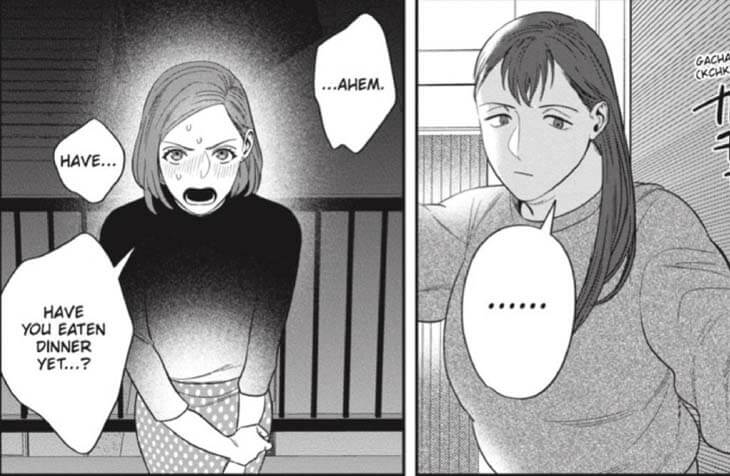
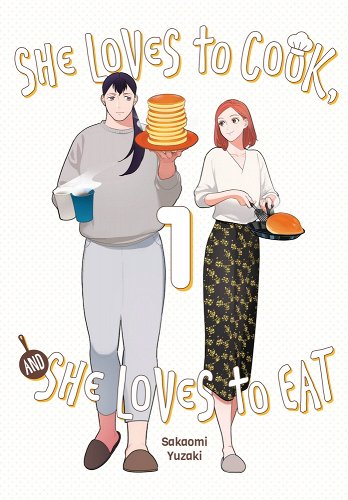
Finding the relationship you need is a nourishing experience. Even more so when food is involved. A comforting slice-of-life manga, She Loves to Cook, and She Loves to Eat volume 1, is about two neighbors bonding over food and cultivating a new caring space for each other.
She Loves to Cook, and She Loves to Eat, Vol. 1
Sakaomi Yuzaki (creator), Caleb David Cook (Translation), Phil Christie (Lettering)
Yen Press
18 October 2022
Content warning for the book: Fatphobia, sexism
Nomoto is an office worker who loves to cook but doesn’t have a big appetite herself. While she has dedicated fans of her cooking on social media, she doesn’t cook how she wants to. What Nomoto really wants is to make big meals but, having moved away from home, she doesn’t have anyone to cook for. That is, until she notices her neighbor, Kasuga, coming home with a feast. One that Kasuga says is all for her.
Seeing this, Nomoto decides to offer Kasuga the food she cooks. Kasuga accepts and the two begin cooking and eating together because Kasuga loves to eat. Or so Nomoto and eventually Kasuga say. Kasuga, as a character, is a bit of a mystery. Yuzaki’s depiction of her is the opposite of Nomoto. She’s tall, somber, and reserved though no less caring than her neighbor. And while she always accepts Nomoto’s food, says it’s tasty, and finishes her plate, Yuzaki’s depiction of her enjoyment borders between subtle and vague.
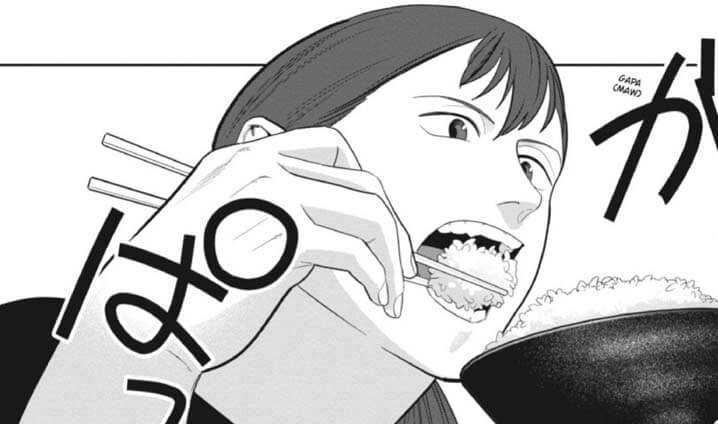
The manga is about people eating, but Yuzaki’s depictions lack the details that convey to me that a character enjoys food. There are slight shifts in Kasuga’s eyes later in the book, suggesting joy. And she’s regularly surrounded by action lines indicating how quickly she eats. But, more often, the characters look like they’re just putting food in their mouths. The panels look almost mechanical, like the characters churn through their meals. While clearly they eat quickly, Yuzaki regularly draws both Kasuga and Nomoto with their mouths open. The result is a bit like watching people constantly eating with their mouths open, which I find unappealing.
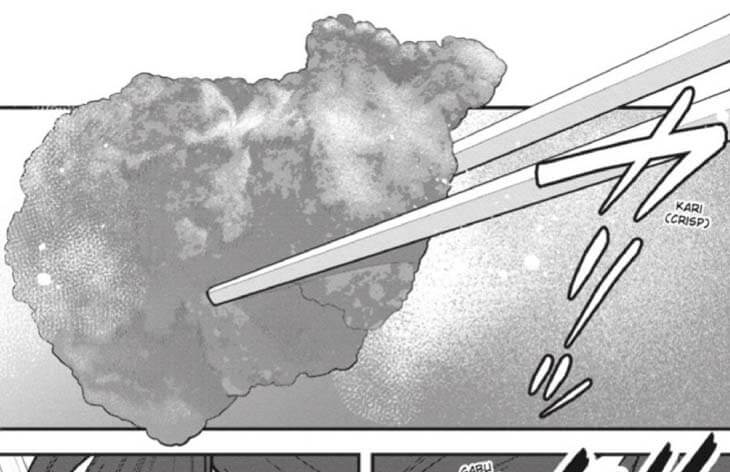
On top of that, there are some other weird things with the art. The food is not rendered with as much detail as I’d expect for manga where eating and cooking are an important part of the story. Part of this seems to be a problem with the screen tones or shading.
An example of this unrelated to food is when Nomoto and Kasuga take a drive to a farmer’s market along a beautiful route. We see Nomoto’s face light up, reacting to the beauty of the landscape. The next panel is an almost illegible landscape where I can’t tell what’s what. It’s like a bad photocopy of an illustration. This screen tone issue, with the lack of detail in the art, make the manga rely more on the dialogue to explain what the art should convey.
That isn’t the worst, as there were some pieces of dialogue I was not expecting in this book. Specifically, both Nomoto and Kasuga are subtly but firmly feminist and Yuzaki’s art supports them. After listening to a male coworker go on about her cooking, who Yuzaki depicts without a face, signaling how he could be anyone, Nomoto notes that she hates that people read her joy of cooking as something that can serve a man. Kasuga similarly notes how it’d be nice if she got paid the same as her male co-workers. She’s also got some other pro-worker dialogue that I was not expecting but I am here for it.
In general, seeing two women care for each other, support each other’s choices, and develop a connection warms my heart, even though watching them eat doesn’t always work for me. Overall, this introduction to the series sets up a sweet connection between these two neighbors and I hope they continue to find new and different ways to care for each other in future.

