

New from the folks at Dark Horse comes a comic that asks a sobering, never-before-considered question: What if Batman was a bad guy????
Cloaked
Jordi Armengol (Art and Colors), Nate Piekos of Blambot (Letters), Mike Richardson (Story)
Dark Horse Comics
August 17, 2022
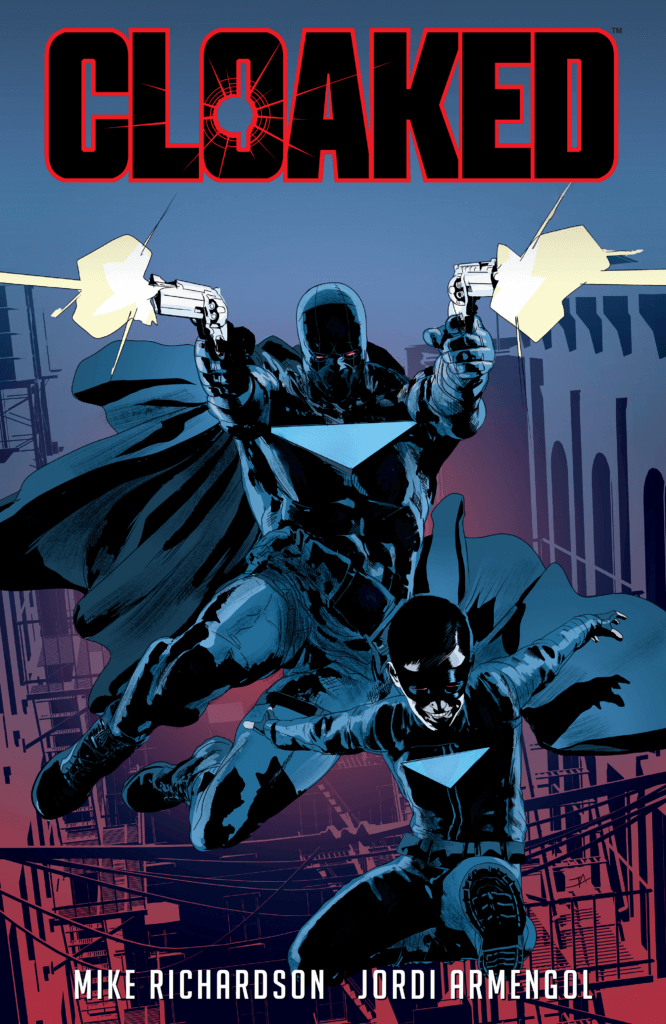
I try not to speculate too much on behind-the-scenes details when I’m focused on writing a review because it detracts from the actual material being covered. Nonetheless, it bears noting that this story’s author, Mike Richardson, happens to be the founder and CEO of Dark Horse Comics. I can’t be entirely sure of what that that means for the editorial process, but I will say that this book reads like the work of someone who doesn’t get told ‘no’ a lot.
The trade paperback collection of a four-issue miniseries published from December 2021 to March 2022, Cloaked is a noirish crime story. A cop-turned-private-eye named Jake Stevens is hired by a rich man to track down the whereabouts of a vigilante known at various points as the Sentinel and the Reaper, who disappeared twenty-five years ago, and was never seen again. Oh wait, excuse me, he appeared twenty-five years ago, was active until at least nineteen years ago, and then disappeared. The details are unclear, you see, because the story itself can’t seem to nail down a proper timeline. If it were a case of intentionally conflicting information, meant to highlight the murkiness of available information, that would be one thing, but it isn’t—it’s the specific number, twenty-five, used in multiple places for different purposes.
Cloaked also includes multiple barely-veiled references to Batman: a crime-riddled city, a caped hero without powers who works at night, a ‘Wonder Boy’ child sidekick, and a clown-themed nemesis. The ‘Terrific Two’ ride around in a souped-up roadster, and the sidekick’s name is ‘Dicky Johnson’—a double-fisted dick joke as well as a play on Dick Grayson. Oh, and before I forget, the man who hires this detective? Byron West. A fancy B-name to echo Bruce, and West shares Wayne’s W while also referencing Adam West, who famously played the character.
The point is, Cloaked is not subtle about what it’s trying to do. As Stevens tracks down the clues to the Sentinel’s (or the Reaper’s?) disappearance, a slew of grisly murders follows him. First, Dicky Johnson is shot outside a bar after Stevens interviews the man, then a reporter who used to cover the crimefighting duo is thrown out of a high-rise apartment window. Finally, the clown-themed nemesis himself, a former accountant subjected to regular shock treatment in a mental institution, is found hanged in his cell.
Each interview gives Stevens a few more clues to the whole picture, but each murder has the cops closer and closer on his tail as he follows his leads. It’s meant to ratchet up the tension, but it falls flat; the story’s beats are so on the nose in their Dark Knight pastiche that it distracts from the narrative. You know who Byron West is the moment you’re introduced to him, and the question of why he would hire a detective to investigate his own history as a costumed vigilante isn’t compelling enough to drive the mystery for four issues. Add in the murder of Stevens’ girlfriend, who is only given two panels of actual face time, and then only to harangue Stevens, and you’re left with a tired, misogynist story with nothing worthwhile to say.
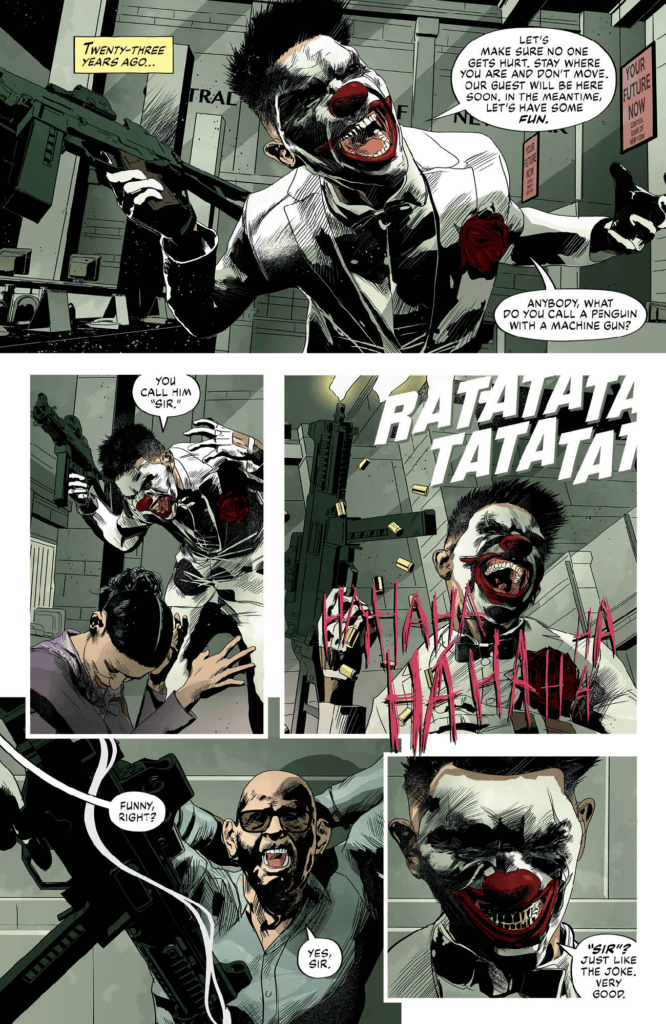
Even this might be forgivable if the artistic choices of the book were memorable, but they aren’t. Armengol’s art feels like a budget Andrea Sorrentino comic, all photo-referenced static poses and no dynamism. The sample page above is a great example; the poses seem dynamic until you spend a moment considering them; there’s never motion depicted, just a freeze-frame a second after the motion. Armengol dresses it up with a lot of thin linework, heavy on the hatching to convey…I don’t know, grit or the much-vaunted “realism” certain comics fans profess to want, but the bones of it are evident nonetheless. Nothing’s moving here, not the characters and not the story itself.
Cloaked lacks the style and panache of even the worst Batman comics, and doesn’t come close to other takes on the model (see Francesco Francavilla’s transcendent The Black Beetle, also published by Dark Horse). Truthfully, it reads like the kind of story that would’ve been rejected at the pitch phase if it were submitted by anyone other than the guy no one at the company can say no to.
