
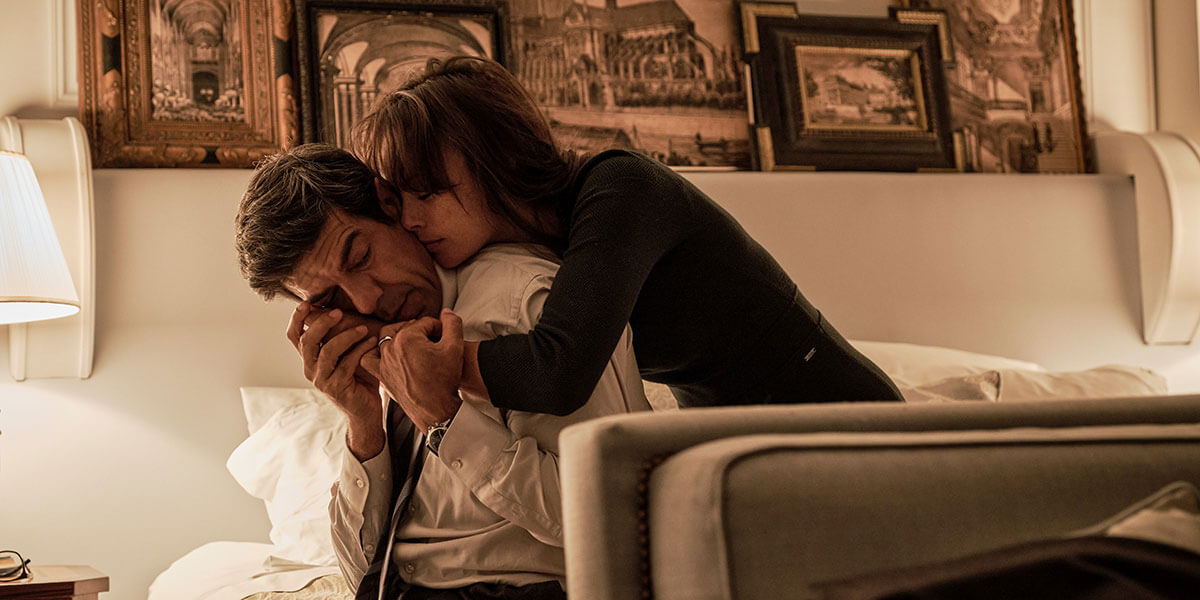
Eschewing standard chronology, The Hummingbird tells the story of Marco Carrera (Pierfrancesco Favino), from his birth to his death, and all the extraordinary people and circumstances he encounters in between.
The Hummingbird
Francesca Archibugi (director and writer), Laura Paolucci, Francesco Piccolo (writers), Luca Bigazzi (cinematography), Esmeralda Calabria (editor)
Pierfrancesco Favino, Kasia Smutniak, Bérénice Bejo, Nanni Moretti, Laura Morante, Sergio Albelli, Massimo Ceccherini, Alessandro Tedeschi, Benedetta Porcaroli (cast)
September 16, 2022 (TIFF)
Based on Sandro Veronesi’s novel of the same name, The Hummingbird is both a story about stillness in a world that’s constantly moving, and a study of how dysfunctional families leave a trail for generations to come. I feel like if the film had focused on one aspect and not both, it might have been more accomplished.
On the dysfunctional side, it becomes clear early in The Hummingbird that Marco’s parents are huge personalities but also have a volatile relationship they fail to hide from their three children. Thus, Marco grows up with a fractured understanding of romantic relationships. He promises himself to his lifelong love but marries a woman who he believes is his destiny. He’s in love with the idea of love and the ideal family but fails to see when people don’t love him and that his family is falling apart.
Throughout The Hummingbird, it seems that Marco is at loggerheads with life itself. He wants to stay still, live in the same house, have one family for life, the same love for eternity. But the world doesn’t stand still. Life and death happen, but Marco stays the same.
This concept doesn’t always translate well in the film. Why does Marco want to stay still? Is his life better for it? Because from my viewing, it didn’t seem that way. Maybe if Marco took a few chances, his life could have been different? Change is scary, definitely. But Marco never even tries. That’s what keeps him content but it also stunts his ambition for himself and the people in his life.
Through Pierfrancesco Favino’s performance, we see Marco adapt to the changes he can’t avoid, but he never really grows. Favino does an apt job of portraying the older Marco as he finds and loses love, family, and so much more. However, there was one scene where his acting came across as stilted—dialogue delivered without emotion. But this was an aberration in The Hummingbird, and later there’s a scene where Favino absolutely kills it with a raw depiction of grief that caused audible sniffles in the theatre I was at.
The acting in The Hummingbird is strong, beyond Favino. But the female characters have so little to do. I’m not sure if it was intentional, but there’s a theme of mental health running through this film which only pertains to the female characters. The takeaway from the film seems to be that all the women in Marco’s life can be described as ‘crazy.’ His sister, mother, wife, lover, daughter, even his sister-in-law. Their actions just don’t make sense! And they all need psychoanalytical help but none of the men ever seem to need the same? There’s a pattern here and I found it disturbing to encounter it in a film released in 2022.
The Hummingbird also ended up being 40 minutes too long. There was a plot line hinted at early in the film that took on a life of its own in the final act. It was meant to give some purpose for Marco’s inaction but it only prolonged a story that had done its work a while ago.
However, the makeup was absolutely flawless. Aging makeup and de-aging technology has been hit or miss even in major film franchises but The Hummingbird pulled it off. I couldn’t tell you what ages the actors were from watching this film. Great work on that front. The cinematography is also gorgeous and luscious, but when you’re shooting in Italy, that seems like a prerequisite. However, I haven’t been able to travel during the pandemic, so it was great to see Florence again!
For the first hour of The Hummingbird, I was enrapt by the family dysfunction and the excellent use of non-linear storytelling. But that last hour was too much. More details than were necessary, a plot line that added little to the story, and too much exposition. The performances were strong, the cinematography stunning, but some editing was desperately required.
