
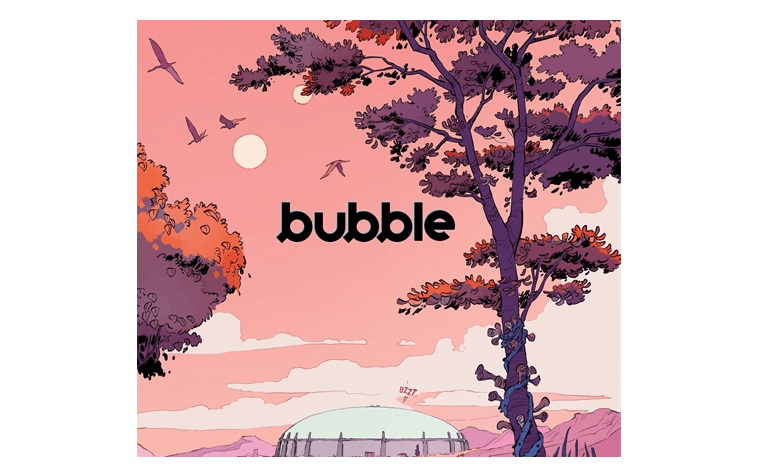
Bubble, the graphic novel adaptation of the Maximum Fun podcast, feels a lot like fanfiction. I don’t mean that to denigrate fanfiction, nor necessarily even Bubble. If you’re the audience for it, you’re the audience for it, and as it turns out, I am most definitely not the audience.
Bubble
Tony Cliff (Artist), Sarah Morgan (Writer), Jordan Morris (Writer), Natalie Riess (Colorist)
First Second
July 13, 2021

Bubble, nominated for both Best Adaptation from Another Medium and Best Humor Publication at the Eisners, is adapted by Jordan Morris (who created the podcast), Sarah Morgan (who wrote an episode of the podcast), Tony Cliff, and Natalie Riess. It takes place in a future semi-dystopia in which many people live in domes, called Bubbles, sealed off from the rest of the world. The outside world, known as the Brush, contains various beasties who are now breaking their way into the Bubble our protagonist, Morgan, calls home.
Morgan grew up in the Brush and uses her knowledge of the creatures to slaughter them and bring them home to her roommate, Annie, who turns their blood into drugs. Everybody needs a side hustle in this world, where, much like our world, everything costs more than a single person can afford.
Enter Huntr, a new gig work app from Tandem, the company where Morgan works her day job. Workers for the app are tasked with slaying the invading imps from the Brush. With a little pressure from Bonnie Ramos, who played a sort of sponsorship role to Morgan to get her out of the Brush, Morgan joins the app along with Mitch, Annie’s goofy former hookup, and Van, an irritating but not unlikable fellow Brush Baby. It should be easy cash for someone with Morgan’s skills, but it quickly becomes clear that the frequency and power of the Imps isn’t normal, not even for this world.
All of that sounds fine. Good, even! I read the premise and blurbs and suggestions of satire and thought, “Yes! This sounds like a fun read!” And while “fun” isn’t off the mark, Bubble‘s plot is largely crammed into a few pages in each section, while the rest is devoted to pop culture references and jokes.
It’s this, more than anything, that makes a comparison to fanfiction feel so apt. Fanfiction is as wide and varied as the fandoms that inspire it, but it often serves to imagine the characters of a beloved franchise outside the peril that normally threatens them—Star Wars characters in coffeeshops, MCU characters having petty relationship disagreements. The world of Bubble is threatening, but more time is spent on pub trivia (with guest appearances from the McElroy brothers) or eating together than the plot.

Again, this isn’t inherently a bad thing, but it feels like fanfiction without the benefit of attachment to the characters. I couldn’t bring myself to care about the cute character interactions because the characters were little more than likable archetypes. Morgan’s a strong, capable protagonist who needs to learn to rely on others, Annie’s fun and queer and polyamorous, Mitch is sweet and goofy… they feel like constructs, not people. It’s not that they aren’t flawed, but that even those surface-level flaws feel focus-tested. Because they aren’t built on an existing foundation, I can’t excuse a shallow interpretation the way I could with fanfiction where I have prior knowledge going in. I can’t grow attached to something that assumes I already love it.
Many of the blurbs and reviewers note Bubble‘s satire, but I found it less incisive than expected. While it certainly is pointing toward the same exploitation we experience in our world, the lack of conflict makes it all feel rather toothless. I can’t appreciate the escape from peril if I never really feel the peril in the first place. Because Morgan (and Van) are so capable, things that should be threats are mere irritants that slow down the steady stream of jokes. Even the imp-ification of a major character is the result of drugs and a little parasite rather than a real threat.
Surely people do experience hardship in this world that isn’t related to fighting monsters, but we don’t see what that looks like. Even the climactic final battle, in which our heroes fight against an important figure from one character’s personal history, feels more like a vehicle for jokes than anything with stakes. Punches are thrown, quips are made, but not only does it not feel threatening, it feels rote. It feels like every other scene in which punches are thrown and quips are made, which is to say the climax of every arc, each of which takes up only a handful of pages amidst all the other jokes.
This approach may have worked if the jokes were funnier. Unfortunately, Bubble‘s humor is more about pop culture references (the number of 311 references—yes, the band—could itself be a joke, but a tiring one) than about incisive commentary. Yes, the characters exist in a capitalist hellscape and sometimes they joke about it, just as we do. But the genre-savviness and referential humor don’t add anything to the story. It would work if we cared more about the characters and their interactions— a la fanfiction—but I never felt that connection. I mostly felt bored.
Bubble isn’t all bad—Tony Cliff’s art and Natalie Riess’ colors are truly stunning. Cliff’s realistic art style grounds the reader in this just-left-of-real world, but doesn’t shy away from exaggerations to complement the jokes. He uses primarily thin lines that let absence (and Riess’ colors) do the work, but leans into detail in scenery and texture. Everything feels organic and alive thanks to limited straight lines—shirts fall at natural angles, faces curve, bodies are soft rather than rigid. The art imbues the comic with a sense of aliveness, bringing the characters to life much the way a voice actor would. If only the script were adapted enough to match the strength of the art.
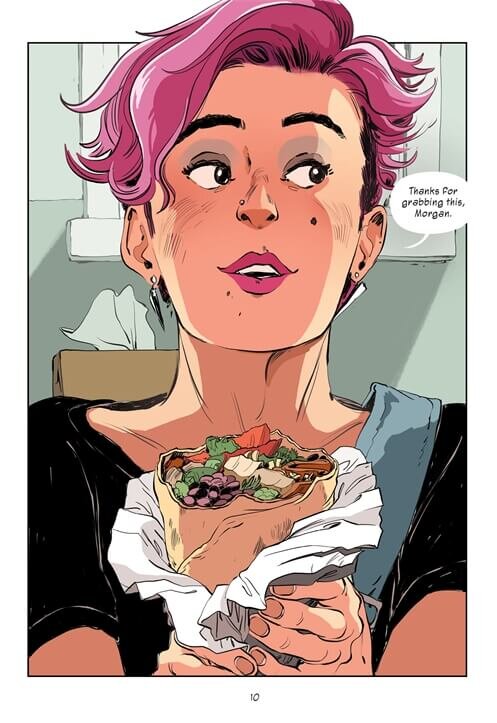
Riess’ colors, too, add dimension to a world that lacks it. Riess works in a mixture of bold, contrasting colors and more neutral palettes, depending on what the scene needs. Fight scenes are rendered in bright greens, blues, and pinks, giving them a boisterous energy that echoes the comic’s overall tone without being distracting. Flashback scenes are emphasized in browns and oranges, while the world outside the bubble appears to be in a perpetual pink, orange, and yellow sunset. Flipping through, you can see each scene thanks to color transitions—all work in harmony together, but Riess’ colors set the visual tone for each scene.
Bubble has a talented team. Though Riess and Cliff stand out, there are good ideas at the heart of the book, but the execution leaves much to be desired. I, a person who loves podcasts (and podcast graphic novel adaptations, no less!), goofiness, and even cozy stories, feel like I ought to be the target demographic here. But reading Bubble felt like I was reading a story attempting to capture a zeitgeist without being part of it. I felt pandered to, and not in a validating way. It was as if it were written to check a number of boxes of “Things people like”—in-joke style references, non-threatening respectful softboys, large queer polyamorous women, jokes about capitalism—but without the work to make it feel real and earned. It feels like it’s written to the specific audience of Maximum Fun podcast listeners: young, fandom-oriented, hungry for optimistic and queer content. That’s not to say that that audience has poor taste, only that there seems to be an assumption on the part of the comic that gesturing toward a character archetype that I like is enough to make me happy. Much like the pop culture references peppered throughout Bubble, the inclusion of surface-level characters makes an assumption about who I am as a reader and asks me to be satisfied by ticking boxes for what that audience likes. It seems to work well enough for others, judging by the Eisner nominations and positive Goodreads reviews. But for me, Bubble felt as hollow as its soapy namesake: a thin layer of rainbow veneer over a whole lot of nothing.
I really did want to enjoy Bubble. The premise is fun, the art and colors are lovely, and I like a good joke as much as the next person. But without the character and thematic work to ground it, the comic just feels like a bunch of empty gestures toward pop culture and anti-capitalism, like taking a sugar pill when you could have had something delicious and nourishing.
