


Himawari House by Harmony Becker (They Called Us Enemy) is slice-of-life diaspora fiction that revolves around the sense of home, belonging, and otherness experienced by three young women living in Japan. Having decided to take a gap year between high school and college, 18-year-old Nao moves into the Himawari share house in Tokyo, where she studies Japanese language while reconnecting with her mother’s family. Over the course of a year, Nao and her housemates become friends and share their stories with one another, inviting the reader on an emotional journey into their everyday lives.
Himawari House
Written and Illustrated by Harmony Becker
First Second Books
November 9, 2021
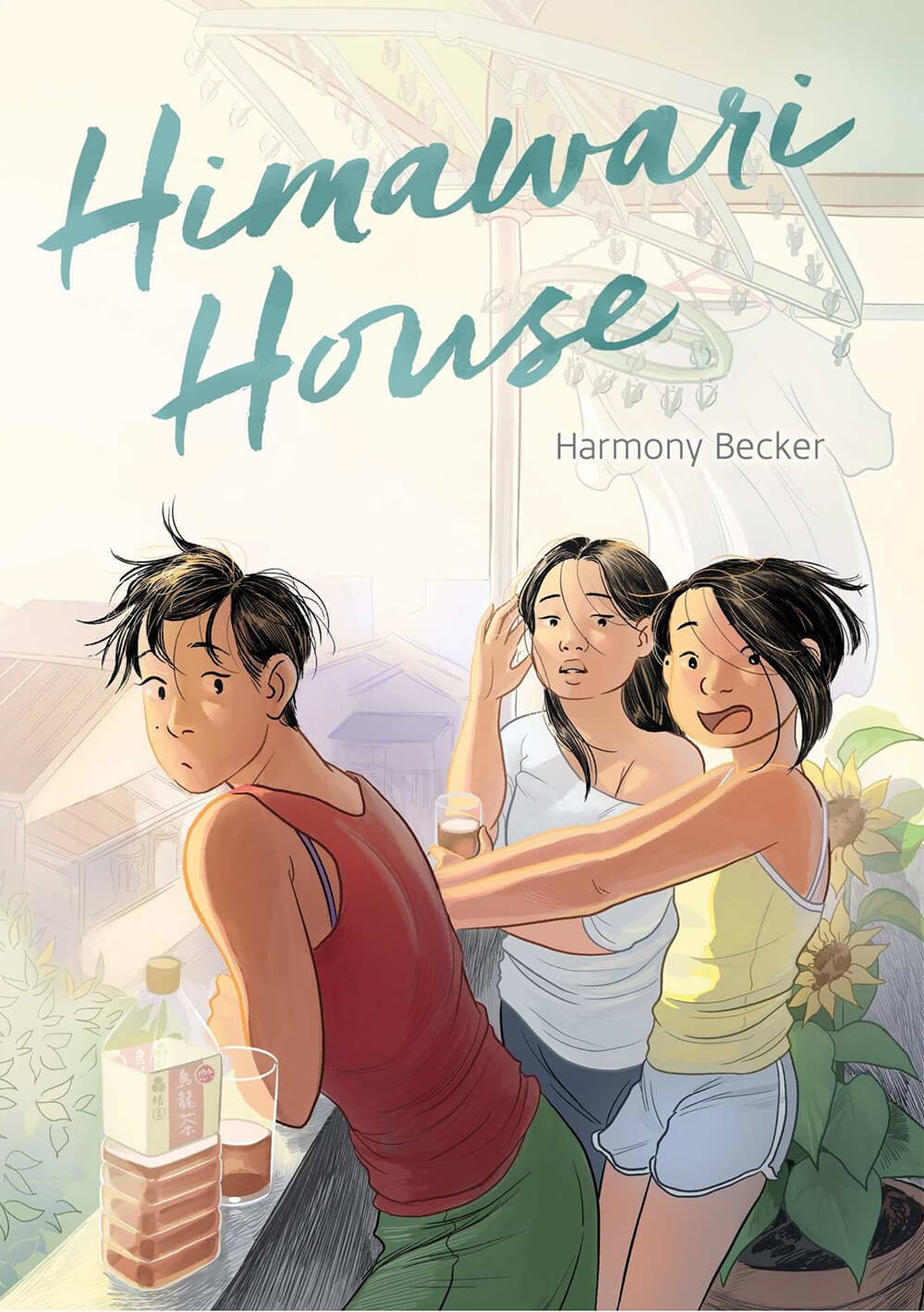
Nao, the main viewpoint character of Himawari House, wants to get in touch with her Japanese roots, but she struggles with the language and occasionally feels as though she’s only wearing a costume of “being Japanese.” Her housemates are Hyejung, a fellow language student from Korea hoping to gain admission to a Japanese art college, and Tina, a young woman from Singapore who works part-time while studying for university entrance exams.
Tina wants to live in a culture that’s like her own but still slightly different. To support her dream, she has to work part-time service jobs where her own difference is all too apparent. Hyejung was a model student in high school but decided to study abroad to get away from her parents, as the pressure to conform to their expectations stifled her sense of individuality. She cut off all contact with her family when she left Korea, but now she’s desperately homesick.
Despite the cultural conflicts informing the narrative arcs of its characters, Himawari House isn’t high drama all the time, or even most of the time. Nao and her housemates study together, cook together, go out drinking together, enjoy summer festivals together, and generally live chill and relaxing lives in each other’s company. When each of their personal stories is resolved, however, it’s extremely touching. Himawari House doesn’t offer its readers wish-fulfillment fantasies about Japan or solutions to the complicated problems it poses, but the earnest and sincere portrayal of the relationships between characters highlights the nuances of their relationships to their respective cultures.
Harmony Becker’s art is beautifully dynamic and masterfully captures the youthful energy and expressive faces of her three protagonists. Although most of the monochromatic drawings are realistic with a gentle touch of stylization, Becker occasionally employs the visual language of shōjo manga for comedic effect. Such stylizations include large, sparkling eyes to signal the characters’ excitement (usually concerning delicious food) and cute chibis in key pivot panels that signal a comedic turn of emotion. Every page of the graphic novel stands on its own as a work of cross-cultural comic art.

One of the most intriguing graphic aspects of Himawari House is its lettering and text layout. As Becker explains in a note at the end of the book, “I love accents, I think that they add depth and character to one’s speech – a sense of place.” Her characters therefore speak English with their own regional accents. This linguistic stylization is never obtrusive, and it’s a pleasure to read. In addition, Becker’s writing normalizes and humanizes people who speak with accents, thereby serving as a welcome corrective to the American cultural practice of using East Asian accents as a vehicle for lowbrow comedy.
Becker also shows characters speaking in Japanese (and occasionally Korean) text with English subtitles, which are sometimes crossed out or even omitted entirely when someone says something the current viewpoint character doesn’t understand. When the viewpoint character is Japanese, Becker represents unintelligible English as messy handwritten cursive scrawl. As languages continue to shift between different character interactions, the reader gradually becomes more comfortable with linguistic mixing and diversity, as do the characters themselves.

Himawari House is an interesting and meaningful follow-up to They Called Us Enemy, Becker’s collaboration with actor and activist George Takei about the illegal internment of Japanese-Americans during the Second World War. While They Called Us Enemy is about how individual lives were subsumed under the cultural identity of “Japanese” (which was foreign to many people to whom it was forcibly applied), Himawari House is about finding and negotiating Japanese cultural heritage as a chosen aspect of individual identity.
Becker’s message is that, while cultural identity is important, it also shifts and changes as different people from different cultures interact with one another. In the end, it’s up to each individual person to decide what their cultural heritage means to them. Himawari House demonstrates that “identity” isn’t abstract and monolithic, but rather a joyful aspect of everyday life. As Nao reflects on her transformative experiences when her year in Japan comes to its close, “However much of an illusion, whether anyone else acknowledges that it happened or not, it was real to me. And isn’t that enough?”
