


From indie roots to millions of fans and a 100% on Rotten Tomatoes, Heartstopper is the coming-of-age queer first-love story that makes your heart full to see succeed.
Heartstopper began in September 2016 when creator Alice Oseman shared the webcomic’s first few pages on Tapas and Tumblr. Following the love story between two British teenagers, Charlie Spring and Nick Nelson, the webcomic quickly became beloved amongst its readers and inspired Oseman to self-publish volume one of Heartstopper in 2018 before it was picked up by a traditional publisher, Hachette Children’s Group, later that year. The Netflix TV series adaptation, even with Oseman at its helm as its writer, had a lot of expectations to live up to when it released in April. Thankfully, it did not disappoint.
Heartstopper the show is a successful adaptation because it captures the essence of the comics. In many ways, Oseman literally brought her pages to life with scene-for-scene and even word-for-word pulled from its source material. Yet the adaptation’s success was also due to two changes they made. The show keeps the queer love story between lead characters Charlie and Nick at its core, but it also expands the scope of the tale to utilize its ensemble cast. At the same time, the show also creates much more intimate and private moments between Charlie and Nick compared to the webcomic. This is a result of a technique that cinematographer Diana Olifirova and director Euros Lyn use called tight framing, wherein there is little space visible around the camera’s subject. Many of the adapted scenes utilize this technique more frequently than the comics for a romantic, intimate effect.

In the comic, Heartstopper closely follows Charlie and Nick, with few exceptions occurring later on in the series. But in order for a supporting or minor character to appear, they were always within a scene that included one of the main characters. The show, however, deviates from this in its first episode as Tao and Elle, two of Charlie’s closest friends, message each other at lunch. Taking advantage of TV’s fluidity of switching between scenes and characters, the show explores Elle’s adjustment to the all-girls school, colloquially known as “Higgs” by the characters, in the early episodes. In the webcomic, Higgs was simply referenced. Elle’s experience at Higgs is one of many examples where the adaptation took smaller, existing story threads from the comics and gave them proper screen time alongside the main love story. Other examples include the mutual pining between Elle and Tao, Tara and Darcy’s relationship, and the friendships of the characters outside of the main coupling. Even Charlie’s connection with his art teacher, Mr. Ajayi, comes into focus in the show.
These extra moments make it so that the significance and importance of finding community, and more specifically that of a queer community, is integral to the adaptation. Just as the comic explored, the focus on community in queer spaces is not just limited to romantic love. Community is also friendship among peers, finding allies in straight spaces, and learning from older generations about how to navigate the world. While the unique experiences of the Heartstopper characters may not resonate with every viewer, the desire for and connection to other queer people is a near universal experience. These elements were all present in the comics, and the Netflix series brings them all to the forefront and makes it more explicit for viewers through its ensemble narrative.
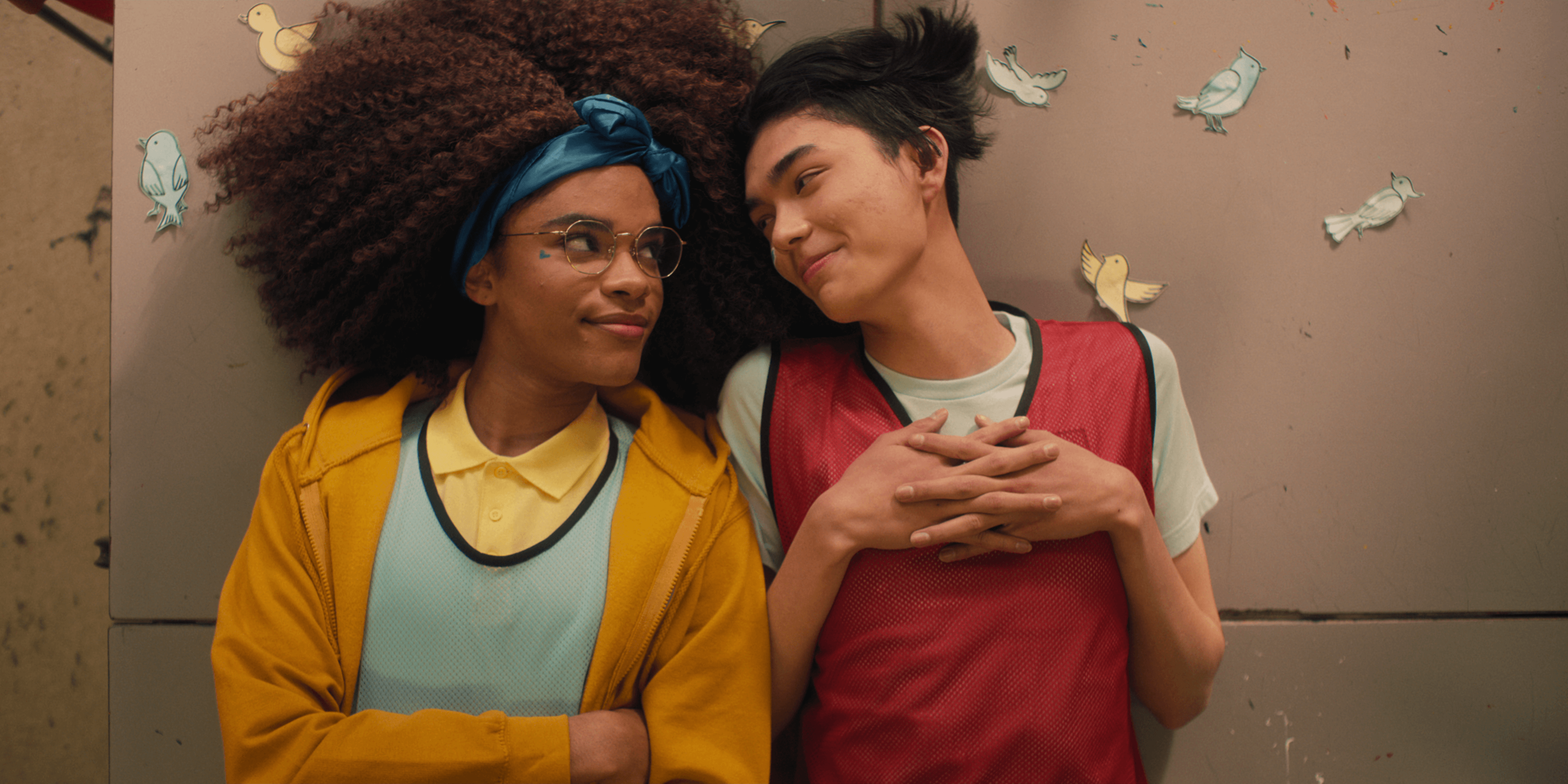
To be clear, Charlie and Nick remain the core of Heartstopper even while the threads of the other character’s stories interweave through each episode. Though many of their scenes together stay the same in the adaptation, there is a slight deviation worth noting. In the comics, Oseman is not afraid of utilizing close-ups for the private moments between Charlie and Nick to show their emotions and allude to their inner thoughts. In the show, these moments feel even more abundant and operate alongside the use of a slightly swaying, hand-held camera rather than a stationary one to evoke a sense of realism. The effect is that of emphasizing the way viewers are peeking into these characters’ own private world in real time.
The iconic beach scene in the last episode is a primary example of how tighter framing underscores these intimate moments. Taken from Heartstopper pages 528-542, Nick tells Charlie he is “definitely bisexual” and wants to be open about their relationship to those who matter to them. In the comic scene, the shots mainly range from showing them from the waist up, to medium close-ups at the shoulders, to close-ups with just their faces in view. It breaks from this pattern when Nick runs into the waves proudly announcing his romantic love for Charlie before returning. The final panel shows their full bodies at a slight distance as they lay on the beach in each other’s arms.

In contrast, with their conversation still being near verbatim from the comics, the show’s beach scene keeps its shots much tighter. The camera focuses on their faces and subtle expressions: their stolen glances, small smiles, and dare I say it, the metaphorical hearts in their eyes. Like its predecessor, the camera pulls away for a moment when Nick runs to the water. However, it finds itself drawn back towards them, panning swiftly back in as Nick notices Charlie’s expression. Their desire to be even closer together is stressed when the frame pulls tighter still as they hug. The scene ends with them laying in each other’s arms, with a close-up on Charlie and then Nick’s face in turn.
The significance of these scenes with tighter framing than that of the comics is twofold. As noted above, the realism evoked by the camera’s slight unsteadiness adds a subtle layer to each of these moments. It heightens the sense of intimacy and privacy between Nick and Charlie. In addition, it allows for the viewers to place themselves in one of the character’s shoes – like a Your Name fanfiction come to life. Combined with the show’s vibrant color palette contrasting to the comic’s black and white style, these scenes represent the fantastical elements of this world for both the characters and the viewers. Thus, the excitement of first love, the closeness that comes with it, and the possibility of it happening to you, too, is captured here from the comics through these cinematic choices.
Much of Netflix’s success with adapting Heartstopper no doubt comes from the direct hand Oseman had in its creation. Working alongside Lyn and Olifirova, Oseman built upon the world she created while taking advantage of what a live action TV series could uniquely achieve for its characters’ stories. The show is not afraid of embracing change because it knows what values to prioritize from its source material. Although adaptations are not required to be absolutely faithful to the source material, Heartstopper successfully demonstrates how to build upon original material across mediums. More importantly, as a queer story finding mainstream acclaim, it hopefully also means that more stories showcasing diverse queer communities and the validity of self-discovery will find success, too.

