


Starting today is Women Write About Comics’ annual review series covering the latest round of Hugo finalists. To kick things off, here are two of the contenders for Best Short Story…
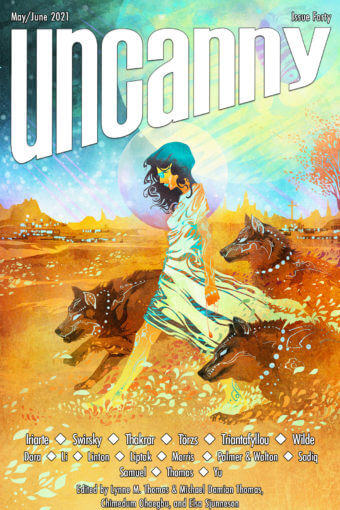
“Proof by Induction” by José Pablo Iriarte
Paulie Gifford has just lost his father, but modern technology provides a way for him to remain in touch – after a manner, at least. The tech in question, Coda, is a form of virtual reality based on a snapshot from a person’s final minutes of consciousness. Thanks to Coda, Paulie can visit a recreation of his father, albeit one with substantial limits. “He can tell you if he had a life insurance policy, where the will is, things like that”, explains the local chaplain. “The Coda cannot change in the way that a person can, however; it cannot learn or grow.” To put it another way, the simulacrum lacks a soul.
But Paulie has something other than insurance policies in mind. He, like his late father, is a mathemetician, and the two had been working together on a project. For this task to be completed, the minds of father and son must be reunited, and Coda provides just such an opportunity. Paulie claims ownership of his father’s simulacrum – which would ordinarily have been sent off to a data storage facility after the final goodbyes – and begins a posthumous collaboration.
“Proof by Induction” is one of the stories that reveals the weakness in the age-old dichotomy between hard and soft science fiction: the nuts and bolts variety versus the more character-driven, psychological or emotional narratives. Author José Pablo Iriarte chooses a hard science – albeit an unusual one for the genre – in mathematics, which permeates the narrative. The protagonist’s holy grail is to prove the Perelman Hypothesis; the details of this are left vague, although it is presumably something put forth by the real-life mathemetician Grigori Perelman at some point in the story’s future.
When communicating with his father’s digital simulacrum, Paulie tries to find whether the latter’s mathematical intellect remains by asking him the square root of i; after the data-ghost passes the test, the discussion quickly turns to contemporary mathematical inquiry:
“If we had a generalized solution for hyperbolic equations,” Paulie’s father began.
“We don’t, though.”
“No, but look up Brumbaugh Manifolds. Doug Brumbaugh was working on this the last time I saw him. He may have made some progress.”
“Okay, that’s something to try. I won’t be able to hold much more in my head anyway.”
“I bet if you talk to the company that makes this, they can find a way for you to email yourself from inside or something.”
“No way,” Paulie said. “I don’t want anyone to know what we’re working on here. I don’t want someone to go find every mathematician who’s died in the last five years and hook all their Codas up in some kind of screwed up massively parallel computer and beat us to the punch.”
All of this is to be expected from a work of hard SF that tackles mathematics. At the same time, the central concept of the story provides room for a poignant exploration of emotion. Paulie may be focused on communication with his father’s digital ghost as a means to a mathematical end, but how might his daughter Maddie react? As Paulie’s wife Gina says: “I don’t want Maddie anywhere near it. I don’t want her confused about whether Grandpa’s really gone or not. Just let her grieve.” Paulie is also faced with the loose threads of his relationship with his father, as the late mathemetician was far from an ideal patriarch, having abandoned his family in life.
The hard and soft are inseparable throughout the story, as made clear when Paulie – idly watching a cop show on television – allows his musings about his father to segue into a meditation on the nature of mathematical dedication:
The officers on the screen, with their private dramas and backstories, make him think of his father—alive again in the hours Paulie spends in his Coda, and nonexistent when Paulie looks away. Or maybe the experience is more like a very lucid dream. Paulie hopes not, given how many seemingly profound middle-of-the-night insights have turned out, upon waking, to be nonsense.
Then again, he’s basing all his hopes on the assumption that deduction works the same in-Coda as outside of it.
No, this is beer-fueled nonsense. The whole point of deduction is it works for any set of starting assumptions. It doesn’t matter whether space is Euclidean or not—what matters what axioms you proceed from and whether your logic is rigorous. A theorem that’s true in the Coda is true outside of the Coda. And if it turns out this life is a simulation, as Paulie has seen posited online, Perelman is just as true in the reality outside this one. Even if it’s simulations all the way up.
Even without the human interest provided by the dead father, Paulie’s quest to prove the Perelman Hypothesis does a better job of sustaining a well-paced narrative than might have been expected. The plot has its stakes – Paulie’s academic career being on the line – and Iriarte is able to fill mathematical conversations with nearly as much tension as Ian Fleming could lend a game of baccarat.
All of this culminates in a bittersweet conclusion which, like the solution to an equation, is the inevitable result of the present values.
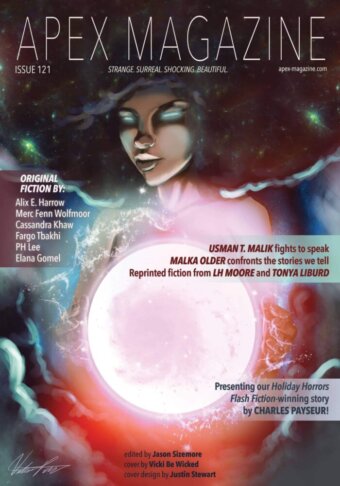
“Mr. Death” by Alix E. Harrow
Sam Grayson is a grim reaper tasked with transporting departed souls to the hereafter. He is deeply unhappy with his latest gig, as the soul he has been ordered to handle is that of a two-and-a-half-year-old child named Lawrence. His dismay stems partly from the practical side of the matter: “two-year-olds are contrarian bastards and it takes several hours and a family-size pack of M&Ms to coax them across the river.” But the gruffness of his response belies the deeply personal stake he has in the job. Sam was once a mortal man – a father, no less – and he suffered the loss of his own son.
What makes this even worse is that a reaper is required to spend at least four hours with the assigned individual prior to their death: “It’s supposed to ‘forge emotional bonds between souls and reapers’ and ‘encourage compassionate care’—the department has been working tirelessly and fruitlessly to combat the whole sweeping robes, menacing scythe stereotype”. The prospect of observing the final hours in the life of little Lawrence, dredging up his own lingering trauma in the process, may just break him.
“Mr. Death” portrays the workplace of the reaper as a realm of briefcases and bureaucracy, with plenty of humorous moments arising from this. Of course, it takes little imagination to build a fantasy world from mundane materials; what does require effort is the small details that bring it to life. Author Alix E. Harrow provides these in ample supply, a typical example being how Sam’s horror at the prospect of reaping a child contrasts with his favourable attitude towards reaping those so old and infirm that death will come as a relief:
There’s something satisfying about those reapings. A routine heroism, like covering a shift for your hungover friend or shooing a trapped bird out the window. Those are the times it’s easiest to believe my supervisor’s speeches about the pristine order of the universe and the cyclical shape of time and the necessity of death.
Haunting the story is the destiny of so many humans: not only death but also the loss of reason to live. Sam knows from experience what it is like to be confronted with “a soul so wasted and dim, so shriveled by bitterness and regret” that he wants to encourage the person to spend their last days truly enjoying themselves. Sam’s perspective on this matter is coloured by his own loss, a detail that the story articulates with sardonic wit:
(The official recruitment policy is race and gender-neutral, but forty-something white males like me are a rarity. We are statistically less likely to experience shattering loss, and culturally permitted to become complete assholes when we do. We turn into addicts and drunks, bitter old men who shed a single, manly, redemptive tear at the end of the movie, while everybody else has to gather up the jagged edges of themselves and keep going)
It is only Sam’s role as reaper that prevents him from falling victim to the spiral of bitterness that the story presents as the lot for much of humanity. He is given a new lease of life – in the most melancholy way imaginable – by his friendship with the due-to-be-reaped Lawrence. We read as Sam keeps an eye on the child, imagines the latter’s family situation, gets embroiled in an impromptu game of ball, and even finds himself “promoted from boring stranger to Imaginary Friend”, all of which makes for a convincing relationship between surrogate father and child despite the unusual angle. Through all of this, Sam compares Lawrence to his own departed son, allowing us to glimpse his emotional backstory:
Lawrence’s mom does bath and bedtime on her own while Lawrence chatters about Maui’s magical fish hook and his big kid underwear and his new friend who’s very tall and sad. She makes the right noises—really? that’s great sweetie!—but she’s not really listening, and I have a sudden, wild urge to shake her until her teeth rattle.
This is it! I want to say. This is the conversation you will replay again and again for the rest of your life! You will wish you took his soft cheeks in your hands and looked into his eyes and said: I love you, Ian, and wherever you go a part of me will always follow, across that dark river and into black beyond, through every eternity.
“Mr. Death” has a large amount of sentimentality to it, but this is arguably the best kind of sentimentality: the kind where dry humour is moistened with tears. The story’s climax faces Sam Grayson with a pointed moral choice – and has him make a decision that cuts through the cynicism inherent in the punch-clock-afterlife setting. When it concludes, “Mr Death” arrives at a note touching enough for a Hans Christian Andersen fairy tale.
