

Continuing the series that celebrates the centenary of Nosferatu with an overview of German vampire literature.
Franz Hartmann, a German occultist and prominent member of Helena Blavatsky’s Theosophist movement, was responsible for one of the more curious specimens of early twentieth-century vampire literature.
Entitled “An Authenticated Vampire Story”, the work in question has been included in multiple anthologies of vampire fiction starting with Leslie Shepard’s Dracula Book of Great Vampire Stories in 1977. Yet when it was first published in the September 1909 edition of Ralph Shirley’s Occult Review (“a monthly magazine devoted to the investigation of supernormal phenomena and the study of psychological problems”) it was presented not as fiction, but as fact.
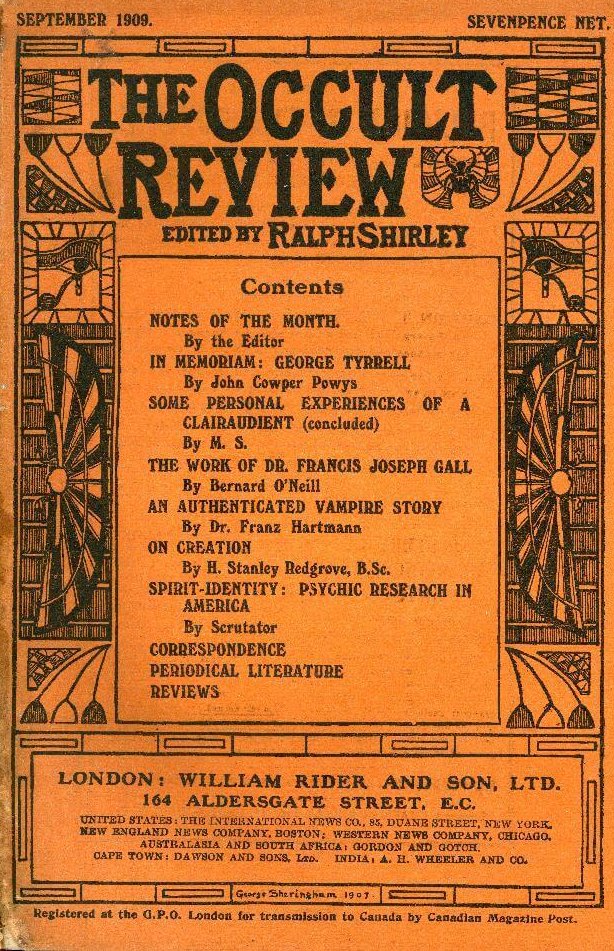
The piece begins by summarising a news report about a castle in the Carpathian Mountains being burnt down, supposedly due to a local superstition involving vampires:
On June 19, 1909, there appeared in a prominent Vienna paper (the Neues Wiener Journal) a notice (which I herewith enclose) saying that the castle of B___ had been burned by the populace, because there was a great mortality among the peasant children, and it was generally believed that this was due to the invasion of a vampire, supposed to be the last Count B___, who died and acquired that reputation. The castle was situated in a wild and desolate part of the Carpathian Mountains and was formerly a fortification against the Turks. It was not inhabited, owing to its being believed to be in the possession of ghosts, only a wing of it was used as a dwelling for the caretaker and his wife.
The author goes on to claim that he read this report while accompanied by a friend, who is left anonymous but described as “an experienced occultist and editor of a well known journal”. After noting that “the vampire in question was probably not the old Count, but his beautiful daughter, the Countess Elga” Hartmann then switches to the first-person narrative of the unnamed friend.
This narrator describes how two years ago he lived in the city of Hermannstadt (Sibiu) in Transylvania, and regularly passed by the castle; he also became acquainted with the building’s caretaker and his wife, who occupied a certain wing rather than the castle proper. The couple, we learn, were reluctant to discuss rumours that the house was haunted, but they did divulge something of the previous occupants and the legends attached to them:
“All I could gather was that the old Count was a widower and had a beautiful daughter, who was one day killed by a fall from her horse, and that soon after the old man died in some mysterious manner, and the bodies were buried in a solitary graveyard belonging to a neighboring village. Not long after their death an unusual mortality was noticed among the inhabitants of the village: several children and even some grown people died without any apparent illness; they merely wasted away; and thus a rumor was started that the old Count had become a vampire after his death. There is no doubt that he was not a saint, as he was addicted to drinking, and some shocking tales were in circulation about his conduct and that of his daughter; but whether or not there was any truth in them. I am not in a position to say.”
We are told that, after the death of the Count and his daughter, the castle was inherited by a distant relative who resided in Vienna and had no interest in visiting the old building in the Carpathian wilderness. The narrator informs us that he, along with two friends (identified as Dr. E– and Mr. W–) visited the castle and saw a painting that appeared to move, after which they performed a seance:
“We all were involuntarily startled on beholding this picture; not so much on account of the beauty of the lady, but on account of the uncanny expression of her eyes, and Dr. E–, after looking at the picture for a short time, suddenly exclaimed–
“‘How strange! The picture closes its eyes and opens them again, and now begins to smile!’.
“Now Dr. E– is a very sensitive person and has more than once had some experience in spiritism, and we made up our minds to form a circle for the purpose of investigating this phenomenon. Accordingly, on the same evening we sat around a table in an adjoining room, forming a magnetic chain with our hands. Soon the table began to move and the name ‘Elga’ was spelled. We asked who this Elga was, and the answer was rapped out ‘The lady, whose picture you have seen.”
The rapping spirit gave out another message, offering to appear “bodily tonight at two o’clock”. After Mr. W– agreed to this arrangement, the table “rose on two legs and pressed against his breast, as if it intended to embrace him.” Meanwhile, the visitors were unable to find more solid evidence of who was depicted in the portrait; all the caretaker could reveal was that it was painted by the Viennese artist Hans Makart and “had been bought by the old Count because its demoniacal look pleased him so much.”
Mr. W– spent the night at an inn a half-hour’s journey from the castle. There, he witnessed the apparition of the woman in the painting – Elga:
“Then the door of his room opened and Elga entered. She was most elegantly dressed and appeared still more youthful and seductive than the picture. There was a lounge on the other side of the table where W– was writing, and there she silently posed herself. She did not speak, but her looks and gestures left no doubt in regard to her desires and intentions.
“Mr. W– resisted the temptation and remained firm. It is not known, whether he did so out of principle or timidity or fear. Be this as it may, he kept on writing, looking from time to time at his visitor and silently wishing that she would leave.
At last, after half an hour, which seemed to him much longer, the lady departed in the same manner in which she came.”
The group subsequently returned to the castle, and the story describes more phenomena including lamps and candles being extinguished when brought near the painting, and the apparition of Elga manifesting to a servant girl. There were so many manifestations, indeed, that “it would be tedious to describe” them all. However, the narrator does dwell on two particular incidents. One occurred a few days later:
“Mr. W– was at that time desirous of obtaining the position as co-editor of a certain journal, and a few days after the above-narrated adventure he received a letter in which a noble lady of high position offered him her patronage for that purpose. The writer requested him to come to a certain place the same evening, where he would meet a gentleman who would give him further particulars. He went and was met by an unknown stranger, who told him that he was requested by the Countess Elga to invite Mr. W– to a carriage drive and that she would await him at midnight at a certain crossing of two roads, not far from the village. The stranger then suddenly disappeared.”
Mr. W– declined to make this appointment, instead sending a policeman to investigate (to no avail). The second incident is put into the mouth of an unnamed friend who, we are told, did not believe in ghosts:
“’Last night something very strange happened to me. At about one o’clock this morning I returned from a late visit and as I happened to pass the graveyard of the village, I saw a carriage with gilded ornaments standing at the entrance. I wondered about this taking place at such an unusual hour, and being curious to see what would happen, I waited. Two elegantly dressed ladies issued from the carriage. One of these was young and pretty, but threw at me a devilish and scornful look as they both passed by and entered the cemetery. There they were met by a well-dressed man, who saluted the ladies and spoke to the younger one, saying: ‘Why, Miss Elga! Are you returned so soon?’ Such a queer feeling came over me that I abruptly left and hurried home.”
Given that the above account is attributed to an anonymous friend by a narrator who is himself the anonymous friend of the story’s author, it constitutes a sterling example of FOAFlore. The narrator concludes his account by describing an attempt to exorcise the painting:
“To look at the picture for a certain time caused me to feel a very disagreeable sensation in the region of the solar plexus. I began to dislike the portrait and proposed to destroy it. We held a sitting in the adjoining room; the table manifested a great aversion against my presence. It was rapped out that I should leave the circle, and that the picture must not be destroyed. I ordered a Bible to be brought in and read the beginning of the first chapter of St. John, whereupon the above-mentioned Mr. E– (the medium) and another man present claimed that they saw the picture distorting its face. I turned the frame and pricked the back of the picture with my penknife in different places, and Mr. E–, as well as the other man, felt all the pricks, although they had retired to the corridor.
“I made the sign of the pentagram over the picture, and again the two gentlemen claimed that the picture was horribly distorting its face.
“Soon afterwards we were called away and left that country. Of Elga I heard nothing more.”
Is there any truth behind this strange story? In 2021, Benjamin Adamah wrote a post for the official blog of the occult publisher VAMzzz confirming that the newspaper story mentioned by Hartmann at the start of the piece – that is, the report in the June 19 1909 Neues Wiener Journal of a castle in the Carpathians being burnt down – is genuine. The relevant page is archived online. The report, in its original German, is as follows:
(Zerstörung eines Schloffes aus Uberglauben.)
Wir erhalten aus Bermannstadt die Nachricht, daß das Schloß Bethenykörös einem seltsamen Aberglauben der walachischer Bevölferung des Dorfes gleichen Namens zum Opfer gefallen ist. Bethenykörös liegt in wildromantischer Gegend am Südostabhang des Karpathengebirges und mag einst ein überaus festes Bollwert gegen die Türken gewesen sein. Seit langen Jahren war es nicht mehr bewohnt und nur ein Kastelan hauste mit seiner Frau in einem Seitenflügel. In der Bevölterung war eine Reihe von Geschichten über die Bewohner des Schlosses verbreitet, unter anderem glaubte man allgemein, der leßte Graf Bethenykörös sei als „Vampir“ gestorben. Als nun in den leßten Wochen zahlreiche Bauernkinder infolge einer Seuche rasc nacheinander starben, behauptete das abergläubische Volk, der Graf Habe sie ermordet, und beschloß, die Grabstätte des „Vampirs“ zu zerstören. Bei dieser Gelegenheit ist wahrscheinlich durch Unachtsamkeit Feuer ausgebrochen, dem der staatliche Bau bis auf die Grundmauern zum Opfer gefallen ist. Das Schloß soll gulegt einem in Wien lebenden jungen Kavallericoffizier, der es durch Erbschaft erwarb, gehört haben.
Benjamin Adamah renders the report into English:
We receive the news that Bethenykörös Castle has fallen victim to a strange superstition of the Wallachian population of the village of the same name. Bethenykörös is situated in a wildly romantic area on the southeastern slope of the Carpathian Mountains and may once have been a a very strong fortress against the Turks. It has not been inhabited for many years and only one castellan lived with his wife in a side wing. There were a series of stories about the inhabitants of the castle. Among other things, it was generally believed that the last Count Bethenykörös died as a “vampire”. When in the last few weeks numerous peasants’ children died one after the other due to an epidemic, the superstitious people claimed that the count had murdered them, and decided to destroy the tomb of the “vampire”. On this occasion, probably due to carelessness, fire broke out, which destroyed the state building till only the foundation walls remained. The castle is said to have belonged to a young cavalry officer who lives in Vienna and who acquired it by inheritance.
So, the report corroborates the history of the castle as sketched out by Hartmann, and also provides a fuller name for Hartmann’s mysterious “Count B___”. However, even if the narrative incorporates a few facts, we are still left with the possibility that the encounters with Elga’s restless spirit are fiction – invented if not by Hartmann himself, then possibly by his anonymous friend.
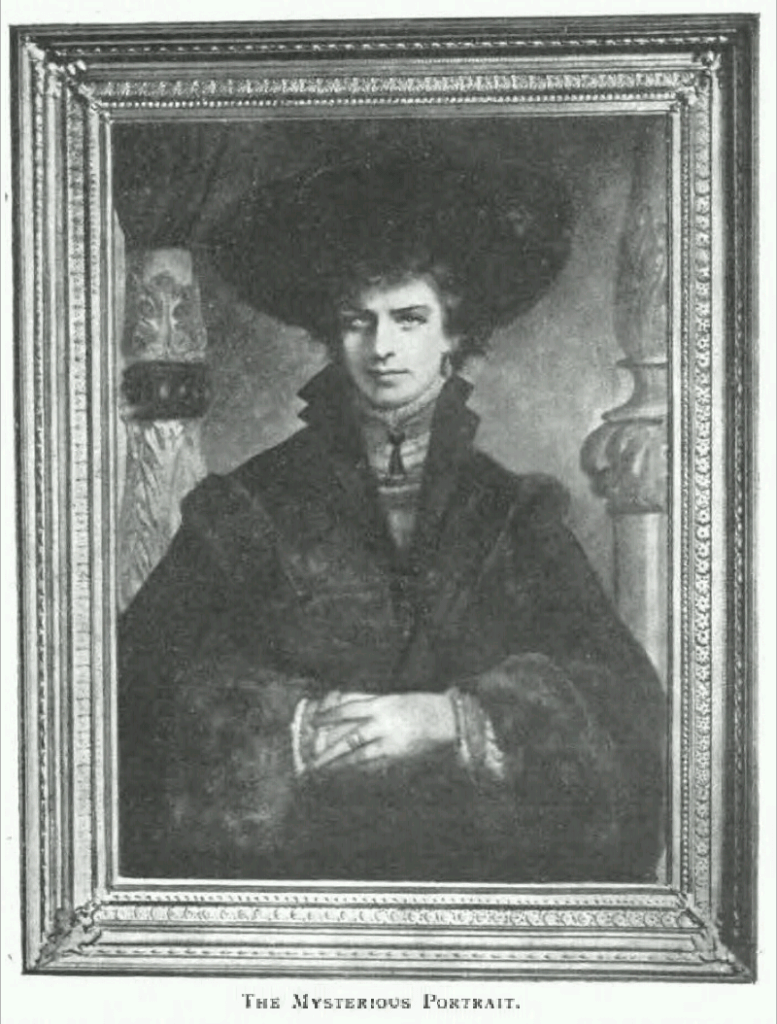
Hartmann illustrated his article with a photograph of what is purportedly the portrait of Countess Elga. The artist credited with the painting – Hans Makart, who died twenty-five years before the tale was published – was a real person, and the portrait is indeed his work. The painting certainly fits the general mood of the story, depicting a dark-clad woman who, with her heavy-lidded doe-eyes and enigmatic smile, would look right at home in a Gothic film by Tim Burton or Guillermo del Toro. But does it really show the allegedly vampiric countess?
The portrait in question had, by the time Hartmann’s story was published, been widely circulated under various names including “Patrizierin”, “The Patrician” and “A Fair Patrician”. An 1882 edition of Britain’s Magazine of Art printed an engraving based upon the painting to represent Makart’s work, and the image made its way into a Brighton Beach Daily Music Programme of the same year. In Germany, the painting was at some point turned into a mass-produced postcard. Bettina Weitner’s 2017 book Das Kostüm bei Hans Makart asserts that the painting by the name of “Die Patrizierin” had been featured on the cover to the February 1882 issue of the Austrian fashion publication Neue Wiener Modebriefe (although the same book does admittedly acknowledge a touch of mystery about the painting: its list of details ends with the note “unbekannter Besitz” – “unknown ownership”). An enterprising prankster would have had ample opportunity to incorporate the painting into a publishing hoax.
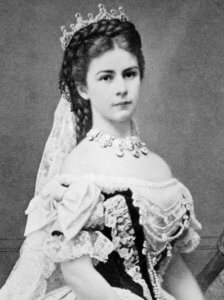
Today, still another copy of the painting can be found on the official website of the Netherlands Institute for Art History, which identifies its subject not as Countess Elga of Castle Bethenykörös but as Empress Elisabeth of Austria. Looking at photographs of the Empress, the resemblance is hard to deny, and she seems a rather more likely candidate than the (possibly fictional) Countess Elga.
Benjamin Adamah’s blog post asserts that Makart “went mad at the age of 44 shortly after completing the portrait of the countess.” This claim appears to have been derived from a 2013 article by Mark Newell for right-wing tabloid the Epoch Times, entitled “Hans Makart’s Portrait of Elga”, which describes how Makart “went suddenly and hopelessly insane” in August 1884 prior to his death the following October. Newell mentions the “disturbing possibilities” of the painting having “had some connection with Makart’s sudden death”, and claims – wrongly – that the Occult Review was the only publication to reproduce the portrait.
All of this might make for a good horror story – and, indeed, Newell’s byline reveals that he was working on a novel based on the Hartmann account at the time – but it simply runs counter to the facts. As noted above, the portrait was being circulated in 1882, and so must have been completed well before Makart’s passing in 1884. Meanwhile, the circumstances of the painter’s death are far from mysterious: he is generally agreed to have died as a result of contracting syphilis.
Whether Franz Hartmann was the perpetrator or a hapless dupe remains a matter of conjecture, but either way, “An Authenticated Vampire Story” appears to have been no more than a hoax. If so, it at least remains a well-constructed hoax, incorporating just enough real-life details – an actual news report of superstitious villagers being blamed for a castle burning down, an actual painting with just the right aesthetic – to ensure that it has lasted for more than a century. At the time of writing, a Google image search for “Hans Makart Elga” will turn up multiple websites that republish the alluring portrait, all ignoring the figure’s resemblance to Empress Elisabeth and instead declaring, with confidence, that the painting depicts Countess Elga.
Tellingly, however, none are able to prove that Countess Elga ever existed outside the pages of the Occult Review.
Note: the original publication of this article contained a transliteration error that has since been fixed.
Next: the series concludes in the Land of the Time-Leeches.
