

This is the humanity that is on display throughout Claire North’s Notes from the Burning Age. One side of that feature of human nature that is a desire to leave some kind of mark on the world, even if it is just something small token for someone to stumble upon in the future.
Here’s the history of the world for you. Here’s what the burning left behind. You want gods, and all you get are people.
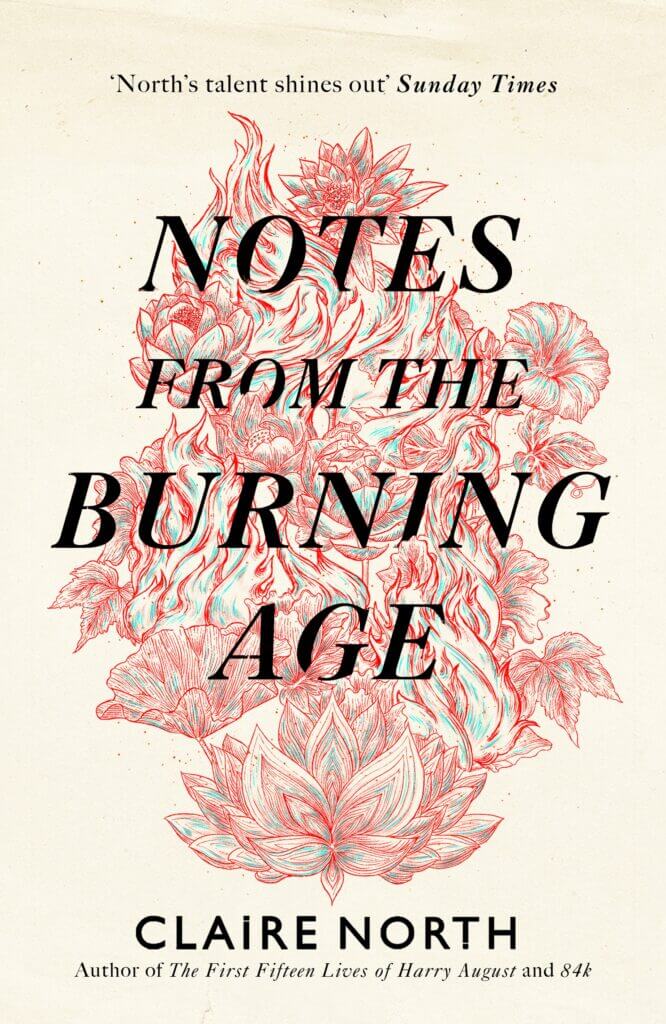
Notes from the Burning Age
Claire North
Orbit Books
July 20, 2021
Note: Title – quoted from “Out of the Wind” by Audre Lorde
Why write love poetry in a burning world?
To train myself, in the midst of a burning world,
to offer poems of love to a burning world.
— Katie Farris, “Why Write Love Poetry in a Burning World”
Notes from the Burning Age deposits its readers sometime between Mad Max and The Broken Earth. The world that seems in the first chapter to be an unknown, fantastical place, is actually a snapshot of a future Earth, its landscape shifted by centuries of exploitation. Eventually, it seems the Earth fought back, defending itself by unleashing fearsome spiritual creatures called the kakui, who, depending on who you ask, burnt the world or saved it from the burning. Regardless, it was a hefty price that humanity paid in both life and lifestyle as those left learned how to survive in this new world, constructed by both reverence for the Earth and fear of her wrath.
By the time the story begins, most of this world that might look familiar to readers is a long-gone memory. It’s been just long enough for old borders to (somewhat) be redrawn, and for old languages to (somewhat) be forgotten. Instead, you’ll find yourself just removed enough from the Burning Age and the cataclysmic rise of the kakui that what was once fact has started to dissolve into myth, and that powerful and greedy individuals have slid into the space left by fading memory to take advantage of what was left behind, those powerful and dangerous tools that once ended the world.
This is where Ven comes in. A former monk once dedicated to sifting through burning age archives, his job is now to help his new boss steal and assess information that may be useful to his budding humanist movement. And no, this isn’t the kind of humanist movement that preaches love for humanity, it’s a fascist brotherhood that believes that there is an inherent hierarchy to humanity and that the strong will prove their superiority over even nature itself.
The conflict between the Brotherhood, the temples of Ven’s past, and young governments fighting to stay alive plays out on both the battlefield and on Ven’s conscience in a way that combines political subterfuge and philosophical treatise. It is both thrilling and thoughtful. Claire North metes out suspense the way that Ven faces death: sometimes fighting against it, pushing himself to survive, keeping readers on the edge of their seat…and sometimes, nearly welcoming it as the inevitably that fuels future life. It’s the end, and it had to be this. It had to be you. It’s still sad, but nothing about this book is tearjerker sad. It’s the slow erosion of the beaches sad, it’s the galaxies drifting slowly away from each other sad, it’s the plodding march of time sad. It’s the sadness of the inevitable finally coming to pass, and what else is to be done now but continue to exist in the face of it, in spite of it all?
The flip side of Ven’s sadness is of course his fury. Much as Ven’s emotions turn and surge and wane as he passes from one challenge to the next, by turns swimming and drowning and treading water, so does the tone of the book. The anger towards ancestors (us, the ancestors are us) who burned the world for greed and wealth and power, fury at both those trying to bring about the same and those who aren’t doing enough, never doing enough, fear of what a second burning looks like, what it means, and how long before the spirits of the world decide that humanity is so much a danger to itself and the world around it that it’s not worth keeping around.
That last concern of course ignores one of the central ideas of the book: that humanity is a part of nature. That nothing escapes the cycle of life and death: not forests, not humans, not countries.
I want to take him down, down, to the cold archives beneath the temple, to the tunnels where we keep the past, to show him selfies and pictures of food, jokes and terrible puns in dead, archaic scripts, tell him, look, look — look at people living. Look how beautiful it is to be alive.
Notes from the Burning Age is an exciting yet poetic window into a possible future. If you’re looking for escapism, this is not the book for you. But, if you’re looking for sci-fi that is rooted in the now and isn’t afraid to take issues in our reality and place them into a reality where they’re even more unavoidably political, then you will love this book.
