

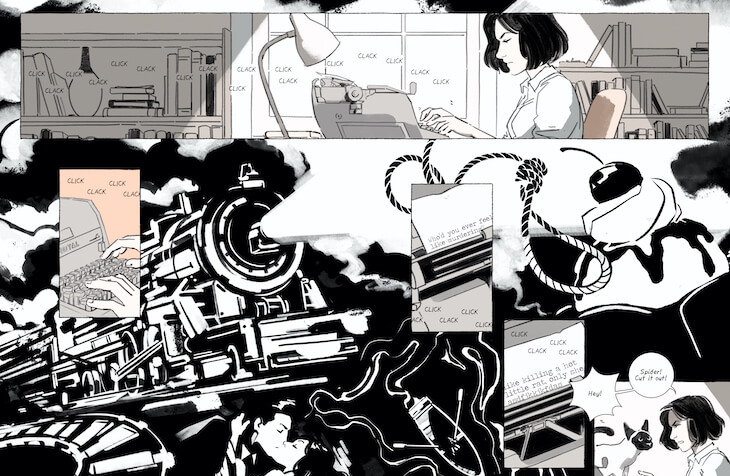
I don’t have the right words to prepare you for this comic. At its simplest, Flung Out of Space is about Patricia Highsmith’s quest to escape the drudgery of writing comics and get her novels published, including Carol, considered the first lesbian romance with a happy ending. It’s also about her years-long attempt to try and expunge her desire for other women. It is a critical, caring, funny, and heartbreaking story in which the hands of the artist and author are visible and essential to depicting Patricia Highsmith as a whole, complex person.
Flung Out of Space
Grace Ellis (Writer), Hannah Templer (Artist)
Abrams ComicArts – Surely
March 15, 2022
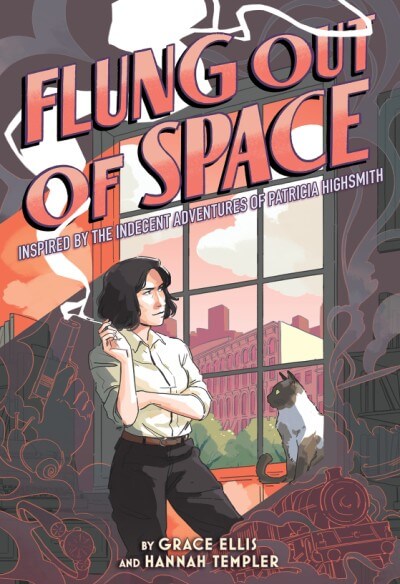
I want to be clear: Flung Out of Space is not a biography, and that is its greatest strength. Writer Grace Ellis offers other descriptors in her introduction to the comic, calling it a story that would be told around a campfire, a fictionalized narrative, and, quoting Highsmith’s biographer, Joan Schenkar, a “fantasia.” I can only describe it as a story about a real person that, instead of striving to be pure fact, instead grapples with that person holistically.
The real Highsmith was a lesbian who gave queer women an important and affirming work of art called Carol (initially The Price of Salt, later republished under the title Highsmith preferred.) She was also anti-Semitic, racist, and simply careless with other people’s feelings. She was not a good person, and did not often try to be a better person. Ellis and artist Hannah Templer take all Highsmith’s flaws into account and express their own values through the comic’s visuals and perspective, but they aren’t cruel to their subject. Rather, they see her fully and present her wholly, flaws and all.
It’s worth spending a moment with the start of the comic proper – not the written introduction but the comic itself, and how the creators introduce their character – to examine how Ellis and Templer ensure their own perspective permeates Pat’s story. (Ellis calls her “Pat” in the introduction, creating some space between the subject of the comic and the real, historical figure, so from here on out we’ll discuss Pat, not Highsmith.) The comic starts with darkness — specifically a textured, painted black that immediately follows the prose introduction. Pat herself is in need of a light for her cigarette, and the first color visual we get is the orange flame of a lighter flaring to life. On the next page, we learn that the lighter belongs to a redheaded woman, who is sitting incredibly close to Pat. Both are in a bar, specifically NOT a lesbian bar (“This isn’t that kind of place,” says the bartender.)
Templer provides the first fully-body shot of Pat in the middle of the second page. She’s handsome and alluring in masculine clothes and a long brown trench coat, with her hair cut to a short, wavy bob. Both her dialogue – she responds, “what an idiotic question to ask,” when simply asked for her name – and her poses are intimidating. Pat is turned out toward the reader, one foot on the floor, the other leaning on the low bar of her stool, her cigarette held at hip height so the smoke wafts up into the panel above her. Even before she curtly asks the redhead, “Are you going home with me or not?” her flirtatious gaze is direct and clear. Put simply – Pat is hot, and she’s an asshole.
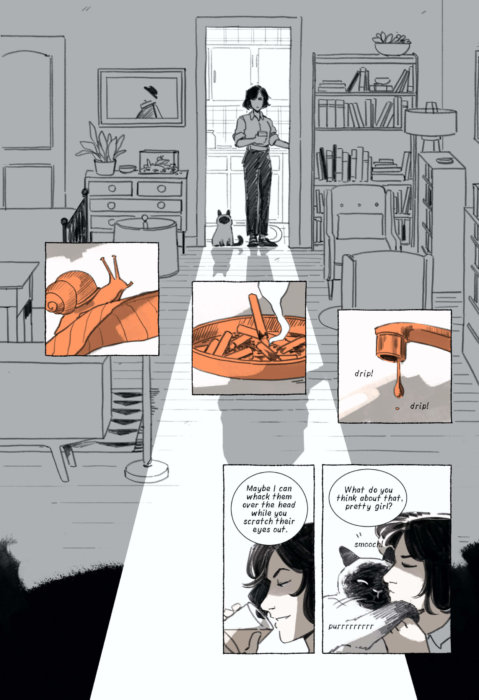
That second point is important: Pat is an asshole. When the bartender accuses her of engaging in gay flirting – a dangerous act that could lead to serious, negative consequences for her companion as well as herself – she shows no concern or remorse, just selfish desire. She doesn’t even apologize for spilling her drink! Pat’s uncaring nature is a clear part of the picture Ellis and Templer are painting.
The aforementioned orange flame is an image that repeats in the comic, which is all grays, whites, browns, and orange spot color. We see it again when Pat meets an up-and-coming comics writer, under the assumption that he is interested in her writing and in Pat as a potential romantic partner. Once again, oranges are associated with lures – the other writer strikes up a match to light Pat’s cigarette, and tells her he is interested in her “raw talent.” He paints a world for Pat in visuals, literally – Templer shows their conversation visually, filling word bubbles with superheroes in capes and costumes, colored again in that delicious orange. In return, Pat fills the space with her own visions which, on the page, appear as word bubbles filled with black-inked murder scenes.

These lures, of course, are not enough for Pat. She wants to publish her thrillers, and she yearns to make connections with women. The comic writer’s match burns down to his finger, burning him just as Pat will burn many bridges as the story goes on.
The bulk of this interaction goes down during a wordless two-page spread on which Templer places the images describing each writers’ ideal stories within word bubbles. This tactic perfectly contrasts the two writers’ different creative visions. Pat hates comics; she’s in it for money. Templer, cheekily, does something wildly creative and communicative with visuals, packing a nuanced conversation into just two pages – something Patricia Highsmith could never do with her words. It’s a beautiful dunk on the comic’s subject, and Highsmith herself would be furious that Templer captures her yearning for writing on the page solely through these black, inky clouds of scenes from her books.
I also want to make clear that Templer and Ellis do not hate their subject. Quite the contrary – they also have a deep empathy for her. Pat’s journey is often difficult to read, especially as she sees therapists to try and cure her own queerness. The aspects of her own story that are woven into Carol are heartbreaking. Patricia Highsmith – or at least Pat because, again, this is not a biography — gave queer women the happy ending they didn’t think they could ever achieve or even were worthy of because she struggled to envision happiness for herself. How can you find happiness when you see yourself as abnormal, as an aberration? How can you move through and beyond heartbreak when you’re questioning the very nature of the love you feel?
Flung Out of Space beautifully and deftly paints a portrait of a complex, cruel, and charming woman who gave the world equally complex and enticing stories. I was enraptured by this comic, by Ellis and Templer’s brilliant approach to engaging with a flawed but beloved subject, and, somewhat begrudgingly, by Pat herself. Snag a copy for yourself, and make sure your local library purchases it too!
