

Weeaboo traces the stories of three high school students. As Maya, James, and Dani survive senior year, they struggle to find themselves and each other in Alissa Sallah’s heartwarming graphic novel.
Weeaboo
Alissa M. Sallah (creator), Susie Lee (setters), Angie Knowles (designer), Sarah Gaydos and Shawna Gore (editors), and Shenwei Chang (sensitivity reader)
Oni Press
November 17, 2021

Dani, Maya, and James are best friends. Coming from different walks of life, they are united in their love of Japanese media. In preparation for the biggest event of the year, their first anime convention as adults, the trio decides to do a group cosplay from KISS: Le Chevalier d’Amore.
However, it is senior year, so they can’t just focus on creating the best triplet cosplay ever. Instead, they’re all expected to apply and get into college, so things don’t quite go as they planned. Between part-time jobs to pay for cosplay, being miscast in musicals, and feeling the weight of societal pressures, James, Dani, and Maya experience a quintessential senior year.
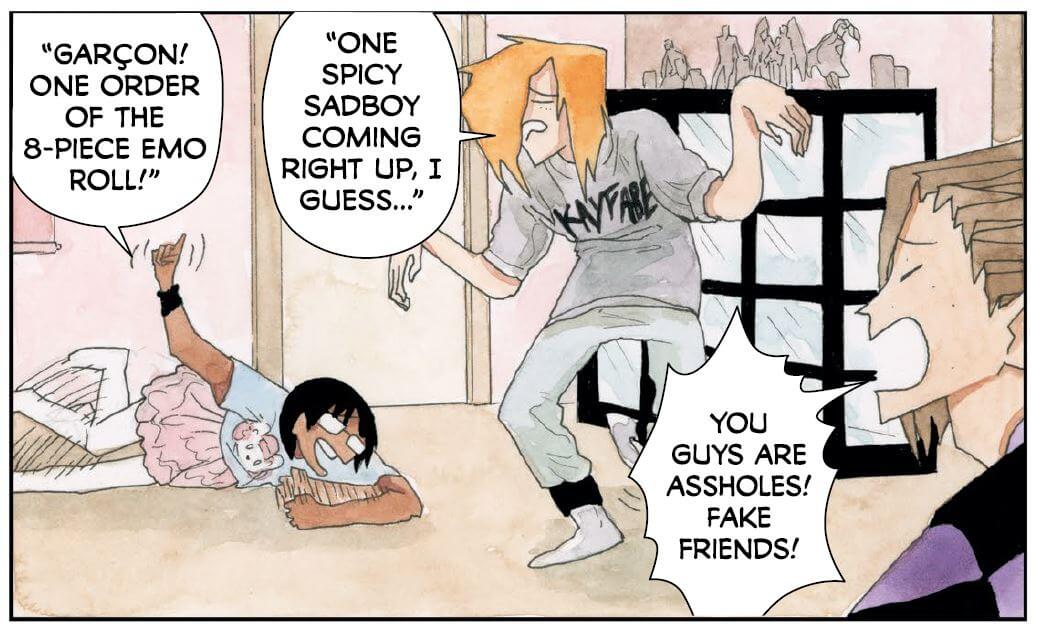
James, who is a mixed-race Japanese American, gets a job at the local sushi restaurant so he can pay for his cosplay. At the restaurant, James experiences a taste of the politics of being an Asian-American. It’s there he hears the term “weeaboo” or “weeb” from Jun, one of the sushi chefs. The stress of money and James’ struggles in school strain his relationship with Dani, but more specifically with Maya, who he calls a weeaboo in a fit of anger.
While those are cause for conflict, James is also a delightfully archetypal high school character. In the scene where he announces that he’s getting a job at the sushi place, Maya and Dani call him out for what he is, an emo roll. The panel does an amazing job of showing the care that teens have for each other. Maya’s face, as she laughs and slaps the floor, is delightfully chibi-esque. Furthermore, Sallah’s watercolor brings added depth to the scene overall.
While that scene highlight’s Sallah’s unique style, she also expertly weaves anime and manga drawing styles reminiscent of Chiho Saito, CLAMP, and Naoko Takeuchi, into the book. The front cover is a great example of this. Sallah contrasts the main trio in her style in watercolor, with their cosplay characters for the con in black and white.
There are so many references in Weeaboo to Japanese media that it would be impossible to list them all. However, two of the major ones are The Rose of Versailles by Riyoko Ikeda, which Sallah mentions in her author bio as inspiration, and Revolutionary Girl Utena. The plot of The Rose of Versailles is referenced in the musical that Dani, the “prince” of the school, stars in. Dani’s main struggle is balancing rehearsing the school musical, a short romantic relationship, and maintaining a friendship with James and Maya. While Dani loves theater, Dani only auditioned for the male lead of the show. Despite this, Dani is cast as the female lead. While others use she/her pronouns for Dani, Dani never confirms those pronouns and tends to dress in more masculine clothing.

By the end of the book, Dani becoming a living heroine rather than the martyr by rewriting the musical. However, that doesn’t fix the friendships she ignored while rehearsing for the show. Sallah does an excellent job depicting that loneliness. After Dani’s personally redeeming edit to the musical, Dani stands alone in the foyer in focus. Sallah captures Dani’s emotional loss in the physical separation between Dani, drawn with crisp lines, and everyone else, a little out of focus.
Sallah also explores Revolutionary Girl Utena and improves some of the shortcomings of the manga. The most obvious reference being that Maya lovingly refers to Dani as her “prince”. Beyond that, I see Maya as a more fully-realized Anthy Himemiya. While in the manga Himemiya’s true self is ambiguous, Maya encompasses a similar caring personality but expresses her real self. Specifically, rather than have (Hime)Maya receive disrespect with almost no reaction, via internet comments and her family members, Maya expresses her sadness and hurt. Sallah’s visual storytelling captures the weight of this, in big and small ways.

One of my favorite panels in the book is a subtle example of this. Behind the glasses, Sallah slightly blurs Maya’s eyes, evoking the pain Maya experiences in the scene. While she can’t express how her grandmother’s words hurt her in a big way, Maya can allow herself some privacy behind her glasses. A little space to feel, as she processes and internalizes a series of hurts experienced during her senior year of high school.
By the end of Weeaboo, I had cried more than I thought I would because it rang in perfect harmony with my relationship with Japanese media. Sallah’s ability to balance the care and love that so many weebs have with the realities of that love is amazing. Specifically, anime and manga, depending on our backgrounds, will not love us back the way we want them to. We might love the stories and adventures but many of those same stories can depict people who look like us in offensive ways or just not at all.
Furthermore, despite how much we love that media, those we care about won’t always respectfully understand that love. Because of that, Weeaboo is a weeb must-read. It delivers juicy Japanese pop culture references and illustrates us with the care and respect often lacking outside our communities.
