
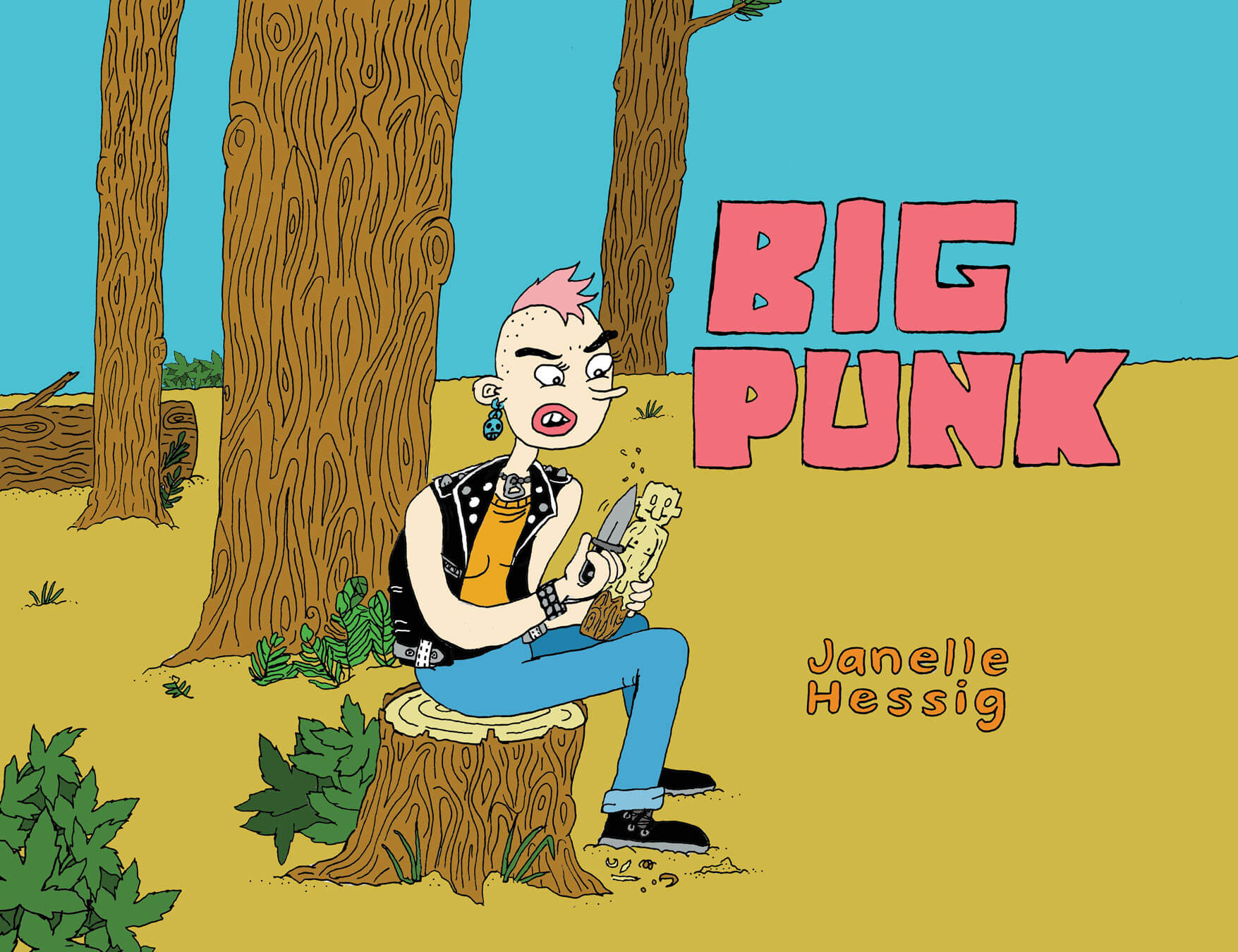
In Big Punk, our protagonist asks an important question—didn’t the world used to be about pushing against convention and boundaries? Why has everyone turned into a yes-man? She can take no more of this and makes the only sensible decision—move to the woods. But is she alone?
Big Punk Episode 1
Janelle Hessig (Writer and Artist)
Silver Sprocket
December 16, 2019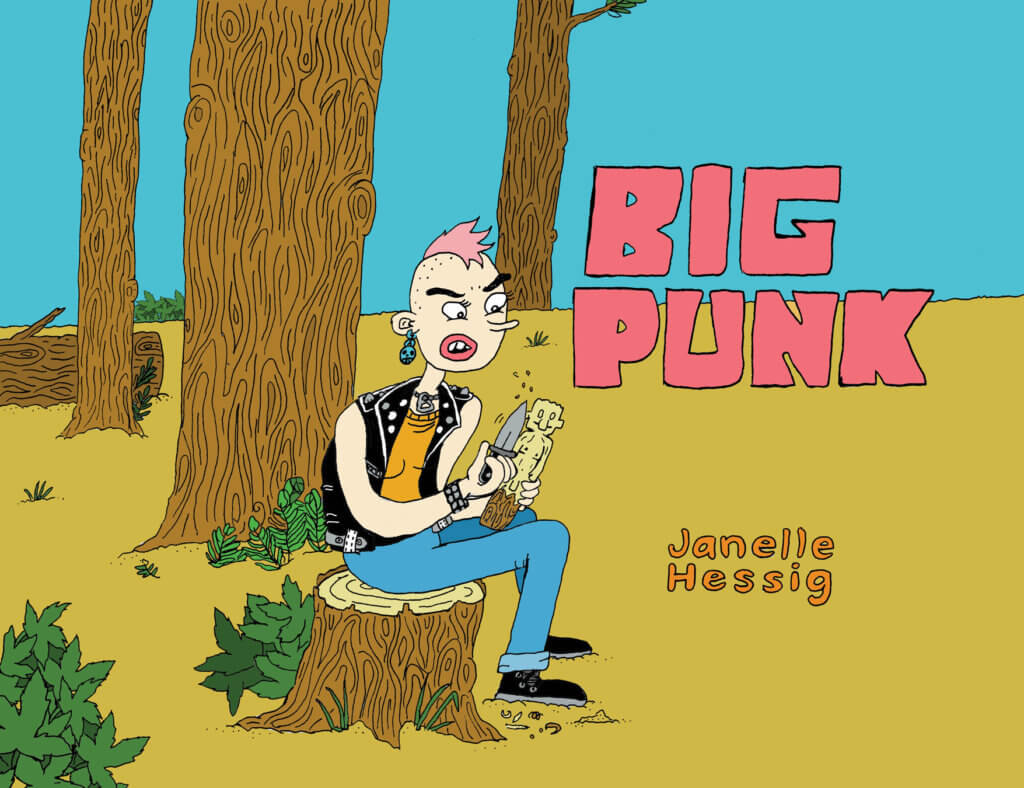
I wasn’t sure what to expect from Big Punk, but it turned out to be extremely relevant. The unnamed protagonist is also self-isolating—just as all of us are having to do during these troubled times. But the protagonist’s solitude isn’t forced upon her—she chooses to isolate herself when she sees how the world around her has changed.
A lifelong punk and rebel with several causes, the protagonist finds herself looking in from the outside as everyone around her begins to turn into a Stepford Wife. How painfully real is that? Look at the political powers at play all around the world—made possible by the hoards of yes-men and sycophants more concerned with losing their privilege, than with making long-lasting sweeping changes. It makes one want to leave the planet, or at least move away somewhere that is safer for you.
That is exactly what Big Punk’s protagonist does—she decides to leave the big city and its many problems for the safety and comfort of a hidden cabin in the woods. But as all of us who are self-isolating right now have learned—being away from people can be hard. The first week is bliss—the beautiful sounds of nature minus the endless distractions and annoyances of human interaction. The next few weeks? Not so great. It isn’t long before Big Punk‘s protagonist becomes increasingly bored and frustrated. There’s no internet in the woods and there is nothing to preoccupy her.
Until, among the familiar forest sounds, she hears a deep growling sound. Is this a beast coming to eat her? Or a supernatural creature come to possess her?
Readers aren’t given a concrete explanation as to what it is that finds the protagonist of Big Punk, but he becomes an inextricable part of her life—as does another smaller companion, the titular Big Punk. I found this development a bit confusing, primarily because the protagonist refers to the being as her husband. I’m not entirely sure why the creature is gendered, at all. Why not refer to the being as her partner?
I ask this because the story felt heavily queer-coded. Not every shaved, pink-haired punk is queer, but everything about her seems to use queer iconography, down to some of the book titles on her shelf—one of which is called ‘Wifey,’ because she wants a wife, I presume? It was a bit disappointing for there to be a husband in the picture after all that, even if it is a hairy being from the woods. Queer-baiting is a pervasive problem in entertainment, and I was hoping that a fun little indie comic would avoid doing the same.
But perhaps I am being too harsh on Big Punk? Our protagonist may have read her situation differently and acted accordingly. She was buying supplies for her home and was asked why she needed so many lint rollers—that’s when she mentions her ‘husband’. Maybe she felt the cashier wouldn’t take kindly to a queer woman? I mean, she isn’t comfortable mentioning that her husband is a hairy wood being either. Of course, that theory is shot to hell by Big Punk, the little hairy creature from the woods. Was the child already with the husband before the protagonist came into the picture? Or was the child born after their liaison? We don’t yet know.
I want to give Big Punk the benefit of the doubt, but there is a dearth of queer stories available. It drives me up the wall when I get a book that has all the hallmarks of a queer story but never follows through on it. If we look past the obvious queer coding that is never realized, Big Punk is exceptionally detailed and witty. There are moments in the book that many a queer-adjacent folk would have had to deal with, such as being asked one’s gender because one doesn’t conform to the conventions of society. I like the way the protagonist handles the situation, and I’m glad she acknowledges that she could be in danger if she isn’t careful about who she talks back to. Far too many marginalized people have been hurt or killed for standing up for themselves.
Big Punk‘s greatest strength is its art, which is a delight. The characters are expressive and quirky, immediately drawing readers into the story. The detail in each panel is breath-taking—I spent a fair amount of time peering into the background and there was always a payoff. From the slogans on t-shirts to book titles and song lyrics, Hessig ensured that every bit of real estate was used for maximum impact. There are fun little details that one misses on first reading—like the puppy wearing a suit, or a random bird cawing in the foreground. It makes the reading journey so much more pleasurable when you can go back and get even more from the experience.
But the art of Big Punk can’t shake my disappointment at being presented a heavily queer-coded story that ends up not being quite as queer as it should. I did like the story and how relevant it felt, but I also couldn’t help but feel like I was being thrust out of the narrative just when I was getting comfortable in it. Perhaps the next episode will clear up my misconceptions, but will I still be reading at that point?
