
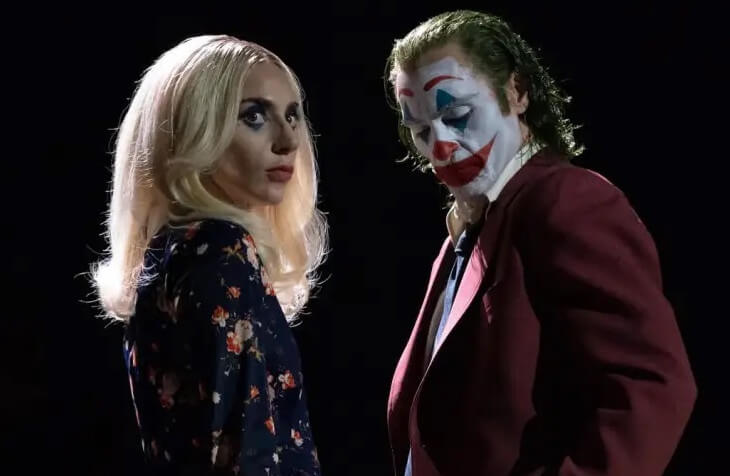
In Joker: Folie à Deux, the long-awaited sequel to Todd Phillips’s Oscar-winning 2019 film Joker, failed comedian turned spree killer, Arthur Fleck (Joaquin Phoenix), strikes up a romance with fellow Arkham Asylum inmate, Lee Quinzel (Lady Gaga). Their relationship unfolds over the course of Arthur’s legal trial where the defense attempts to answer the question: is the Joker just an extension of Arthur’s darkest desires or is he another personality inhabiting Arthur’s body?
Joker: Folie à Deux
Todd Phillips (director and writer), Scott Silver (writer), Lawrence Sher (cinematography), Jeff Groth (editor)
Joaquin Phoenix, Lady Gaga, Harry Lawtey (cast)
October 4, 2024 (United States)
Content warning: Mentions of violence, domestic violence, and sexual assault.
This review contains spoilers for Joker: Folie à Deux.
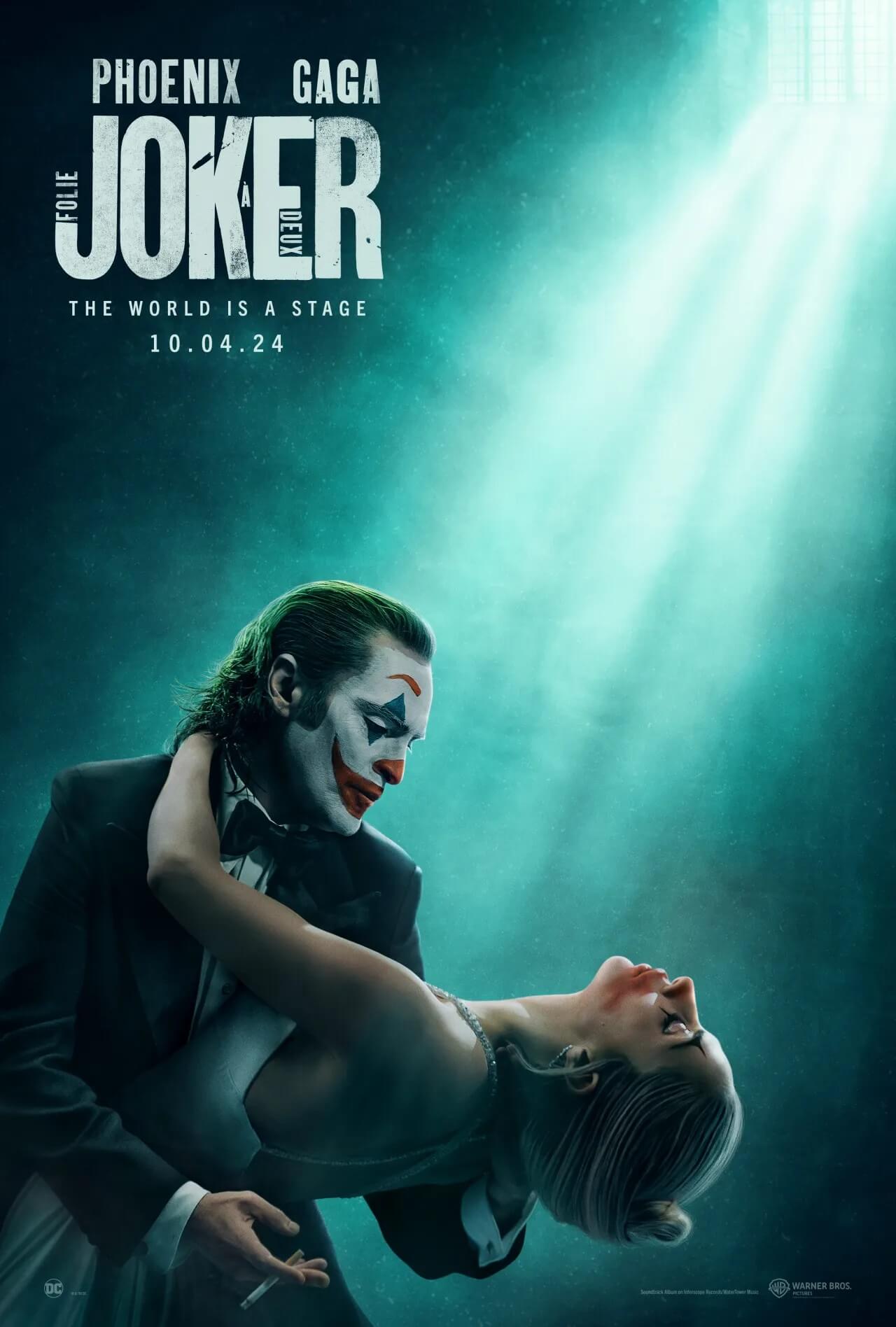
On a superficial level, Todd Phillips’s long-awaited Joker sequel is the natural progression of its predecessor. The two are stylistically one and the same. The interior world of Arkham Asylum is a dull grayscale color palette, while the world outside the prison’s windows glows purple and golden. Light is placed strategically to frame the focal point of every shot: moonlight frames Arthur’s silhouette as he sits alone in his maximum-security cell; sunlight highlights Lee’s face in the blue-toned music room when she sees Arthur for the first time; blinding fluorescents whiten the screen completely when the door to Arthur’s legal trial is opened for him to enter. Joaquin Phoenix’s transformation back into Arthur Fleck is so all-consuming that his entire body seems to shift into the character’s. Perpetually hunched shoulders, a strained voice always on the verge of cracking, and an off-beat delivery that makes every joke land uncomfortably make up his Oscar-winning performance.
Where Folie à Deux loses sight is in the film’s general plot line. A grand musical number of Anthony Newley’s “Gonna Build a Mountain” incorporates three dream sequence scenes taking place on a Sonny and Cher-inspired Joker and Harley show, at the wedding altar on the end of a literal walkway to heaven, and at a jazz club with a break for a tap dancing number. In the next scene of note, the disgruntled guards at Arkham Asylum take our titular protagonist Arthur Fleck (Joaquin Phoenix) into an empty bathroom and throw him to the ground of the communal shower. When they drag him back to his cell one fade-to-black scene later, he’s pantsless except for his signature ill-fitting tightie whities but bearing no signs of physical violence. Was this a rape scene? Like the general plot of the film, the writers’ intentions for this scene aren’t quite clear.
Folie à Deux begins its 138 minute runtime with a vintage-style cartoon of the Joker being haunted by his own shadow, a creative introduction to the question that will frame the rest of the movie: are Arthur Fleck and the Joker different people or has this unflinching cruelty existed in Arthur all along? In their pre-trial meetings, Arthur’s lawyer, Maryanne Stewart (Catherine Keener), lends unflinching sympathy to him and his situation. She takes him to a state-funded psychologist with the goal of gaining an expert opinion on Arthur’s “split” personalities.
Intentionally or not, the main internal conflict of Arthur’s identity as Joker does little more than undermine the character development of the first Joker film. It doesn’t matter what mental health diagnoses apply to Arthur, the reality remains the same: we saw his descent into insanity and we know as an audience that this madness was an emotional cataclysm, not a split. Batman adaptations have shown a puzzling but longstanding fascination with the Joker’s true identity. In Tim Burton’s Batman, he was Jack Napier; in TV’s Gotham he was the Valeska twins; during Knight Terrors, he was working an office job as Johann Kaiser. But what purpose do these pseudonyms and backstories ultimately serve? Trying to find clear authorial intent in Alan Moore’s Killing Joke is a lost cause, but it’s widely considered the definitive Joker backstory, and its central theme is undeniable: anyone can be the Joker.
However, not just anyone can be Harley Quinn. It’s at a prison music class where Arthur first catches sight of Harleen “Lee” Quinzel (Lady Gaga), whose nickname has been changed for no discernable reason. In this universe she is not his psychiatrist, but another patient in a lower-security level of the same mental institution. Immediately, this departure from comic canon dramatically changes one of the most compelling parts of the Joker and Harley “love” story: how they went from psychiatrist and patient to victim and abuser. It also automatically and dramatically limits Arthur and Lee’s ability to cross paths, as well as adding a level of surveillance to their relationship. When Dr. Quinzel does psychiatry sessions with the Joker, she is effectively alone in a room with him, and her sole responsibility is to listen to what he has to say. This is what makes her so easy to sway to his whim. When Arthur and Lee speak for the first time outside the prison music room, they only have time to flirt and make small talk before Arthur’s personal guard inevitably comes to ruin the moment. This is enough interaction to build an obsession in Arthur’s mind, but not to build romantic tension in the eyes of the audience. His romantic interest in Lee is expressed via the first full-scale musical performance of the movie, a cover of “For Once in My Life” by Stevie Wonder. This is too much, too fast. We know from Arthur’s obsession with single mother Sophie Dumond (Zazie Beetz) in Joker that he has a tendency for romanticization, but this is extreme. It appears almost as if the writers have swapped the dynamics of Lee and Arthur’s comic book relationship, making Arthur the obsessive one and Lee the master manipulator. This has the potential to be an interesting dynamic, but it’s never going to be a Joker and Harley dynamic.
In Harley Quinn’s earliest iteration on Batman: The Animated Series, her most defining characteristic was her obsession with the Joker. This notion was a throughline through the first twenty or so years of her page and screen appearances. In Folie à Deux, we are told of this obsession, but it is not shown in practice. Lee tells consistent lies in order to gain Arthur’s trust, but her eagerness to gain his affections seems to dissipate once she’s effectively captured them. Lee tells Arthur that her abusive father died in a car accident when she was a child—her father is actually alive and working as a doctor. Lee claims that she and Arthur are from the same low-income neighborhood in Gotham—she lives with her parents in the Upper East Side. Lee vents about being involuntarily committed to Arkham for a psychotic break—she checked herself in and out voluntarily.
In their second-ever rendezvous, Lee sets a fire in the prison so that she and Arthur can run into the courtyard and scale the fence, which is lined with eagerly awaiting reporters. Cameras flash while she sings a strained rendition of “If My Friends Could See Me Now” from Sweet Charity. What primarily motivates the usual switch from Dr. Harleen Quinzel to Harley Quinn is her belief that the Joker isn’t who the outside world says he is; he’s who he’s told her he is in private. This is the polar opposite of Lee’s affections towards Arthur and it makes their relationship dull and superficial; Lee isn’t obsessed with Arthur, she’s obsessed with the attention she gets for being with him. This isn’t mad love, it’s slightly irritated love at most.
At the tailend of Arthur’s trial, he delivers the most memorable monologue of the film, ending in a miserable knock-knock aimed directly at the camera: “There is no Joker. It’s just me. I killed six people. I wish I didn’t, but I did. […] I just want…I just want to blow it all up and start a new life. Knock, knock. Who’s there? Arthur Fleck. Arthur Fleck who?” The verdict is delivered and Arthur is found guilty, not Joker. This is the end for Lee, who storms out, and the end for the Gotham City Courthouse which is promptly obliterated by a car bomb. When Arthur confronts Lee later on the iconic Joker stairs, it’s she who ends their relationship for good, and he who’s begging her to reconsider. For eight and a half decades of Batman fans, the Joker has been evil incarnate. He’ll shoot your daughter, he’ll blow up your son, he’ll…beg you not to dump him? If Arthur’s submissive desperation is a mischaracterization of the Joker, then Lee’s lack of possessiveness is character assassination for Harley. In her best adaptations, Harley Quinn has personality and motives beyond being with her beloved Puddin,’ but Phillips doesn’t give Lee enough screentime to focus on these traits. Thus, a three-dimensional antihero becomes a two-dimensional love interest. It is easy to excuse Lee’s lack of depth as simply being a consequence of telling the story from Arthur’s perspective.
After all, the primary love interest of the first movie wasn’t exactly three-dimensional either. However, what separates Joker’s Sophie Dumond from Folie à Deux’s Lee Quinzel is that Joker isn’t about Sophie. She’s more of a symbol than a protagonist, she’s meant to play the rational everywoman side character who signifies Arthur’s loosening grip on reality. Lee is Folie à Deux’s deuteragonist, the protagonist’s constant companion and enabler. She’s the focus of every musical number dream sequence, her perspective is shown to the audience in the pivotal moments leading to the movie’s climax, and pleasing her is arguably one of Arthur’s main character motivations in this film. Since Phillips showed us in the first Joker movie that he can turn a two-dimensional supervillain into a three-dimensional protagonist, this disparaging treatment of Lee starts to look more like a gender problem than a writing problem. Combine this with Phillips’s pre-Joker filmography of male-centric comedies, and it looks like a career-long penchant for sexism.
Another key member of Batman’s rogues gallery stands in the periphery of Arthur and Lee’s melodrama: a fresh-faced Harvey Dent (Harry Lawtey) serves as assistant district attorney in the scenes at Arthur’s trial. Harvey is impeccably casted—if you were to place Lawtey on the streets of Georgetown in salmon shorts and boating shoes, I would be none the wiser—but his haughty prep schoolboy swagger isn’t enough to save court scenes that feel always on the precipice of some big moment that never comes. It’s Harvey who tells the audience, via a televised appearance which Arthur watches at Arkham, that the State of New York is seeking the death penalty in the City of Gotham v. Fleck. During the actual trial, he asks some of the pivotal questions to witnesses on the stand, while also providing smug smirks and raised eyebrow reactions at Arthur’s antics. There are Batman fans who couldn’t name more than one Robin, but could still tell you how hot-shot lawyer Harvey Dent becomes deranged gangster Two-Face, and so there is immediate intrigue in Harvey’s inclusion. Most people in the audience would be hard pressed to guess how the movie ends for Arthur, but everybody knows how things are going to end for Harvey—it’s just a matter of when, why, and how. Thus, there is a temporary satisfaction in watching the car bomb that exploded the Gotham City Courthouse also set exactly half of Harvey Dent’s body aflame.
But it’s too little, too late. The last time we saw Harvey on the big screen in Christopher Nolan’s Dark Knight trilogy, the stakes were impossibly high. He’s the potential savior of Gotham City, drenched in gasoline, and his fiancée Rachel Dawes can hear him, but she can’t save him, nor can he save her. Nobody in Folie à Deux gives a bat’s ass about saving this Harvey. This is just another in a two hour string of plot points that don’t feel as if they matter and which are made void entirely by the film’s anticlimactic ending.
The main argument in the courtroom, whether Arthur Fleck and the Joker are one and the same, doesn’t matter in the end when Arthur Fleck is unceremoniously murdered by an unnamed inmate at Arkham Asylum. Neither Lee nor Harvey’s inclusion matters when we fade to black on a scene that feels as if it would’ve happened anyway. Nothing matters when Arthur’s fate at the end remains unchanged. In a better-executed work, this sort of ending could be considered a tragedy, but when the narrative so clearly lacks intention, then the same excuses can’t be justifiably made. A cardboard cutout of a murderer is fine when it’s applied to characters like Thomas and Martha Wayne, whose deaths are necessary to kickstart the entirety of the Batman mythos. It’s not fine when the Joker dies before Batman ever puts on the cape.

