
Went Up the Hill is an ambitious attempt to metamorphose a ghost story into something deeper and darker. Unfortunately, the film tries to juggle far too many themes and ends up unable to flesh out any.
Went Up the Hill
Samuel Van Grinsven (director), Samuel Van Grinsven, Jory Anast (writers), Tyson Perkins (cinematography), Dany Cooper (editor)
Vicky Krieps, Dacre Montgomery, Sarah Peirse (cast)
September 5, 2024 (TIFF)
CONTENT WARNING: This article contains mention of domestic violence and child abuse.
It’s never a good sign when, not even halfway into a film, I’m screaming for it to end. That’s what happened with Went Up the Hill. Look, I didn’t expect to feel that way. After all the film is a ghost story that unravels family secrets, and I am definitely a fan of such stories, but the ambition of the film outstretched its execution.
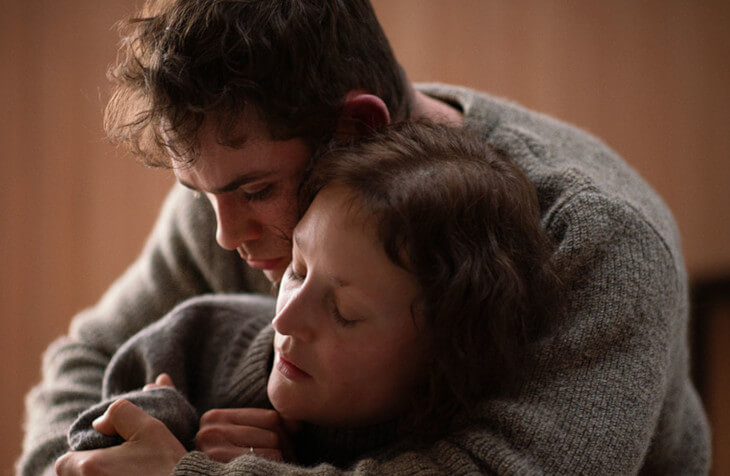
I try not to go into a film with expectations, but when the premise of the film is literally the death of a loved one and the appearance of their heretofore unknown kin, surely it’s not too much to ask the story to actually deal with that? But the story doesn’t linger in suspenseful opening mystery. Jack (Dacre Montgomery of Stranger Things fame) appears at his mother’s wake, only to discover that his mother’s widow, Jill (Vicky Krieps), had no idea he was coming, or who he even was. So who called Jack to the funeral? We’re told almost immediately, and the rest of the film wilts.
There’s a lot to unpack in Went Up the Hill — it tries, and fails, to address matters like child abuse as a result of mental illness, family estrangement, family secrets, domestic violence in a queer relationship, and grief. How does it miss the mark so spectacularly? It tries to sensationalize its ghost story. This isn’t just any ghost story; it’s too busy making an overlong artsy sex scene between Jack and Jill because reasons, instead of giving us a story about the characters dealing with family and loss, and it just feels so icky. I mean, I cannot fathom how heterosexual this film is given that both its protagonists are gay. It’s such a bizarre choice. But that’s just one of many bizarre choices in this film.
Even from a technical level, Went Up the Hill was flawed. I want to blame the TIFF screen, but the cinematography was lacklustre. Wide shots of the house (which is real as opposed to being a set or a scale model) made it look like a toy model. The picturesque landscape outside the house, which the art directors who attended the screening I was at reiterated actually exists, looked like a painting stuck on a wall.
To make matters worse, the sound mixing was inconsistent. I was unable to pick up some of the mumbled dialogue, but during a scream-crying scene, I literally had to cover my ears. And, apparently, the score was made up of these haunting vocalizations — the sound editor Robert Mackenzie mentioned this after the screening — but I only heard a little of that. Maybe those weird banging and chattering sounds were part of the score and not the sounds coming from the theatre lobby? The fact that I am left to wonder this does the sound mixing no credit. It simply doesn’t work in a loud, crowded theatre. Went Up the Hill is an intimate film with spare dialogue and gentle musical arrangements — much of that ambience is lost when people are still shouting to get to their seats or worse, coughing their brains out every two seconds. Either half the ticket-holders came in sick or were choking on their popcorn. It was all so distracting that I couldn’t immerse myself in the story.
I can’t, however, fault the performances. Both Vicky Krieps and Dacre Montgomery play their parts admirably, if not in any groundbreaking fashion. Krieps captured a heartbroken and grieving woman well. Montgomery, as well, looked understandably lost in the situation he found himself in. He also has a couple of really good emotional scenes. But, I do wish that the director had asked more of them in the ghost story part of the film. When you go into a film that’s purportedly a ghost story, there should be an essence of that genre in the visuals. But there’s no melancholy, no eeriness in Went Up the Hill. The supposed haunting that we’re witnessing is played and shot so straight it’s indecipherable from any other drama.
Went Up the Hill is an uninspired experience because it tells more than it shows how these characters feel and how the audience should feel. It should have cut back on what it wanted to explore and focused more on developing its characters and their backstories. I have to wonder whether the creative team consulted with people who’ve dealt with the issues that the film is about, because there’s absolutely no sensitivity with which these matters were explored. The end product is not just muddled, but tedious to watch. Like many of the TIFF films, Went Up the Hill simply tries to pack in too much and accomplishes nothing.
