
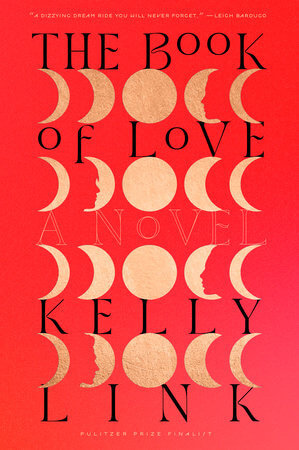
Every door may represent a choice, but what if it’s not your choice to make? In The Book of Love by Kelly Link, we meet characters who open some doors and are shoved through others as they grapple with the consequences of other people’s decisions. The Book of Love, Kelly Link’s highly anticipated first full-length novel, takes all the lyrical invention of her short fiction and brings it to a massive scale.
The Book of Love
Kelly Link
Random House
February 13, 2024
I was surprised and overall pleased that The Book of Love has far more narrative causality and linear progression than I’d expected from Link’s short stories, which are rightly celebrated for their slipstream qualities and dream logic. While I love that quality of her short stories, it’s probably for the best that in a narrative of 640 pages, with multiple points of view and a complicated timeline, Link opts for a more traditional overall arc. And luckily, the story and world in The Book of Love are still as immersive and foundation-shaking as you’d expect from Official Genius Kelly Link.
In the beginning of The Book of Love, we are presented with a premise that reminded me of Diana Wynne Jones’ books, like Archer’s Goon and Fire and Hemlock, in all the ways I could wish for. First we meet Susannah, a teenager mourning her sister Laura and friend Daniel. They’ve been gone a while and Susannah isn’t quite sure what happened that led to them being missing. Or dead.
Then we get a shift in perspective to Laura’s point of view. She’s with Daniel and someone else they knew slightly, Mo, and there’s a presence they can’t identify. Suddenly they appear in their high school music classroom and their previously completely unassuming music teacher shows signs of understanding the situation, when a powerful and handsome shapeshifter arrives and wants them all back. This is all happening in the opening pages of the book.
What’s going on? Who is anybody? I don’t know, but I am immediately immersed and start writing down notes about my theories, many of which are based on parallels I see between the characters’ current situation and fairy tales I know.
We gradually learn the year is late 2014, and Laura, Daniel and Mo have been dead for almost a full year, trapped in the handsome shapeshifter’s domain. They’ve slipped back through a doorway into their regular world, and now a bargain is struck that may allow some of them to remain. With the focus on doors and keys I was reminded of Bluebeard, and with the premise of a powerful entity keeping children in their domain, I was reminded of The Snow Queen.
As the characters try to figure out what happened to them, what powers they now have, and how to stay alive, their small Massachusetts town becomes a battleground for supernatural forces.
The setting of 2014 works very well. It is recent enough to feel contemporary but fixed enough not to age poorly immediately after publication. It means we don’t need to deal with the 2016 election or the pandemic, or Elon Musk, but still have enough in common with 2024 to go on with.
The references to pop culture of 2014 work in an additional way, too, since this is a book with teenage main characters, but it is not a young adult book. While the intersections of contemporary teen experience and magic reminded me of Francesca Lia Block at times, there’s far more explicit sex, drug use and crime than most readers would expect in YA. I’m sure many teens will read and enjoy this novel but it’s not going to get shelved next to Highly Suspicious and Unfairly Cute. Therefore, the pop culture references from a decade ago work to situate adult readers with a “contemporary” teen experience.
The Book of Love is churning with references to various kinds of texts. Not only to the pop culture the characters know and fairy tales influencing this plot, but also to classics like Alice’s Adventures in Wonderland, with a Cheshire Cat-like character who disappears, leaving a lingering smile till last.
Personally, I love it when books are highly referential, and felt like my reading was enhanced when I paused to reread Christina Rossetti’s Goblin Market one time, and listen to the bluegrass song “Pretty Saro” another. (I like this Rhiannon Giddens recording) I will say, though, that I don’t think catching these references is required to enjoy The Book of Love. If you’re familiar with a general western fairytale plot structure, you’ll be fine.
From the title, The Book of Love, and how referential it is to existing literature, perhaps you are assuming this novel is about books and their importance. Reader, that’s only true in an abstract way. In much more explicit ways, The Book of Love is about doors, and sibling relationships, and overwhelmingly about the power of music.
All the main characters are musicians who have fraught relationships with the music they make, and their efforts at composing, playing, and performing music shape the plot far more than the in-universe books do. A pal who also read an advance copy of The Book of Love and knows more about music than I do, said she’d love a crossover where Laura from this novel plays a set with Laura from The Wicked and the Divine, and there are certainly some overlapping themes of the power of a musical performance.
With all of those intricately woven themes, and the multiple character perspectives we get throughout the book, no wonder it’s 640 pages. Link has a lot to connect, and it’s tough not making a pun with her last name here, but I’m being strong.
I think my overall takeaway from The Book of Love is that it is about not accepting the options you’re presented with. If you are given a choice between two options, look for ways to create a third option. A fourth one. Keep going, keep an eye out, and more doors might open for you than you expect.
