


The genre of gothic horror is replete with imagery from an imagined past of crumbling castles and abandoned graveyards. Even in the Victorian era, whose media culture evinced a strong interest in the gothic, these spooky stories were often set in isolated country manors far away from the innovations of modern society. The past, after all, is a convenient stage for fears that seem out of sync with contemporary society but have nevertheless refused to fade.
Emily Carroll’s A Guest in the House is set in a past that now seems so far away it might as well be medieval: the 1990s, which were perhaps the last decade when it was easy for someone to disappear without a trace. Instead of ancient stonework covered with vines, A Guest in the House is set amidst cathode-ray televisions, wall-to-wall carpeting, and high-waisted jeans. Its story is haunted by secrets that would be impossible to keep during the current age of social media, as well as dark fantasies that still persist in the shadows of social progress.
A Guest in the House
Emily Carroll
First Second
August 15, 2023
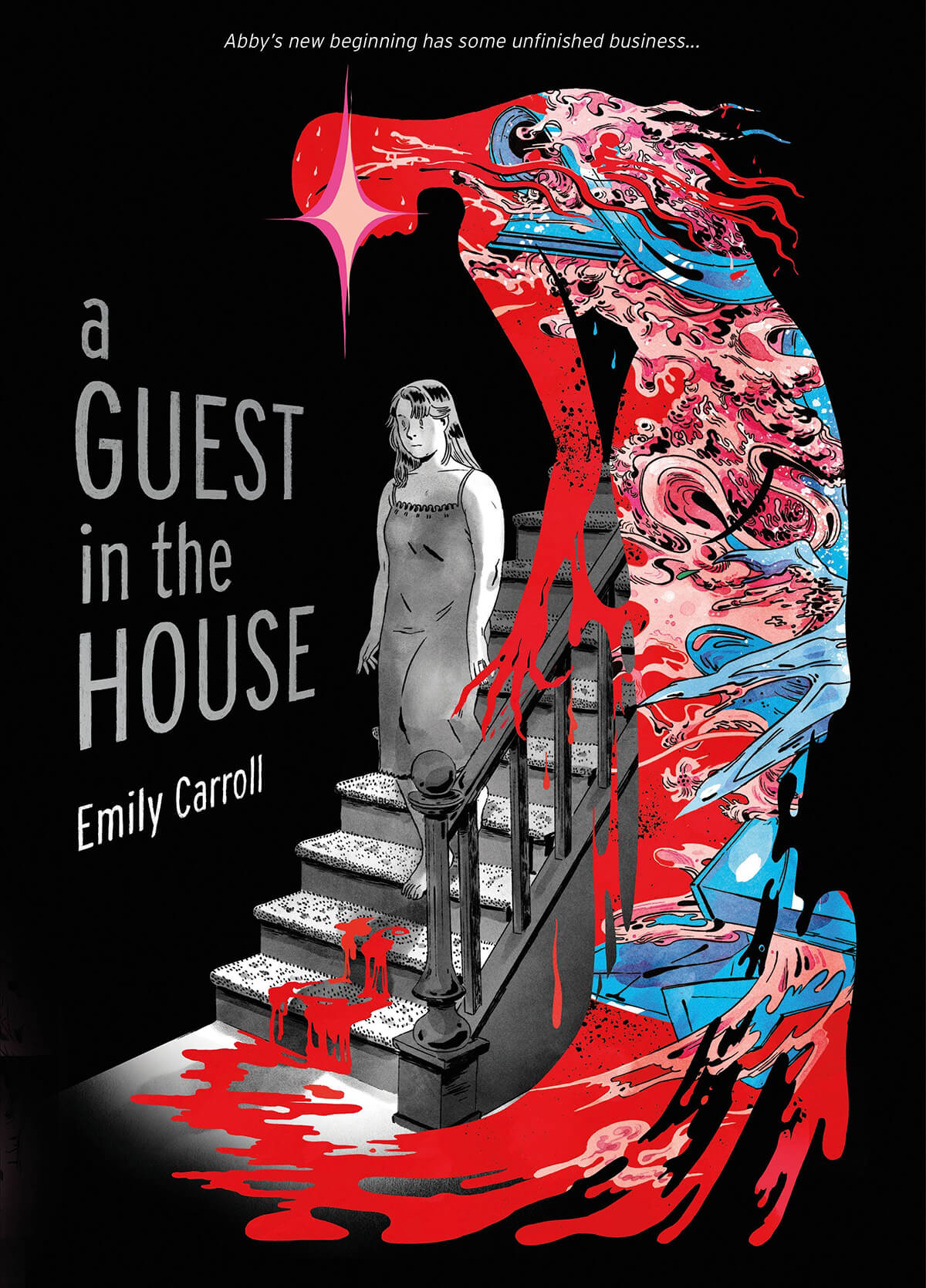
Abby is almost thirty, but she’s lived all her life in a small town in rural Canada. She recently married David, a widower who came to town with his eleven-year-old daughter Crystal, and she’s moved into their house by a picturesque lake. Abby’s new life would seem like a dream were it not for David’s reluctance to talk about his late wife. Meanwhile, Crystal displays a strange fascination with the dark water under the dock, where she claims to have seen a ghost.
Abby gradually arrives at the conclusion that perhaps her husband isn’t being entirely honest about his former wife’s accidental death in a house fire. She fears the woman’s body lies at the bottom of the lake, and the persistence of this anxiety leads to an encounter with the spirit that haunts her new house, who appears to her as a tragic fairytale princess. What the spirit wants is what all gothic apparitions desire – for a hidden truth to come to light. The nature of this truth remains a mystery, however, and the ghost grows progressively more monstrous as Abby becomes more insecure in her marriage.
A Guest in the House is reminiscent of Henry James’s classic work of gothic fiction, The Turn of the Screw, in which a young governess takes it upon herself to confront the ghosts haunting her young charges. As in The Turn of the Screw, it’s never entirely clear how much Crystal knows, nor is it certain whether the spirit Abby sees is “real” or a projection of her repressed sexuality.
Carroll’s visual representation of Abby’s inner world is brilliantly strange and gorgeously queer. In her more introspective moments, Abby indulges in a fantasy of herself as a heroic knight fighting dragons, who lay waiting for her, hot and wet in their dark caves. Having slain a dragon while remaining protected and genderless inside her full-body armor, Abby seeks comfort in the arms of the beautiful ladies that awaited her arrival. While the majority of the artwork in A Guest in the House is painted in black ink with gradations of gray, Abby’s fantasies practically scream from the page in lurid full color that slowly begins to bleed into Abby’s waking life.
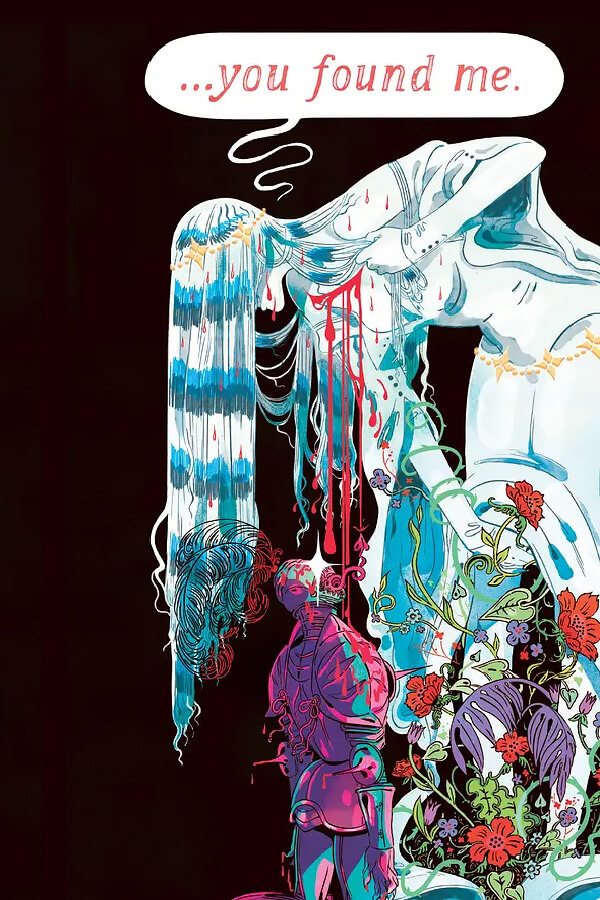
It’s tempting to read A Guest in the House on a symbolic level. The shift from measured gray panels to fluid compositions exploding with color is perhaps analogous to Abby’s realization that the stability of a straight marriage cannot suppress her true desires. A Guest in the House defies easy analysis, however. The story’s ambiguity is partially due to a twist ending that Carroll skillfully misdirects the reader from being able to anticipate. Although Abby’s fantasies are alluring, she must eventually come to terms with the reality of her situation, which is horrifying enough without ghosts or dragons.
From The Mysteries of Udolpho to The Haunting of Hill House to Mexican Gothic, gothic fiction has served as a means of processing gendered trauma and cultural anxieties. In other words, it’s a way of screaming on the page when one must be silent in real life. The genre is a classic expression of what Sigmund Freud called “the return of the repressed” in his 1919 essay “The Uncanny,” which details the psychological discomfort we experience upon noticing incongruities lurking in the shadows of the familiar.
As in her earlier work, such as When I Arrived at the Castle and “Don’t Linger in the Woods,” Emily Carroll employs gothic elements to chilling effect, and A Guest in the House confronts the reader with an uncomfortable set of questions. How many of the marriages of past decades were truly “straight,” and how did queer people (not) survive their “traditional” heterosexual relationship? Even within the security of the progressive new gender identities and sexualities that we’ve created for ourselves in the twenty-first century, how can we truly capture what lies within the shadowy depths of human desire? In its invitation to interrogate the hidden mysteries of the psyche, A Guest in the House is gothic horror at its sexiest and most subversive.
