

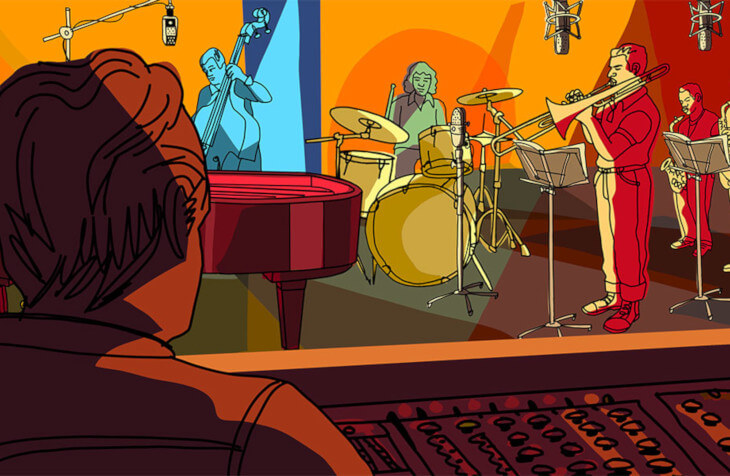
Fernando Trueba and Javier Mariscal tell the story of genius Brazilian pianist Francisco Tenório Júnior through the voices of those who knew him best in the animated extravaganza They Shot the Piano Player.
They Shot the Piano Player
Fernando Trueba, Javier Mariscal (directors), Fernando Trueba (writer), Carlos León Sancha (animation), Arnau Quiles (editor)
Jeff Goldblum, Roberta Wallach, Tony Ramos, João Gilberto, Caetano Veloso (cast)
September 6, 2023 (Telluride)
One of the highly anticipated films at TIFF 2023 was They Shot the Piano Player. The IMAX screening I attended was packed and the applause as the credits rolled was thunderous. Both were well-deserved, because this film was quite an experience–it was easy to get lost in the bossa nova music, as well as the gorgeous visuals. But, at the center of the film is a heart-breaking tragedy about how political upheaval devastated the musical scene in Brazil.
In They Shot the Piano Player, we’re introduced to one of the few fictional characters in the film, music journalist Jeff (voiced by Jeff Goldblum), who narrates the story of how he ended up writing a book about Brazilian piano player Tenório Jr., a creative genius who suddenly disappeared under mysterious circumstances. During the film, Jeff speaks to people who were closest to Tenório Jr. before he disappeared, including his wife Carmen, his mistress, his children, and especially the other musicians who worked with him.
Trueba interviewed around 150 people for the film to create the narrative, and used the recordings of his interviews in They Shot the Piano Player. The interviewees include well-known greats from Brazilian music, and those unfamiliar with the music of the country will undoubtedly find some new favourites after watching this film. The interviews not only give the viewer an understanding of the man at the centre of the story, but the musical scene in Brazil and the impact of the bossa nova movement. I won’t give away some of the fun nuggets shared in the film, because they added a lot of significance to the narrative.
They Shot the Piano Player is essentially a talking heads documentary, but the directors bring a new flair to telling the story through the medium of animation, a la Flee, another animated documentary that appeared at TIFF. Fernando Trueba and Javier Mariscal worked together on the Oscar-nominated and Goya-winning Chico & Rita and they bring the same beautiful visuals and a love of Latine music to this film. I wasn’t the biggest fan of the staccato movements of the people, nor of the slightly imprecise outlines of objects, but those critiques are a matter of personal taste. The level of detail that Mariscal put into the locations, especially the many splendid homes of the interviewees, was something to behold – I think I took away a lot of home design tips! The colours are also fabulous—they’re vivid and vibrant when depicting the locales, but mono/bichromatic when showcasing the musicians under stage lights.
Trueba, who was in attendance at TIFF, told the audience that he hadn’t originally intended to make an animation, but realized animation would be the ‘perfect language’ to show us Tenório Jr. when he was young and in love, as well as a way to showcase the political situation in Brazil and Argentina affecting the musicians. I was mesmerized by this directorial choice, especially the realistic way that the real interviewees were rendered in animation.
Trueba also explained at the screening why he chose an American journalist as his on-screen stand-in–Trueba didn’t think the story of a Spanish filmmaker travelling around Brazil doing interviews would be believable. While the sentiment drew laughs, what he mentioned afterwards made the choice of narrator a clever one. Trueba said that he also wanted to make the narrator feel guilty about the hand America played in the coups that disrupted much of Latin America. That was a necessary perspective I’m glad the filmmakers chose to include. I also feel that, even now, a lot of films still need a representative American stand-in to get US audiences invested in tuning in. Jeff the fictional journalist, or rather the star power of Jeff Goldblum, will hopefully open the door for more audiences to watch They Shot the Piano Player and learn about the darker side of American history.
Goldblum is not as Goldblum-esque as I expected in this film, you can tell that he felt the weight and gravitas of the story he was conveying and toned down his eccentricities for the voice work. But there were a few of those quintessential awkward pauses that belied who was behind the microphone. It was a bit odd at the start, but I got used to it.
I didn’t feel the IMAX screen was the correct choice for the film. Perhaps the viewers who didn’t need to read the subtitles enjoyed the giant screen more, but I felt I kept missing out on enjoying the visual details, and especially the names of the interviewees, because I was looking way down to read the subtitles. This is one of the rare occasions I wish the programmers had chosen a regular screen over an IMAX one.
They Shot the Piano Player is beautiful, the music sublime, but it’s not an easy watch. Tenório Jr.’s demise is horrifying, and yet, he was one person of so many who faced similar, or worse, ends due to the end of democracy in parts of South America. The latter part of the film is very affecting, especially as we learn more about what happened to political prisoners during that time. A film like They Shot the Piano Player not only spotlights Tenório Jr.’s musical genius, but also that of other bossa nova and Latin American musicians, whose music may have been forgotten. More importantly, it puts into perspective the impact that politics and international interference has on art and the things we love.
