

Kyoko Okazaki’s graphic novel River’s Edge is a gritty foray into the lives of teenagers with nothing to lose. Originally serialized between 1993 and 1994 in the women’s fashion magazine Monthly Cutie, this powerful work by an influential artist has been released in a handsome edition by Kodansha USA with an excellent translation by Alexa Frank. River’s Edge deals with mature themes and isn’t always easy to read, but its story of sex, murder, and young people struggling to find meaning in bleak circumstances is compelling and relatable even in its darkest moments.
River’s Edge
Kyoko Okazaki (writer and artist), Alexa Frank (translator)
Kodansha USA
June 23, 2023

River’s Edge follows the students of a high school that has seen better days. The building is falling apart and covered in obscene graffiti. Loose garbage litters the hallways, and an older school building sits unused on campus as it rots away. In the distance, factory smokestacks billow clouds of black smoke into the hazy sky above a polluted river.
The students don’t see themselves as having a future, so they pass their days fighting and sleeping with each other. The main viewpoint character, Wakakusa, admires her friend Rumi, who spends time with older men in exchange for money and presents. Meanwhile, a boy named Kannonzaki harasses Wakakusa, calling himself her boyfriend after she slept with him once. Despite hating Kannonzaki, Wakakusa feels responsible for the boy he bullies, Yamada. Though he is seemingly dating a girl named Tajima, Yamada is gay. He allows Kannonzaki to bully him because he’s aroused by the violence.
River’s Edge can sometimes feel episodic, with each short chapter jumping between characters, but the connecting thread is the relationship that develops between Wakakusa and Yamada. This friendship begins when Wakakusa breaks into the high school building late one night to rescue Yamada, who has been beaten and stuffed into a locker by Kannonzaki’s gang of bullies.
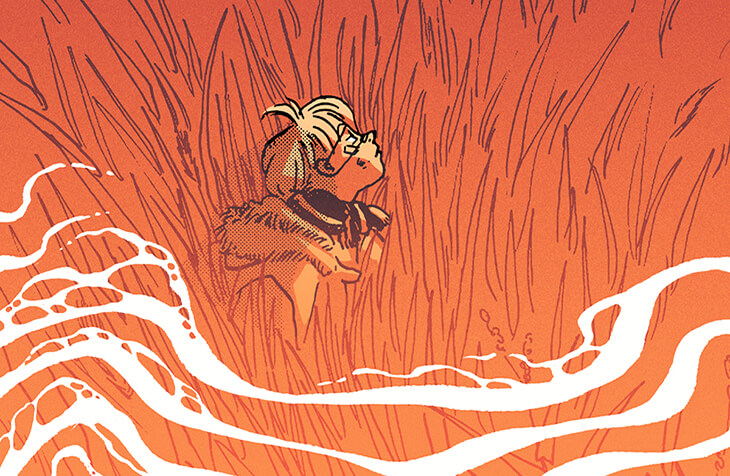
To express his gratitude, Yamada takes Wakakusa to the overgrown wasteland on the bank of the river to see his treasure, the decomposing body of a homeless man. Artist Kyoko Okazaki pairs peaceful panels of the grass field at night with panels containing explicit depictions of Kannonzaki at a love hotel with Wakakusa’s friend Rumi. The juxtaposition between sex and death is striking; Okazaki suggests that both are equally meaningless to the characters, whose liminal teenage years are as wild and unproductive as the eponymous river’s edge.

As Wakakusa and Yamada learn to support one another, the characters surrounding them grow increasingly alienated. Yamada’s girlfriend Tajima refuses to acknowledge that he’s just not that into her, and her attempts to win his affection become manic and unhinged. As Rumi chronicles her sexual exploits in her diary, her otaku sister uses these escapades as material for her amateur manga while growing ever more jealous. Meanwhile, a professional teen model and television actress named Kozue, formerly Yamada’s only friend, develops an unhealthy crush on Wakakusa. The beautiful and sophisticated Kozue appears to be an embodiment of a teenage ideal, but she maintains her desirability through a serious eating disorder.
In the commercial culture of the 1990s, in which it was a truism that “sex sells,” teenage bodies were treated as commodities. When this culture was combined with the pressures to optimize oneself for the labor market, self-commodification could be a difficult mindset for young women to escape. Young men were likewise pressured into a performance of masculinity in which the glorification of sexual aggression impeded communication and facilitated destructive relationships. Since LGBTQ+ activism had not yet become mainstream, queer kids like Yamada and Kozue had few resources to combat negative stereotypes and the sense that they would never be “normal.” So why try?
Meanwhile, Japan was internationally celebrated for its model education system and the high test scores of its students, who suffered from intense pressure to become competitive in Japan’s economy, then the second-largest in the world. By the 1990s, Japan had already entered a prolonged period of economic recession, but students were still expected to shoulder the burdens of a future that only existed in the imaginations of bureaucrats. Okazaki challenges the government-sanctioned image of hard-working and productive students by borrowing elements from the 1986 Hollywood movie River’s Edge, which portrays criminal behavior in American teenagers. The kids are not all right, Okazaki argues, and anyone who says otherwise is lying.
The plotlines and characters of River’s Edge are dramatic and intense, like a shōjo romance gone horribly wrong. Okazaki uses this element of exaggeration to shock the reader into an acknowledgment of how unpleasant high school can be for many teenagers. The fault lines in the lives of the manga’s characters become increasingly unstable, and their plot arcs intersect at various points before converging in a violent climax of blood, fire, and attempted murder. With one tragic exception, everyone survives this night, which serves as a catalyst for change – or at least taking a few small steps in a different direction.

Okazaki’s art is a far cry from the hyper-polished style common in contemporary manga, but the grittiness of her style is appropriate to the themes of the story. The character art focuses on gestures and expressions, while the backgrounds are more detailed and specific. The panel compositions of River’s Edge tend not to be as bold and artistic as those in Okazaki’s later work Helter Skelter (also published in translation by Kodansha’s Vertical imprint), but Okazaki puts a great deal of care into the paneling of key scenes, widening and decentering frames to create an appropriate emotional impact.
The digital page editors have done a fantastic job of creating crisp and clear images that allow Okazaki’s artwork to shine, and Alexa Frank has created a similarly crisp and clear translation that skillfully conveys the teenage voices of the characters without becoming bogged down in 1990s slang or cultural references. The English-language edition of River’s Edge is a beautiful book, and the care and attention of the production team is apparent on every page.
Even to readers not interested in manga classics or sociopolitical readings of millennial Japan, River’s Edge tells an engrossing story of teenagers precariously close to falling out of mainstream society. Characters who initially seem to be stereotypes gain fascinating depth and complexity as their lives spiral out of control. River’s Edge isn’t entirely bleak, however. The footholds the characters find in the landslide are meaningful, and their small moments of genuine friendship and connection are all the more valuable in the cultural wasteland they inhabit. The reader senses that these kids won’t remain friends into adulthood but will be okay eventually. Probably. Hopefully.

