
The best stories in fiction always have some truth in them, and nowhere is that more apparent than in Victoria Ying’s newest graphic novel, Hungry Ghost. While not a memoir, it’s clear that this book is written from a real place of dealing with eating disorders, cultural values, trauma, and coming to terms with not fitting the mold your parents have set for you. While I, as an Egyptian-Polish person, can’t claim to have dealt with exactly what Valerie and Victoria have here, the complex relationship with family, food, and not being the child you were expected to be really hit close to home for me. Hungry Ghost is very indicative of the way food carries our cultural traditions with us, for better or worse.
Hungry Ghost
Victoria Ying (Creator), Lynette Wong (Colors)
First Second
April 25, 2023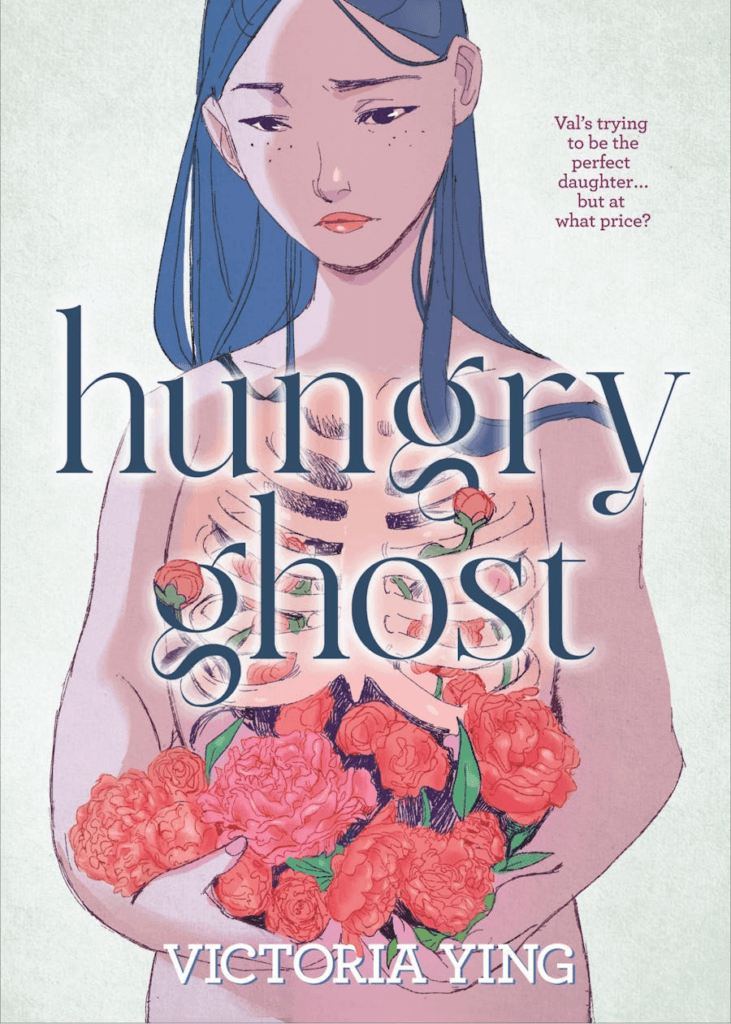

CONTENT WARNING: This book and review contain depictions of disordered eating, fatphobia, and mentions of trauma and grief.
SPOILER WARNING: This review contains spoilers for Hungry Ghost.
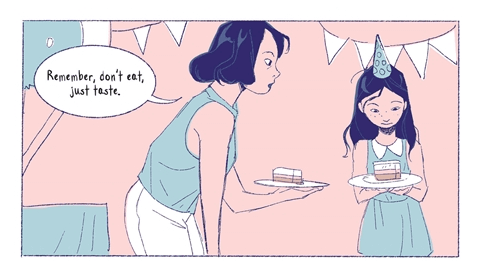
In Hungry Ghost, we’re introduced to Valerie Chu, a Taiwanese girl who, even as a young child, is pressured by her mom to watch what she eats to keep her thin. Contrasted with her friend Jordan, who’s able to eat what she wants, they quickly become best friends, sticking together in high school. And it’s here that we see what Val has been keeping a secret: an eating disorder of binging and purging to maintain that expected body shape imposed on her. To not look “weird,” as Val herself says early on.
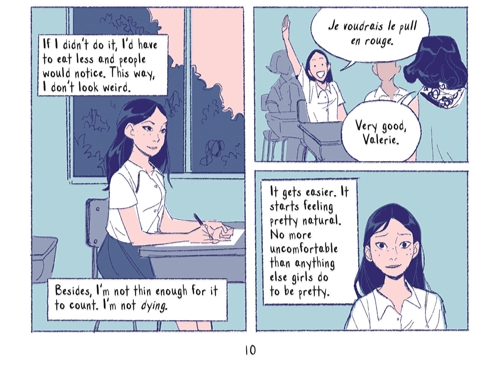
Right away, we’re confronted with how this kind of parental programming sounds bad when examined closely. The internal monologue Valerie has at the start of the book is just one of many – it’s easy to see that this is her mother’s voice imposed over her own, justifying this kind of behavior. To feel pretty, to feel desirable, to feel loved means making yourself sick in this context. But when you’ve grown up with this expectation of being thin from your parents and have it constantly repeated as a condition for their approval, it makes sense that you might eventually internalize it and do whatever you need to keep that going!
Val starts internalizing the messaging from her mom about attractiveness in a way that doesn’t seem intentionally malicious, but comes out on the page as thinking her friend Jordan can’t be attractive because she’s fat. This kind of fatphobia is juxtaposed very intentionally the first time we see it, with a series of panels where a football player and Jordan are making eyes at each other in a way that tells the reader this mindset isn’t based in reality. Being programmed by your parents as a teenager makes it hard to unlearn biases until you actually get a chance to confront them. And even in this set of panels, it’s clear that Val is not seeing what’s happening and is stuck in her head trying to unpack these beauty standards imposed on her. We know it’s wrong to think about people like that, and the text is making that clear.
On the topic of Hungry Ghost‘s art, let’s briefly shift gears to talk about Lynette Wong’s amazing color work. The five-color palette used here is incredibly striking and elevates each scene in ways that aren’t even noticeable if you’re not looking for them. Every scene manages to feel new and vibrant with different arrangements of the same colors. Ying nails the fashion with this mix of colors too, making Val and Jordan constantly sport fun outfit variations with the boy in the group, Allan, wearing mostly plain gray and white shirts as boys with less of a fashion sense are wont to do.

Ultimately, what ends up breaking Val out of this toxic thought pattern is one of the worst things imaginable: the loss of her father. That kind of shock, as this writer who’s experienced it can attest, breaks you out of a lot of things about your routines and thought patterns. Val’s focus becomes taking care of her mother in this crisis and when you’re a teenager and have to take care of a parent, it can be hard to think much about yourself. This increased dependency and Val’s mother clinging even tighter to perceived normalcy (or having her daughter be thin, in this case) is what finally breaks this cycle and allows Val to decide what she wants for herself. We’re left with an uneven resolution where even if Val’s mother can’t understand her, that isn’t going to stop Val from doing what makes her feel happy with herself. She doesn’t need her mother’s approval to be happy.
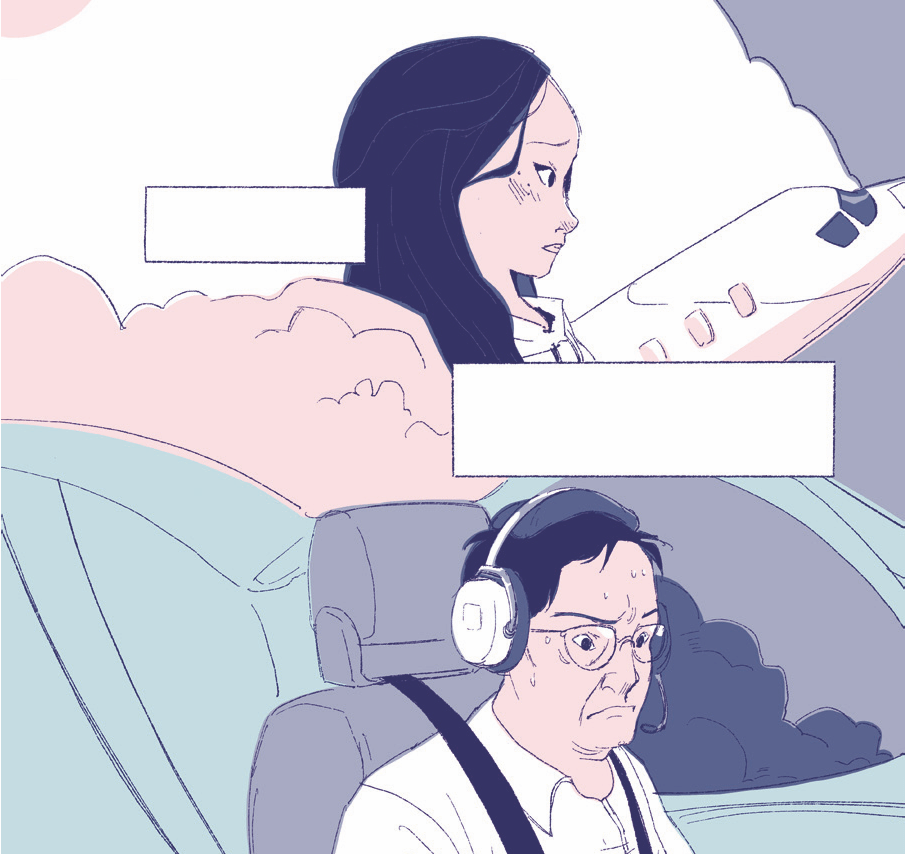
It’s in the tragedy of this story that we also see some variation on the visual storytelling, with more full-page spreads as we delve deeper into Valerie’s thought process around losing her dad. The way that we tend to see less gutter space and more freeform paneling in places where Val’s lost in thought or emotions is a nice touch that makes those moments stand out that much more. How panels will bleed into each other with the faintest outlines reflects what it often feels like in those disjointed moments, cycling from one thing to the next without much warning.
Early on, Val mentions wanting to be 乖 (guai), a Chinese word roughly translating to well-behaved or good behavior as perceived by her parents as one of the reasons she didn’t eat. This kind of cultural expectation surrounding food is one that children with intergenerational trauma know all too well, especially when thinking about first, second, or third -generation immigrants. Just speaking for myself, I am still unlearning what my parents tried to program into me about all the problems in my life boiling down to eating too much and not exercising constantly. The cultural beauty standards surrounding so many cultures, and in this case, many East Asian cultures, can’t be separated from how Val and her mom relate to food in Hungry Ghost.
Much later in the book, it comes up that Val’s grandma (presumably her mom’s mother) also imparted this toxic mindset about thinness with her children that is now getting passed down to Val as well. Entire studies have been done on how mothers will often pass on habits of disordered eating to their daughters and how this cycle perpetuates as a result. Only thinking about food and the guilt that comes with eating, which leads to skipping meals, not eating enough to survive, or purging it up later, is not a way to live.
If I have any complaints about Hungry Ghost, it’s the lettering. While it meshes well with the art style of the book, it doesn’t change that much throughout the story. With one or two exceptions, dialog never shifts from the same size, and thoughts always appear in the same square boxes. For the kind of story that’s being told, the lettering doesn’t need to change much to feel the tension and emotional weight for pages with very difficult subject matter, but that doesn’t mean it couldn’t be improved as well. Bold lettering styles for overemphasis in those charged conversations is one thing that makes comics special as a medium, and I love seeing it when cartoonists take advantage of that in their work.
All in all, Victoria Ying brings us a painfully true story about learning to be good to yourself and your body, even if that means bucking the expectations your parents have for you. And that a cultural ideal is not worth it if it costs you your happiness.
