

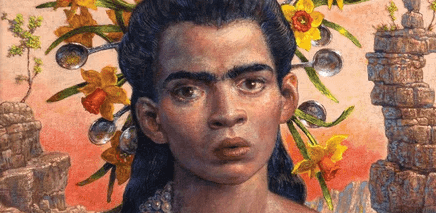
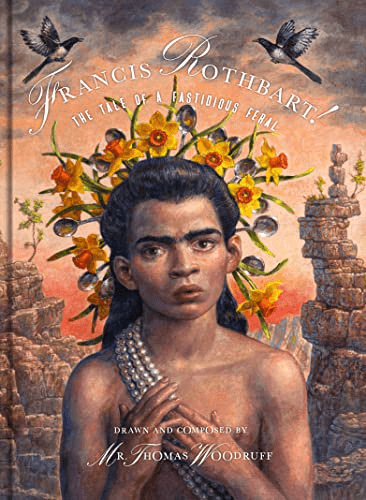
The Eisner Awards, as a long-standing comic award of some renown, are no stranger to controversy, between privacy concerns and notable transphobes being inducted into the hall of fame, and this year’s nominations are proving to be no different. Released just a week before at the time of this writing, cartoonists and comic fans alike are voicing extreme concern, to put it lightly, at the four nominations given to Thomas Woodruff for Francis Rothbart! The Tale of a Fastidious Feral, published by Fantagraphics.
Prior to the publishing of his “graphic opera” last year, Thomas Woodruff served as Chair of the Bachelor Of Fine Arts Illustration and Cartooning Department at School of Visual Arts for 20 years, until his departure in 2021. However, as SVA alum Kendra Wells told WWAC, Woodruff appears to have created a hostile environment for the same art form he’s now selling himself on.
“Woodruff openly and obviously hated comics. He didn’t understand the visual language, would berate students when they tried to explain their choices, and was hostile and dismissive when he received any pushback. Even if you didn’t take his classes, he was responsible for our thesis and portfolio reviews. He was cruel to students of all sorts but the cartooning students drew his ire specifically, and none of this stayed behind closed doors. He would verbally abuse students in front of their classmates and teachers, often using misogynist, racist, and transphobic language. We were no stranger to critique, it wasn’t a matter of our feelings getting hurt. It was the fact that his critiques ranged from horrifying and problematic (“Your art is too ghetto” to a Black student, saying someone’s drawn head shapes looked like those of the mentally disabled, saying female students would never be successful unless they drew “slender women with big tits”), to the completely irrelevant (mocking students for their clothing, or their assumed lack of money). The administration and his fellow teachers were either too scared or didn’t care enough to push back, often taking students aside after the fact to try to do damage control. Thomas Woodruff is directly responsible for countless young artists being chased out of careers and art altogether, because even if you survived til graduation, you were burnt out and discouraged and shamed into actually believing you didn’t have what it took to make it.”
In interviews about Francis Rothbart!, Woodruff does not describe it as a comic book, and the words “comic” hardly appear in reference to the book at all. When asked about the hostile environment Woodruff created at SVA, another former SVA artist, Steen, who worked in administration with Woodruff told WWAC, “His contempt for the art form of cartooning began before students came into the department proper. I worked with him and chose the exact (international) students he would see for scholarship consideration, a necessity for many, given the schools exorbitant price tag. I would be told to limit certain nationalities on said list, because he didn’t like the way the work looked. Or that it looked hollow, cheap, or derivative. These instructions were given to me by management at the Admissions Office, who protected him and his ways.
It was well known that the junior year thesis show and deciding who would be exhibited in it would likely result in students crying, being berated, or cut out of the show entirely if their work did not appeal to him. Being in his thesis advisory class I endured him belittling me, my work, and taste. He called the way I drew people ‘mongoloid’. He told me I didn’t know what I wanted to do for this massive year-long project and did not offer me tangible support, only to scrap everything I had done and come to him next week with a new idea.”
Graduates of the School for Visual Arts include, just to name a few, Molly Ostertag, Rebecca Sugar, Jess Fink, Phil Jimenez, Gerard Way, Jen Bartel and Sabrina Jones. Many reports from former SVA students and other cartoonists have been appearing across Twitter and other social media platforms of Woodruff’s disturbing behavior, echoing similar experiences of hostility towards cartoonists and marginalized artists.
Many comic professionals have been quick to point out the anti-indigenous and culturally appropriative language and imagery used in this book by a cis white author following this announcement, a $75 book with a main character that relies heavily on racist tropes. Many are quick to question why such a book or author would even get a single nomination. Woodruff’s racist behavior is seemingly well-known enough to have even been addressed by SVA directly in 2020. On the subject of the nomination, Wells remarks, “The Eisners voting panel this year is entirely white, and I am curious to hear their reasoning behind not only nominating this book, but nominating it four times in a row. Whether it is a desire for a fine arts legitimization of comics, sorry, graphic operas, or overt racism, there should have been someone raising the alarms about this book.
Furthermore, it’s our duty as white creators to look around the room in these spaces and panels and juries we are invited to. How can you see five other white faces staring back at you and not see a problem? These awards are meant to mean something, and if all they do is enforce the status quo then they serve no purpose in art.”
Steen also considered the impact Woodruff had on marginalized students, saying, “His nomination tells marginalized creators, those with lived experience: your work does not matter as much as the work of a man who sees this art form as inherently lesser. We cannot separate art from the artist in this case. Ideally the nomination is rescinded. He is no longer chair of the department that I was once in, that I once worked and advocated for other young artists to go into. The best I can hope for is his book not selling and not getting any more work or platforming.”

Woodruff and Fantagraphics have responded to the controversy, defending the nomination in a response to The Beat. An open letter to the Eisner Award jury panel that has over 600 signatures from comic professionals at the time of this publication is calling for the Eisner nominations for Francis Rothbart! to be rescinded. [Editor’s note: WWAC has signed this petition] Echoing the sentiments of many comic professionals, “It is heartbreaking that so many young and vulnerable creators were severely hurt, some even getting pushed out of pursuing their dreams, because an “educator” blatantly used his institutional advantage to continuously insult, embarrass, and verbally abuse students before their careers even had a chance to begin. The championing of a comic created by somebody who exploited a position of power in academia to hurt vulnerable comic artists is a slap in the face to our hard-working, caring, resilient community, and to the wonderful medium that we love.
Until now, these experiences were shared mostly in whispers, as it unfortunately often happens when a perpetrator of destructive behavior becomes publicly lauded. But now, as a community, we are standing up to say that it is unacceptable to condone and applaud said behavior.”

