


Grace Needs Space! is an immersive and heartening graphic novel about a kid traveling in space in a realistic far future! I, an extremely lucky person, have been friends with the writer Ben Wilgus since college. I got to ask him a bunch of questions about creating Grace, her moms, and the futuristic spacefaring world they inhabit, and the experience of working with fabulous artist Rii Abrego.
Grace Needs Space!
Ben Wilgus and Rii Abrego
Penguin Random House Graphic
April 4, 2023
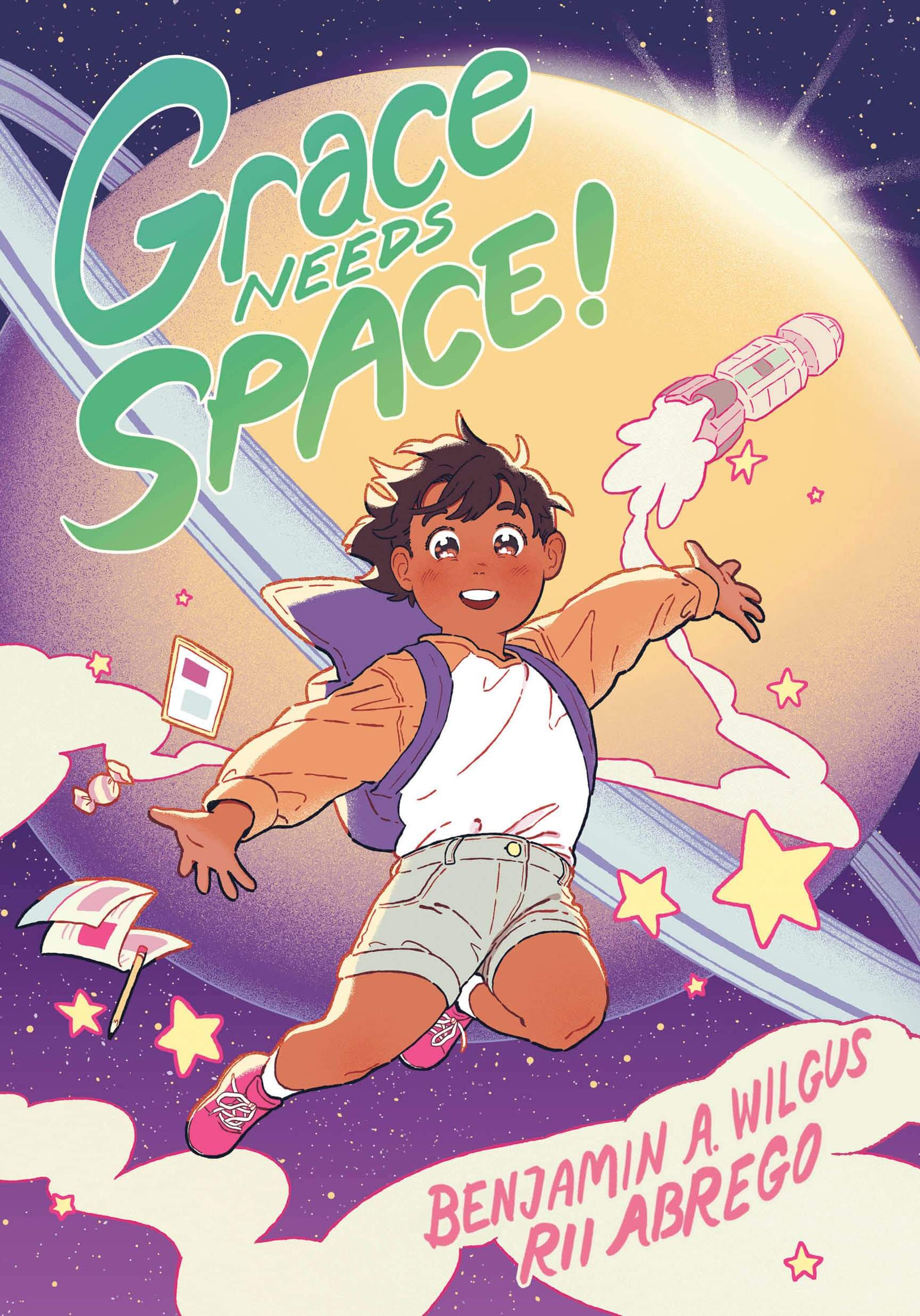
In Grace Needs Space! , Grace has a nice life in a pleasant space station: hanging out with friends, helping with projects, and living with her mom Evelyn. In this book she takes a trip with her other mom, Kendra, who flies a spaceship doing cargo runs, and doesn’t seem to be as invested in parenting. Not everything goes according to plan. Ben Wilgus’s words and Rii Abrego’s art combine to convey a future in which social advances are balanced by the kinds of personality conflicts that will arise despite them, just as technological advances are balanced by what our current hard science says might be plausible.
About the title. I love the title, it rhymes, everyone’s going to be into it, but I feel like Grace needs a lot of things and maybe space isn’t really at the top of the list? So, why this title?
The working title was Space Moms—
I remember! So, when you pitched the book, did you pitch it as Space Moms?
Yeah, it was pitched as Space Moms, and we had to come up with a title after that. Grace Needs Space is the title that Grace would give this book, although part of her arc is figuring out that what she actually needs is her parents to be paying attention to her and parenting her. And she maybe also does need to go to space, but maybe that’s less urgent? Everything is very urgent to her.
Maybe the real space is the lessons we learned along the way.
I think it kind of is! If Space Moms was the grown up book, Grace Needs Space is the kids book, and I think very wisely we chose to frame the initial impression of this book for kids.
The art in Grace Needs Space is perfect for that layered impression because Rii Abrego’s work is definitely kid friendly, but I think it is also quite sophisticated in a simple way.
I cannot stress enough that Rii Abrego is the hero of the hour here. She did such an incredible job with this book, and I cannot emphasize enough how the reality of this book has turned out to be every single thing I hoped for when Rii came onto this project, which was that she would bring her own voice as an artist to every level—the character designs, the layouts, the facial expressions—everything. She’s bringing these rigid, cold structures into her own organic artistic voice, which breathes a huge amount of life into them.
Rii has so much empathy for everyone in this book. She really got all the characters. I think Rii immediately understood Grace’s inner life, and does a really good job communicating being full of all these feelings and feeling them very intensely. She also really got the subtext that there are also adults here and they also have their own inner life going on, and I really appreciate that. I feel like Rii and I were invested in both Grace’s perspective on what was happening, as well as the parents’ perspective on what was happening.
I cannot stress enough that Rii Abrego is the hero of the hour here. She did such an incredible job with this book, and I cannot emphasize enough how the reality of this book has turned out to be every single thing I hoped for when Rii came onto this project.
I think comics as a medium is very well suited for that kind of layered reading. Even if a comics panel is focused on the kid, you can still see an exchange of looks between grown ups in the background, you can see that moment happening, whereas if it was a book that was purely written text, it would take a different kind of work to show that. In some ways, that reminds me of the text blocks that form some of the backgrounds as Grace has headphones on, listening to travel information that the reader maybe doesn’t need in extreme detail.
Grace is constantly listening to information about Titan, which is the moon they’re visiting. It was definitely a way to sneak in some actual information about that moon, but if you don’t read any of those captions, you can still read the book, it’s fine! The point is that she’s that kind of kid, who has YouTube on all the time in the background. I say this as that adult, who is also still somehow that kid.
But then, if you do actually go in and read those captions, it’s a mix of information explaining how the hydrocarbon lakes work, combined with bits and pieces of the fictional history of establishing a human presence on that moon. That’s the kind of background worldbuilding I like to do. There were probably people on that moon before there was a big fancy space station like the one Grace lives on, because you’d need the resources from a place like Titan to be able to sustain a big human population on that space station. But it’s just flavor, bits and pieces in the background.
Can you say more about your approach to worldbuilding?
I wanted everything to be recognizable. Everything is a natural progression from things we already know how to do or have thought of how to do, but far enough in the future that we’ve solved some boring but very important problems. We’ve solved all the materials science problems. There’s a strong enough, lightweight enough material to build these vehicles and structures. We’ve solved, you know, oxygen generation and all that, which is all very important! So I was trying to account for the fact that all these issues would need to be dealt with: like, where’s the food coming from? Where’s their water coming from? But I don’t actually have to solve all these specific problems, I think it’s enough just to show that you’re thinking about how these are issues they’d have, that’s fine.
Again, we’re far enough in the future with this book that all of these problems have been solved, they’re all commonplace technologies. When I was talking with Rii when we were first starting to work together, I said, “feel free to have things look lived in and organic. Your artwork looks like that, and part of what is going to make this work is that it should look like people live there.”
You have created and worked in a lot of different kinds of books. Fiction, nonfiction, different age ranges—do you feel like you have a different part of your brain that you engage when you’re working on something like Flying Machines or The Mars Challenge, versus when you are working on something with a fictional plot?
Oh, one hundred percent. Honestly, one of the reasons I’ve been moving away from nonfiction is because of this. I would say that the majority of my favorite things about what I write are things that were not part of my original outline at all, where I’m recombining or recontextualizing something that organically comes to me over the course of working on the book. And that works great for fiction! Most of what I really like about Grace Needs Space was not really present in the outline.
With nonfiction, though, you have to be extremely organized, you have to be detailed, and you have to Do the Thing that’s the goal of your book, communicating specific information. The facts are the the facts, and you need to find a way to make them work on the page. At the end of the day propulsion systems are propulsion systems, I couldn’t decide, “you know, I’m not really feeling this, I’m going to move in a different direction.” It’s a little like the difference between copying a photo by drawing on a grid, versus freehand sketching.
I would say that the majority of my favorite things about what I write are things that were not part of my original outline at all, where I’m recombining or recontextualizing something that organically comes to me over the course of working on the book.
Do you feel like Grace Needs Space is in a revisitable world? Would you tell more stories about Grace and her world?
I would love to do another story about Grace! I love her because she’s just a kid. She’s got a balance of being very typical and also very specific: she has a specific experience and family structure, a specific place that she lives, and specific relationships with people around her. I would love to write about Grace and her friends doing something on the space station! And even if the family dynamics weren’t the focus, I’d want to include something about her ba, Kendra, to show that she’s trying.
That would be a nice piece of continuity. What are your hopes for Grace Needs Space? What do you want a kid reader to go away feeling about Grace?
“You deserve to have someone to support you, someone in your life who has your back.” Even if not every adult in her life is perfect, I wanted Grace to have that support. If any kid sees their own experience in Grace, and this book helps them understand their feelings a little better, that would be wonderful. I’d love that so much.
Yeah, part of what you’re providing is a model for how this could go better. And people in real life who might have a lot in common with Kendra might not be the ones reading this book, right? It’s going to be real life versions of Evelyn and Grace reading this book together and talking about the person in their life who is like Kendra.
Nothing would make me happier than for a kid to read this book and realize they have a need that isn’t being met and for it to help them collaborate with an adult in their life to get that need met. Because ideally, your parents will have a ton of time for you and pay a ton of attention to you, but realistically in the world that isn’t always the case. I think that kids desperately want to be independent, and they can tell when their parents are overwhelmed and don’t want to impose on them. I would love for this book to convey that it’s not imposing to have needs, and that it’s okay to tell another adult that you’re having a problem. I don’t mean to be patronizing about this! I just think this stuff is really hard for anyone, especially kids. I feel like at the end of the day, all fiction is therapy. And I love that, I think it’s nice.
__
Note: This interview has been edited for space and coherence.
