

Fantastic Four titles have had a tumultuous decade or so, and it’s enough to make even a diehard F4 fan wary. Fortunately, I’m not one of those, so I jumped right in!
Fantastic Four #1
Jesus Aburtov (Colorist), VC’s Joe Caramagna (Letterer), Iban Coello (Artist), Ryan North (Writer), Alex Ross (Cover Artist)
Marvel Comics
November 9, 2022
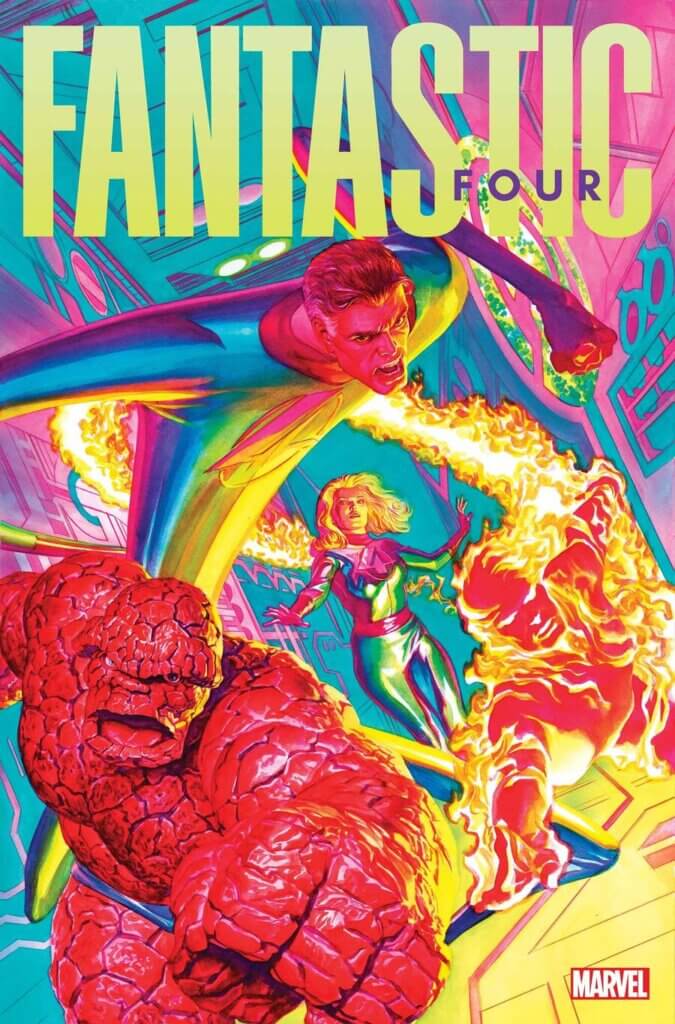
It’s not that I dislike the team, it’s just that I’ve never quite been grabbed by what they represent. Blame that on my being an X-Men fan for years and years, if you like. Either way, I was very interested in the newest iteration given the presence of writer Ryan North, who dazzled audiences with Unbeatable Squirrel Girl not long ago. As a writer, North excels at a blend of humor and heart, and if I was going to give Marvel’s First Family an honest try, the presence of that blend felt like a necessity.
What I was not expecting was a near-complete eschewing of the Fantastic Four as a team, especially given that dynamite Alex Ross cover! Rather than setting up a large-scale story arc, North takes team member Ben Grimm (he’s the big rocky one) and his wife Alicia Masters on a road trip to the town of Cedar, Pennsylvania, where they’re embroiled in a mystery—all of the town’s residents supposedly vanished decades ago, leaving the town itself to crumble to ruin. But if that’s the case, why can Ben and Alicia see them everywhere?
It’s a fun mystery hook that leads to a tightly plotted and compassionately written first issue, and I found its done-in-one nature to be especially charming. Near the end of the book, North lays out his guiding principles for stories featuring the team:
1. The Fantastic Four are fun.
These are people who know they can help people and are here to do exactly that. No angst, having super-powers rules!
2. The Fantastic Four are adventurers.
Exploring the unexplored is fun and gratifying. The unknown and the impossible are crazy interesting!
3. The Fantastic Four can do anything.
If we want to recapture the feeling of the FF as they were in the ’60s where anything could happen, we have to let what’s come before be there to inspire stories but not limit them.
4. The Fantastic Four are accessible.
This is a comic for people who’ve read every Fantastic Four appearance since 1961, but it’s also one that welcomes people who have never read a single Fantastic Four comic before or even a single Marvel comic. While we have deep-cut references to what’s come before, you won’t feel left out if you don’t know it, because this is a comic for everyone.
That these principles are laid out in four points is not lost on me, and that’s part of the charm here. Despite the lack this issue of a full team dynamic, this is a book that resonates with love for both what the Fantastic Four and comics as a whole represent: a sense of adventure and wonder. North sets up a few seeds of bigger adventures in this tale, but they’re just that, left to germinate and grow to fruition later. This story is about Ben and Alicia, and it stays that way.
Of course, a comic is more than just its scripting, and North is assisted in a grand way by artist Iban Coello. I mentioned frustration in a recent review with artists who depict characters posing rather than moving and interacting with their environments, and Coello gives a delightful demonstration of how to do it right. He renders scene settings fully and from different angles, plays with panel counts to give characters room to gesture and emote, and even draws some full out clobbering (in the traditional Grimm variety) with dynamism and drama. His work is a joy to take in, full of motion and life. So too is the work of colorist Jesus Aburtov, who shifts palettes and tones effortlessly to suit the mood of a particular scene. Aburtov is careful with lighting and hue, and it shows, combining with Coello’s work to sell the way each character interacts with the setting of the story.
“But Nola,” you might find yourself asking, “what about the lettering?” Indeed, all the writing and art in the world won’t help a story if it’s an unreadable mess, but that’s certainly not an issue here. Joe Caramagna has been working on Marvel books for a while, including a decent amount of time spent in the X-Office, and there’s a reason for that. His skill is evident, both in the clarity of the dialogue as presented and in things like his use of sound effects, or—my favorite bit of the issue—Ben’s personal, handwritten diary entry, presented in a font that approaches the line of illegible without actually going over. It’s clever and fun, and if those captions take a little more effort to read than the standard, they make for a perfect indication of the difficulties of handwriting when your hand is several pounds of blocky stone.
As a whole, I found Fantastic Four to be exactly what North promised: an engaging entry point that understands the history of its characters and presents a fun tale for new and old readers alike. It is the start of something people are going to remember being there for, so consider checking it out.
