
2022 marks the 150th anniversary of J. Sheridan Le Fanu’s classic vampire story Carmilla, which was originally serialized in The Dark Blue magazine between 1871 and 1872. As well as ranking alongside John Polidori’s “The Vampyre” and Bram Stoker’s Dracula as a foundational text for the vampire genre, Carmilla is remembered as a pioneering work of lesbian horror.
Doris V. Sutherland chairs while Emily Lauer, Alenka Figa and Kayleigh Hearn gather together for a Halloween roundtable marking a century and a half of literature’s most famous sapphic vampire…
Was this your first time reading the story? If so, do you feel it lived up to its reputation? If not, has your opinion altered on re-reading?
Alenka: This was my second time reading Carmilla! I read it for the first time when preparing to review Soft, a Carmilla adaptation by Jane Mai. What struck me most upon rereading was the lack of communication in the story. Laura has a very warm relationship with her father, but the whole “you’re a little girl, don’t think about difficult things” vibe creates a barrier between them that keeps Laura from actually telling him about any of the disturbing things that she experiences and witnesses. Even when General Spielsdorf arrives and tells his horrible story, they don’t talk about Carmilla until she arrives at the Karnstein ruins. No wonder vampires are so successful – these people don’t communicate and miss all the warning signs! Overall, though, Carmilla is a very fun novella. So much ATMOSPHERE and scene setting, but also a lot of touching and eerie intimacy between Carmilla and Laura.
Emily: This was a reread for me, too! I’m also participating in Dracula Daily, in which every day something happens in Dracula, I receive it as an email, and thus the parallels between Carmilla and Dracula are at the forefront of my mind. Both vampires are helped a lot by the lack of communication Alenka mentions! It’s a pretty clear moral that keeping young women ignorant of the threats that face them, “for their own good,” has dire consequences.
Kayleigh: This is maybe my fourth time reading the oft-anthologized Carmilla; I first encountered it during a college course on vampire fiction, and dug out my battered and highlighted copy of The Penguin Book of Vampires (complete with Edward Gorey’s cover) for the latest re-read. Carmilla is a Gothic masterpiece. It’s the kind of compulsively readable little mystery that lingers in your mind like a fine mist long after you set the book down. Over a hundred years later, some of the finer points of the plot seem a little corny (LAURA! “CARMILLA” IS AN ANAGRAM OF “MIRCALLA”! LAURA! LAURAAAAAA!) but that’s quickly overshadowed by Le Fanu’s gorgeously-written passages about picnics in ruined vampire castles.
The story has a reputation as a lesbian text. Do you have any thoughts on this reading?
Alenka: I recently read Julia Serano’s new book, Sexed Up: How Society Sexualizes Us and How We Can Fight Back, and she cites a study in which participants were shown various photos while being monitored for physiological signs of disgust. The researchers were surprised to learn that even participants who reported positive opinions on homosexuality exhibited a disgust response when shown photos of two men kissing. Serano then goes on to document some personal experiences in which she realized she was feeling disgust in response to possible queer relationships, despite being a bi trans woman. Everyone is subject to homophobic messaging, and has to work through various forms of internalized homophobia (and transphobia, biphobia etc.) which we can identify when we experience these unexpected responses of disgust.
Reading that section immediately made me think of Carmilla – more specifically, of Laura! Upon first meeting Carmilla, Laura describes her emotions in a manner that is very similar to how Serano describes her own feelings about her first contemplations of having sexual relationships with men. Laura just uses a different word: “Now the truth is, I felt rather unaccountably towards the beautiful stranger. I did feel, as she said, ‘drawn towards her,’ but there was also something of repulsion. In this ambiguous feeling, however, the sense of attraction immensely prevailed. She interested and won me; she was so beautiful and so indescribably engaging.”
Laura mentions this sense of repulsion multiple times throughout the novella, and as the reader we of course are meant to understand this as her prey sense warning her of Carmilla’s monstrousness. However, it also reads just like internalized homophobia. Carmilla courts Laura slowly, spending more time with her than any other victim we know about, and even expresses that she is waiting for Laura to be ready to fully give herself over and be willing to die for her – very dramatic, of course, but to be ready to be with Carmilla the part of Laura that feels repulsion for her would have to die. And then there is, of course, all the kissing and touching. So yes, very gay.
Emily: It would never occur to me to propose that Carmilla is not a lesbian text. This reread, I kept thinking about Mel Gillman’s fantastic new fairytale comics collection, Other Ever Afters, and how Gillman might enable Carmilla and Laura (and maybe the General’s neice, too!) to have a happy queer ending together.
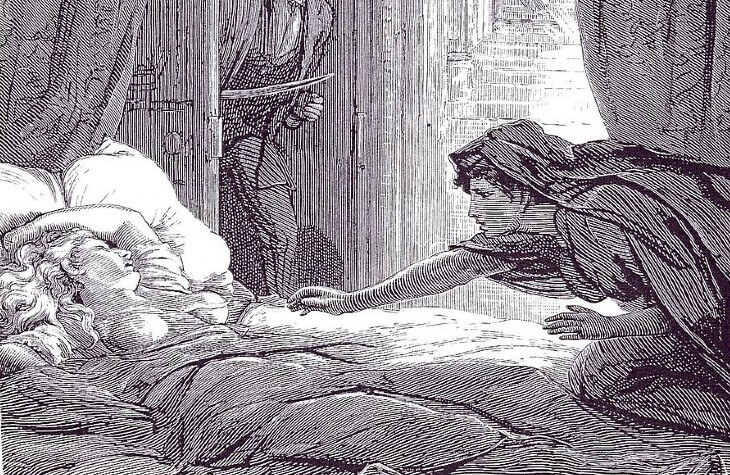
Kayleigh: There are texts that resist heterosexual readings, Carmilla openly defies them. There is the inherent homoeroticism of Carmilla sneaking into Laura’s bedroom at night and biting her above her breast, of course, as well as the lengthy scenes where Carmilla proclaims her undying (ha) love for Laura. One key passage that surprised me is the moment where Laura wonders if Carmilla is really an adventurous boy pursuing her in disguise – she recognizes Carmilla’s overtures as romantic, even as she struggles (it is 1872, after all) to comprehend Carmilla’s alarming allure and what it means to feel so intensely about another woman.
Do you have any thoughts on how the vampire genre has developed since Carmilla was published? Does the story feel like a progenitor – or a relic?
Alenka: Something that comes up a lot in discussions of Dracula is how unattractive Dracula actually is! The hairy hands always stand out in my memory, although it’s been a long time since I read Dracula. Carmilla, on the other hand, feels like the progenitor of the sexy vampire. Everyone is obsessed with Carmilla’s unearthly beauty and her other charms and nearly seduces General Spielsdorf. The mother also has a hot, mysterious and seemingly also monstrous young man who shows up at just the right time to draw her away.
Emily: It’s always a good time to think about Our Vampires, Ourselves, an incredible work of scholarship in which Nina Auerbach “shows how every age embraces the vampire it needs, and gets the vampire it deserves.” I definitely feel like Carmilla was a vital text in the evolution of the genre, and I also feel like it has the hallmark of a classic in that every time I revisit it, it feels fresh and new and speaks to me in new ways. For instance, this time, reading it in 2022, pretty fresh off of a couple years of pandemic isolation, I had new appreciation for lonely Laura saying, “You, who live in towns, can have no idea how great an event the introduction of a new friend is, in such solitude as surrounded us.” Oh, Laura. I sure do.
Kayleigh: Carmilla Karnstein is the great-great-great grandmother of modern vampire fiction. For me, October 2022 has been the month of queer vampires – I recently dived into Anne Rice’s Interview with the Vampire and The Vampire Lestat, and while Interview was written almost exactly 100 years after Carmilla, they feel like companion pieces. Carmilla is very accessible in terms of length and style, as opposed to a genuinely unreadable, tedious relic like Varney the Vampire. It embodies the #aesthetic of the genre right down to the goddamn vampire masquerade in the middle of the story.
We also have to discuss Carmilla as a social parable as well as a sexual one. Class consciousness in vampire fiction goes back even farther than Carmilla, to John Polidori’s savage portrayal of Lord Byron in “The Vampyre.” In Carmilla, it manifests as the “ruined” village once dominated by “the proud family of Karnstein, now extinct.” Pale, predatory nobles living off the blood and tears of the lower classes? Alas, a tale as old as time. Carmilla’s love comes with a terrible price.
Are you familiar with any of the adaptations and retellings of the story? How do you think they compare to the original?”
Alenka: As mentioned above, I reviewed Jane Mai’s Soft for WWAC back in 2020 when Peow launched their digital store. I won’t get into it here, since you can just read the review, but I absolutely love Soft and how it zeroes in on the toxicity of Laura and Carmilla’s relationship.
I also watched the Carmilla web series and the movie. It’s very hammy, gay and fun, and if you’ve never seen it I do recommend it! A friend from college recommended it to me because she identified with Laura as a fellow “lazy femme,” which is a concept I love. The web series really digs into the world building within the novella and blows it way way up in a very wild, campy way. It wasn’t until this reread that I realized various side characters who come up later, like Vordenburg, are in the original novella! One thing I also really appreciate, in retrospect, is the series’ focus on Carmilla’s relationship with her very toxic and terrifyingly powerful mother. In the novella there are only small hints of the older, even more powerful forces behind Carmilla (who is the strange laughing woman in the carriage? But also I don’t want to know because the description of her is very racist!) and the web series really digs into those forces and how they manipulated, abused and shaped Carmilla.
Also – if you’ve not read the novella and want it read to you, I just learned that Elise Bauman and Natasha Negovanlis did Carmilla story time during COVID quarantine! Instead of reading, you can have it read to you!
Kayleigh: I’m partial to the 1970 Hammer Horror flick The Vampire Lovers, starring Ingrid Pitt as Carmilla and Peter Cushing (Van Helsing himself) as General Spielsdorf. The film absolutely leans into the more sensationalistic aspects of the story – the poster implores you to “Taste the Deadly Passion of the BLOOD NYMPHS!” – but it’s a surprisingly faithful adaptation that is anything but coy about the lesbian undertones. The gowns? Diaphanous. The bosoms? Positively heaving.
If a new adaptation of Carmilla were made today, in any medium, what would your ideal cast/creative team?
Alenka: Anyone queer who would ensure this stayed full of angst and did not turn it into an action movie. Maybe Alice Wu, who made The Half of It? I could see her making something that was perfectly quiet, emotional and terrifying.
Emily: I would want an off-Broadway musical in the campy tradition of Little Shop of Horrors or Bat Boy: The Musical.
Kayleigh: I’m usually not one for fan casts, but my insane “if I had a time machine” answer for a film adaptation would be to cast 2004, Mean Girls-era Lindsay Lohan as Carmilla with Amanda Seyfried as Laura. More seriously, Céline Sciamma could make a fascinating, haunting film about sapphic longing across eons.
Carmilla is almost certainly second only to Dracula as the best-known vampire story of the nineteenth century. Why do you think it has endured for 150 years?
Alenka: 1) Because it is an engrossing, tightly written story. Even during my reread there were points where I didn’t want to put it down. 2) Because the vampires are alluring, beautiful, but also taboo – because they’re hot, basically. 3) Because it’s a queer story that could fly under the radar.
Emily: Everything Alenka said, for sure, and also, Laura’s narrative voice is very engaging! I want the best for her.
Kayleigh: It’s gay. I promise I’m only being slightly flippant – Le Fanu wrote one of the quintessential works of supernatural fiction, a story that is as gripping as it is gruesome. (Cue my Penguin Book of Vampire Stories: “In 1858, Le Fanu became rather a recluse, writing ghost and horror stories in bed” – wow, he’s just like me!) Carmilla is about that most potent subject: forbidden desire. It reaches deep inside our psyche to caress the shadowy part of us that is thrilled and repulsed by the unknown – and it whispers, “I have been in love with no one, and never shall…unless it should be with you.”

